The Warmth in Her Hand
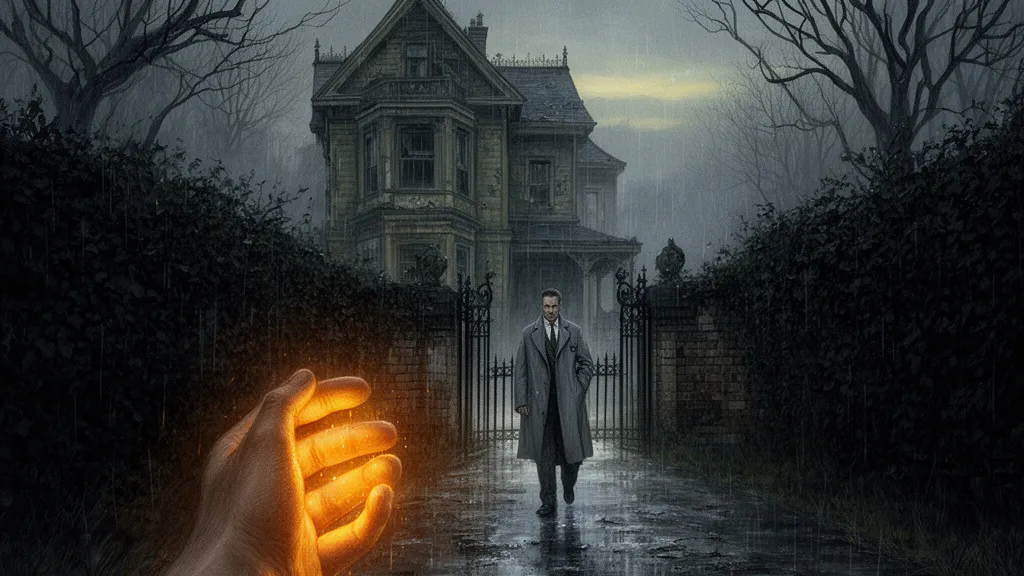
The rain had been falling since Thursday, which Dr. Aldous Vale considered a personal affront, and the address he had been given — Harrow Gate, Perseverance Lane, at the furthest end — had not appeared on any map he possessed, which he considered worse.
He found it regardless. One always does, with such houses.
It stood at the terminus of a lane so narrow that the hedgerows brushed both sides of his motorcar simultaneously, a three-storey affair of blackened Victorian brick whose front garden had long since given itself over to the serious business of decomposition. The gate hung at an angle that suggested profound exhaustion. The path to the door was composed of tiles that shifted underfoot in a manner he found, professionally speaking, inadvisable.
A woman met him at the door before he had raised his hand to knock. She was perhaps fifty, dressed in the sort of dark clothing that suggested preparation rather than grief, and she took his bag from him with a speed that he found faintly impolite.
"You'll want to come through," she said. "Before midnight."
"Before midnight," he repeated. It was not yet nine. "I have merely come to certify a death, Miss —"
"Harrow," she said. "This way."
The front parlour occupied the left side of the entrance hall and was lit by a single lamp of such antiquity that Vale could not immediately identify its fuel. It burned with a steady, yellowish light that did not so much illuminate the room as stain it, coating every surface in the particular colour of old newspaper left too long in a window. In this light, the wallpaper — a pattern of climbing roses, or what had once been climbing roses — had separated from the plaster in broad, curling sheets, each one peeling back from the wall with a quality that Vale found himself reluctant to name. It was not, he told himself firmly, unlike skin. Merely paper. Merely damp.
There were three other people in the room: a young man who stood very close to the far wall and did not look at Vale; an older gentleman, thin and angular, who introduced himself as Mr. Harrow and shook hands with the unnecessary vigour of a man who wanted very much to seem composed; and a woman seated at the room's single table who did not introduce herself and whose stillness Vale only gradually understood to be something other than reticence.
She was dead. He ought to have known at once, but the lamp's jaundiced light had obscured the particular quality of that stillness, the way it differed from any stillness produced by the living. She sat upright in a high-backed chair with her hands in her lap and her eyes closed, her silver hair dressed with what he suspected had been considerable care, and she might — very plausibly — have been sleeping, were it not for the colour of her and the silence she generated, which was a different order of silence than the room itself produced.
"My mother," said Mr. Harrow, with a wave of his hand.
"I see," said Vale, and opened his bag.
It was during his examination that he found the key.
He had lifted her right hand to check the pulse he did not expect and would not find, and two things occurred to him simultaneously: first, that the wrist was warm — not the residual warmth of a body recently stopped, but a warmth that seemed to him, in his clinical and not inconsiderable experience, active; and second, that the fingers, folded loosely in her lap, were loosely folded around a brass key of the sort one associated with old houses, old doors, old rooms that one had been, at some point, persuaded to leave.
He said nothing immediately. He continued his examination with the methodical thoroughness that had characterised his practice for thirty years, noting what he noted, recording what he recorded, maintaining the expression of professional neutrality that the situation demanded. But his attention did not leave the hand.
The fingers, he observed, were not quite still.
"How long," he said, when he had completed his examination to all outward appearances, "has she been — when was she found?"
"This morning," said Miss Harrow, from behind him. "At seven."
"She was seated as she is now?"
"She was."
The warmth in the wrist did not accord with a body dead since seven in the morning. He was aware of this. He was also aware that the young man by the far wall had not moved since Vale entered the room, and that his gaze was directed not at his grandmother's body but at the ceiling, at some point on the ceiling roughly above where Vale stood, with an expression that Vale found, upon examination, to be one of concentrated and specific dread.
"Is there," said Vale, carefully, "a room above this one?"
The silence that followed was of the kind that constitutes an answer.
"The nursery," said Mr. Harrow, at last, "has been locked for some years."
"Since our brother," said Miss Harrow, and stopped.
"I see," said Vale, who did not.
He looked at the key in the old woman's hand. He thought about removing it, and found that he could not determine — on any rational grounds — why he should not, and could not determine — on any grounds at all, rational or otherwise — why the prospect of doing so produced in him such a significant reluctance.
"She must be sealed," said Mr. Harrow. "Before midnight. That was always — that was what was agreed."
"Agreed with whom?" said Vale.
No one answered. The lamp burned its yellow, steady burning. Above them, through the ceiling, Vale heard — or believed he heard, and he was not a man given to believing things he had not heard — a sound that was not quite movement and not quite the settling of old timber, a sound that arrived at intervals of approximately eleven seconds, which he counted, because counting was the sort of thing one did when one was attempting to remain a rational creature in an irrational situation.
"She must be sealed with the key inside her hands," said Miss Harrow. "It is not — she was very specific."
"That is," said Vale, "not a medical —"
"Please," said Miss Harrow, and the word, in its plainness, was more alarming than anything else she had said.
He went upstairs. He had not intended to go upstairs. He had, in fact, formed a clear and considered intention to complete his certificate, offer his condolences, and remove himself from Perseverance Lane with the firmness of a man who had no interest whatsoever in what lay beyond a locked door at the end of a corridor. But there is a quality to certain corridors — he had noticed this before, in certain hospitals, in certain houses, in certain buildings that have accumulated enough human significance to begin generating their own gravity — that does not permit the neutral passage of persons who have begun to ask questions.
The corridor at the top of the stairs was long and dark and smelled of lavender and of something beneath lavender, something that lavender had been deployed, historically, to address. There were three doors on the left and two on the right and the nursery was the last on the right and he knew it was the nursery before he reached it, because the door was the only one in the corridor that had been painted over, not once but several times, until the wood beneath the paint was encased in so many layers of white that the door had begun to lose its definition at the edges, to merge softly with the wall around it, as though the house itself had been attempting — patiently, persistently, over many years — to forget that it was there.
He did not have the key.
He stood before the door and was, in this moment, extraordinarily grateful that he did not have the key.
Because the door was — he placed his hand against it, and felt this, and understood it fully — warm. Not as a door that has absorbed a day's heat might be warm. Warm as a thing is warm from the inside.
And then the sound came again — eleven seconds, he had counted, eleven seconds between each — directly on the other side of the wood, and it was not the settling of timber and it was not movement and it was not quite breathing except that it had the rhythm of breathing, and he stood with his palm flat against the painted-over door in a corridor that smelled of lavender and of what lavender had been meant to cover, and he thought of the old woman downstairs in her chair, with her eyes closed and her hands in her lap and the warmth in her wrist that should not have been there, and he understood — not completely, never completely, he would never understand it completely — he understood what it was she had been holding.
Not a key to open.
He went downstairs. He signed the certificate. He wrote what he wrote in the appropriate boxes — cardiac failure, natural causes, time of death estimated — and he shook Mr. Harrow's hand and nodded to Miss Harrow and did not look at the young man by the wall.
He left the key where it was.
He did not look back at the house as he drove away, which was, he would later tell himself, a straightforward matter of navigating a very narrow lane in the dark and the rain.
The rain had been falling since Thursday.
It continued to fall.