The Water Rises From Within
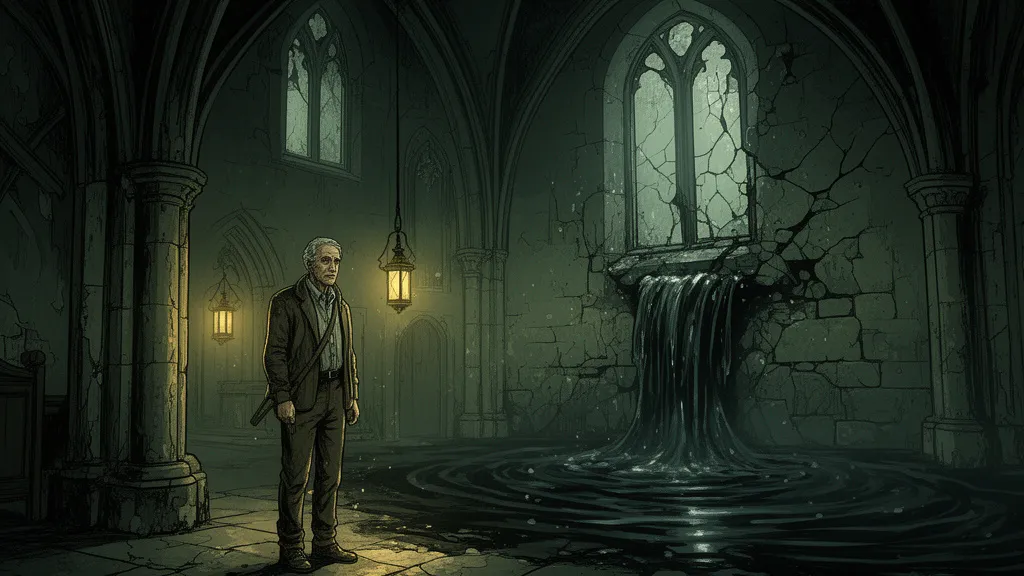
The commission arrived on a Saturday, which Mr. Aldous Fenn considered unusual, and from the Reverend Josias Carne of St. Dunstan's, Morbridge, which he considered more unusual still, for he had surveyed that church three years prior and found nothing of consequence beyond a crack in the north transept wall and a persistent damp about the vestry that he had attributed, in his report, to inadequate drainage and the fundamental dishonesty of Morbridge soil.
He was retired. He had been retired for fourteen months. His instruments occupied a leather case beneath the guest bed, and he had not opened that case since the morning he carried it there, which was the same morning his wife had told him, with characteristic precision, that she intended to enjoy his company now that she finally had it, and that she hoped he would not go looking for reasons to leave the house.
He wrote to Reverend Carne that he would come on Thursday.
The flooding had begun, Reverend Carne explained, in August, though begun was perhaps not the correct word — the water had been noticed in August, which was a different thing. The crypt beneath St. Dunstan's predated the current church by three centuries at minimum, possibly four, and had not been opened with any regularity since the previous incumbent had used it, in 1841, for the storage of hymn-books and a broken harmonium. The brass door at the head of the crypt stairs had, at that time, been secured with a padlock of no great distinction, and it was this padlock that the sexton, Mr. Orde, had forced open in September when a parishioner reported water seeping beneath the door and spreading in a thin, dark film across the flagstones of the nave.
"What was found," Reverend Carne said, and paused in a manner that Fenn found professionally irritating, "was a quantity of water. Standing water. The crypt floor, which is stone, was submerged to a depth of perhaps eight inches. Possibly nine."
"And your concern is structural," Fenn said.
"My concern," said Reverend Carne, "is several things."
He did not enumerate them at that meeting, which Fenn noted as he rode the coach back to his inn. A clergyman who would not enumerate his concerns was, in Fenn's experience, a clergyman who believed his concerns would not survive enumeration. This was not a comfortable thought, and he applied himself to his mutton-chop with the focused determination of a man who found comfort in the physical reality of food.
He examined the brass door on Friday morning, in good autumn light.
It was a remarkable piece — medieval work, green-black with age, set into an arch of pale stone at the rear of the chancel. The surface bore decorative motifs that Fenn could not identify with confidence, being, as he reminded himself, a surveyor and not an antiquarian. What he could identify, and what caused him to set down his measuring rod and stand quite still for a period he was unable to precisely reckon afterward, was the mark upon the door at approximately chest height.
It was the imprint of a hand.
Not carved. Not cast into the metal. The brass around the mark was its ordinary green-black, but the mark itself was darker — blackened, scorched, as though something had pressed a burning hand against the door from the inside and held it there with considerable patience.
Fenn measured the hand. He did this methodically, because he was a methodical man, and he wrote the measurements in his ledger with the same mechanical diligence that had served him across thirty-one years of professional life. The hand was larger than he had expected, though he did not examine that expectation closely. He wrote the figures down. He noted the date and the time. He descended into the crypt.
The water was cold in a way that Fenn could only describe, in his notes, as specifically cold — a cold that seemed directed, purposeful, applied to the ankles and calves with something approaching deliberateness. He had worn his tall boots, which was sensible, and he carried a lantern, which was essential, and he had his ledger and his instruments, which were professional, and he stood at the bottom of the stone stairs in eight inches of black water and understood, with a certainty that arrived not through reason but through some older and less reputable faculty, that he would have preferred to be elsewhere.
The crypt was long. That was the first surprise. His survey three years prior had not included it, and Reverend Carne had not thought to mention that the space extended further than the footprint of the church above, running north under the churchyard in a direction that his compass rendered uncertain. The ceiling was low, vaulted in the Norman manner, and the lantern threw shadows in configurations that Fenn's mind kept trying to resolve into shapes he recognised, with limited success.
He took his measurements. He was thorough. He sounded the walls with his knuckle in the manner he had employed for three decades and listened to the quality of the stone. It was here that the second surprise arrived.
The stone was not wet on the surface.
He pressed his palm flat against the wall. The face of the stone was dry, or nearly so. And yet the water stood in the crypt at eight inches — eight and a quarter, by his rod — and when he watched the surface of the water with the fixed attention of a professional, he saw, or believed he saw, that it rose not in any single place but generally, seeping upward through the floor in a manner that was inconsistent with the hydraulic principles he understood.
The water was coming from inside the stone.
He wrote this in his ledger. He considered what he had written, crossed it out, and wrote: Evidence of internal moisture migration; mechanism unclear. Recommend further investigation.
This satisfied neither proposition.
On Saturday morning, he opened his ledger to review the previous day's notes.
The measurements had changed.
Not all of them. Not the dimensions of the crypt, not the height of the vault, not the breadth of the door. Only the water depth readings. Where he had written 8.25 inches, he now read 8.5. Where he had written 8.25 in a second location and then crossed it out and written 8.25 again, with some emphasis, both versions had been altered. The ink was undisturbed; there were no smears, no evidence of erasure. The figures were simply different from the figures he had written, rendered in what appeared to be his own hand, with a confidence in the strokes that he found, upon reflection, more characteristic of his writing than the numbers he had originally set down.
He sat with this for some time.
Then he went downstairs and ate a very large breakfast.
He returned to the crypt on Saturday afternoon with the intention of taking the measurements again. He found Mr. Orde, the sexton, waiting for him in the chancel — a thin, grey-faced man of approximately seventy, whose expression conveyed a specific combination of obligation and reluctance that Fenn had learned to associate with people who knew more than they intended to say and were managing the distance between those two positions with diminishing success.
"Vicar says you'll want to work through the evening," Orde said.
"I had not requested that," Fenn said.
"No," said Orde.
This exchange concluded the matter in a manner that Fenn was unable, afterward, to explain. He descended at four o'clock with his lantern and his ledger and a second lantern that he had purchased from his own resources, and at some point between four-thirty and five he heard, without ambiguity, the sound of the brass door closing above him and the unmistakable finality of a lock.
The cold reached his boots at seven o'clock, or what he estimated to be seven o'clock, his watch having stopped at half past five.
Reached his boots is imprecise. The cold passed through his boots in the manner that cold passes through inadequate shelter — not by breach, but by occupation. He stood in water that had risen, by this point, to ten inches, and he felt the temperature not as a property of the water but as a property of the dark itself, which had thickened in the hours since the lanterns began to dim and now pressed against him with what he could only describe, and did describe, in the final entries of his ledger, as attention.
He had been tapping the walls.
This was professional habit — sounding the stone, gauging the resonance. He had done it without thinking, one knuckle against the vault above the waterline, moving methodically north toward the far end of the crypt, which he had not yet reached and which the lanterns, now one, now failing, could not illuminate.
He stopped tapping.
From the far dark, after a pause of precisely the length that a patient thing would allow — not a frightened pause, not a startled pause, but the pause of something that had been waiting for him to finish before it replied — the tapping came back.
Once. Twice. Three times.
A human rhythm. Considered. Almost courteous.
Fenn stood in the rising water and held his ledger against his chest, and understood, in the way that one understands something that reorganises every prior understanding around it, that the hand on the brass door had not been pressing outward.
It had been knocking in.
The lantern found its last reserve of oil and burned, briefly, very bright.
Then the tapping came again — closer now — and the light went out.