What the Mirror Kept Behind Her
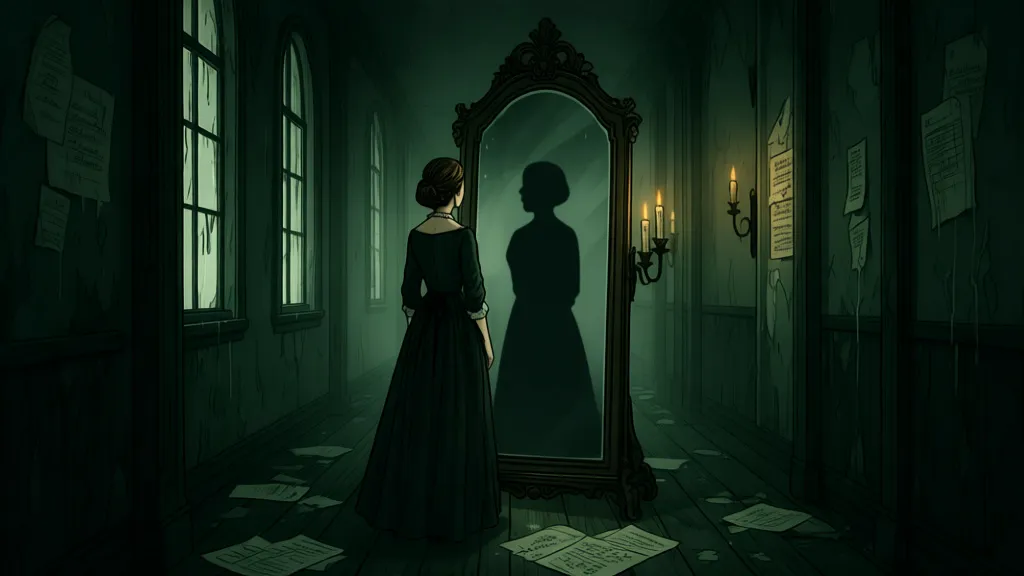
The inventory had been assigned to Miss Alderton on a Wednesday, which she considered neither auspicious nor otherwise — she was not, by temperament or training, a woman given to the interpretation of omens. She had catalogued four estates in the past eighteen months, and she approached Mornfield House with the same methodical confidence she had brought to all of them: a leather satchel, a sharpened pencil, and the quiet certainty that objects, however accumulated, could be named, numbered, and thereby understood.
The house was larger than the solicitor's letter had suggested. It sat at the end of a gravel drive that curved through a stand of wet beeches, and the afternoon light — already thin for October, already beginning its retreat — fell across the west wing in a way that made the stone look less like stone and more like something that had been poured there and had not quite set. Miss Alderton noted this impression, dismissed it as the effect of overcast skies upon pale Cotswold limestone, and knocked upon the front door.
The housekeeper who admitted her was a woman of perhaps sixty, solid and deliberate in the manner of those who have tended a house so long that they have begun, imperceptibly, to resemble it. She gave her name as Mrs. Peel, offered no other pleasantries, and led Miss Alderton through a entrance hall of considerable proportions and considerable silence.
"You'll begin in the library," Mrs. Peel said. It was not a question.
"I had intended the ground floor rooms in order," Miss Alderton replied, drawing out her notebook. "Library, drawing room, dining room, and then the upper floors as time permits. I expect I shall require three days, possibly four."
"Yes," said Mrs. Peel, and left her.
The library was unremarkable in the way that libraries of that class and period so often are: several hundred volumes of county history, agricultural management, and devotional literature that showed, in its uncracked spines, the depth of its owner's piety and the shallowness of his curiosity. Miss Alderton catalogued them with practised efficiency, pausing only once, over a slim volume on the upper shelf whose title had been worn entirely away, whose pages, when she ventured to open it, proved to be entirely blank.
She recorded it as One volume, contents unidentified, pages apparently unused, and moved on.
The drawing room occupied the better part of an hour. By the time she passed through the connecting door into the corridor that led to the west wing, the light had begun its first perceptible withdrawal, and the rain, which had been threatening since her arrival, commenced in earnest against the tall windows at the corridor's end.
It was here that she first noticed the mirrors.
There were three of them in the corridor — large, gilt-framed affairs of the sort that had been fashionable some forty years prior — and each had been covered with brown paper, cut and affixed with the careful thoroughness of someone who had wished to be certain no reflection remained possible. The paper was not new. The edges had darkened with age, and in places the paste had begun to separate, leaving the paper to hang forward slightly, like a face turned away.
Miss Alderton recorded them without comment: Three mirrors, west corridor, covered. Frames gilt. Condition of mirrors unknown.
She did not find it necessary to speculate in her catalogues. That was not what catalogues were for.
The west sitting room contained a writing desk, four chairs of middling quality, a mahogany side table bearing a collection of ceramic dogs, and one mirror.
This one had not been covered.
It was smaller than the corridor mirrors, oval rather than rectangular, and hung between the two western windows at a height designed for someone standing precisely at the room's centre. Miss Alderton, who was standing precisely at the room's centre, turned to examine it.
The glass was very old. She could see that at once — the slight waver in its surface, the way it rendered the room behind her in tones marginally cooler than reality. She looked at the reflection of the rain-darkened windows, the reflection of the four chairs, the reflection of the writing desk.
She looked at the child standing in the doorway behind her.
It was a girl, she thought — small, perhaps seven or eight years of age, wearing something pale that might have been a nightgown. The child stood quite still, which was the first thing Miss Alderton noticed, and the second thing she noticed was that she could hear nothing behind her — no breathing, no small footfall on the floorboards — and the third thing she noticed, arriving not as a thought but as a sensation distributed across the whole of her body simultaneously, was that she had left the door closed.
She turned.
The doorway was empty. The door stood closed. The room contained nothing but herself and the objects she had been listing.
Miss Alderton stood for a moment with her pencil raised. Then she wrote, in the column reserved for condition notes: Mirror, oval, period glass, some distortion. She underlined distortion. She moved on.
Mrs. Peel brought tea at half past four, setting it on the dining room table without ceremony and preparing to withdraw.
"Mrs. Peel," said Miss Alderton. "The mirrors in the west corridor. When were they covered?"
The housekeeper paused with her back still turned. "Some years ago."
"And the mirror in the west sitting room — was it an oversight that it was not covered with the rest?"
A longer pause. Mrs. Peel turned then, and Miss Alderton had the unsettling impression that the woman had spent the intervening seconds not searching for an answer but deciding how much of the truth the answer ought to contain.
"No," Mrs. Peel said. "Not an oversight."
Miss Alderton set down her pencil. "I saw something in that glass," she said, in the tone she reserved for difficult facts that nonetheless required stating. "A child. Standing behind me."
Mrs. Peel's expression did not change, which was itself a kind of change — the sudden rigidity of a face that has decided not to react, and in so deciding, has reacted entirely.
"It would be today," Mrs. Peel said. "Yes. It's always this date."
"What is always this date?"
"The girl," Mrs. Peel said. "She appears in the glass. Has done, every year, on this date, since 1897." She paused. "The other mirrors were covered because — because it was felt that one was sufficient."
Miss Alderton considered this answer for a long moment. She wanted very much to ask sufficient for what, but she found, somewhat to her own surprise, that she did not particularly want to hear the response.
"Whose child?" she asked instead.
Mrs. Peel's eyes moved briefly to the ceiling, in the manner of someone locating a room above rather than invoking the divine. "The nursery is on the upper floor," she said. "It's been sealed these thirty years. The ledger is in there. I would leave it sealed, if I were you." She paused again, at the door this time. "I would leave the ledger in particular."
She withdrew before Miss Alderton could ask what the ledger contained, or why a ledger, specifically, had warranted particular mention.
The nursery door was at the end of the upper east corridor, which Miss Alderton told herself was entirely out of her way and also entirely irrelevant to a property inventory, and then told herself again as she stood before it with a candle — the upper floors had no gas — and tried the handle.
It opened without resistance, which surprised her. She had expected a locked door. What she found was simply a room that had been emptied of warmth so completely that the emptiness itself had become a presence, a silence that was not the absence of sound so much as the active suppression of it.
The nursery contained what one would expect of a nursery thirty years uninhabited: a small iron bed stripped to its ticking, a shelf of dolls in various states of preservation, a rocking horse with one ear missing, and a writing desk in the corner upon which sat a ledger bound in dark green cloth.
Miss Alderton approached it.
The ledger's cover bore no title. The first page bore a date — October 1897 — and then a list of names, written in a careful copperplate hand, one name per line, each followed by a notation she did not at first understand. The notations were numbers and times. Twice, three o'clock. Once, the hour uncertain. Three times: morning. Beneath each cluster of notations, a second hand — shakier, written later — had added a single phrase, the same phrase, repeated down the page without variation:
She is still looking for the door.
Miss Alderton turned the pages.
The names continued for several years. Then they ceased, midway through a page, and the remaining pages were blank — or nearly blank. On the final page, in handwriting she did not recognise, was written simply:
If you have come to catalogue this house, you have already been seen.
Below this, a blank line. Then:
Do not record her name. It is how she finds the door.
Miss Alderton stood in the nursery for some time. The candle moved in a draught she could not locate. The rain against the single window was very loud, and beneath it — beneath everything — there was the smell she had noticed since entering the upper floor: damp plaster, old stone, something that suggested the house was not merely containing the rain but incorporating it, drawing it inward and downward through the walls the way a body draws breath.
She closed the ledger.
She left it where it was.
Her room for the night was on the first floor, east side, which Mrs. Peel had prepared with the minimum of comfort and the maximum of practical warmth: a fire laid, a water jug, heavy curtains drawn against the weather. Miss Alderton ate supper alone in the dining room — cold chicken, good bread, a glass of burgundy she drank more quickly than she intended — and retired at nine o'clock with the specific intention of being asleep by half past.
The knocking began at twenty minutes past.
It came from inside the wall beside the bed — not a pipe's complaint, not the house settling into the cold — but a deliberate, unhurried series of impacts: three, then a pause, then three. She lay perfectly still and listened to it for a full minute, constructing and discarding explanations with the rapid efficiency of someone who knows the explanations will not hold. Loose structural timber. Water pressure in an old system. An animal in the cavity.
Three, and a pause, and three.
None of her explanations could account for the rhythm, which remained constant, or for the way it seemed — and she was aware that she was perhaps not thinking clearly, that the burgundy and the day's accumulated peculiarities might be operating upon her judgment — the way it seemed to wait between repetitions. Not random. Not mechanical. Patient.
The rain came harder.
The smell of damp plaster reached her even here, even through the closed door, as if the corridor beyond were simply no longer dry, as if the walls were doing what the ledger had implied — breathing, slowly, admitting something inward through their mass.
Miss Alderton sat up. She lit the candle on the bedside table. She opened her notebook to a fresh page.
She was, above all things, a cataloguer. It was the only reliable instrument she possessed.
She wrote: Knocking in the east wall, first floor, commencing approximately 20:20. Rhythm: groups of three, interval of approximately four seconds between groups. Character: consistent. Appears deliberate.
She paused with the pencil above the page.
She thought of the ledger. She thought of the phrase written at its end in the unfamiliar hand. She thought of the oval mirror and the still, pale figure in its glass, and the closed door behind her, which had been closed.
She thought: Do not record her name.
Below her last entry, Miss Alderton wrote a single additional line — slowly, as though she were not entirely certain she wished to write it, as though the act of writing it made it more true rather than merely more legible:
The knocking does not come from outside the wall.
Three, and a pause.
The candle moved in the draught from a source she could not name, and the flame did not go out, and she wished very much that it had, because then she would not have been able to see what she saw in the dark glass of the uncurtained dressing mirror across the room — would not have seen the small pale shape standing at the far edge of its frame, quite still, regarding her with an attention that no catalogue she had ever written was equipped to name, and most certainly, she told herself, most certainly not to answer.
The pencil remained in her hand.
She was still deciding.
Three, and a pause, and three.