What the Violets Were Keeping
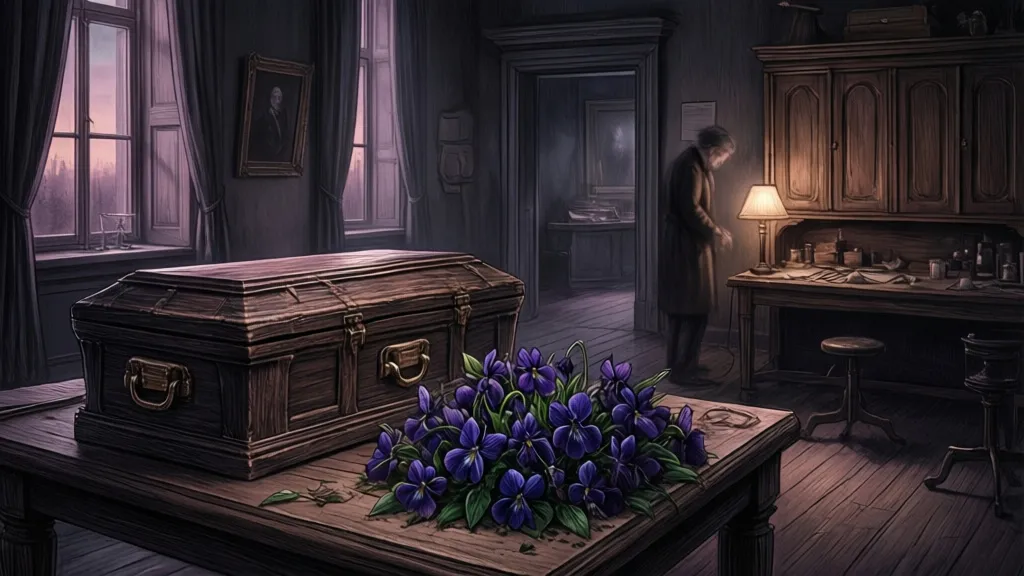
The coffin arrived on a Tuesday, which was already irregular, as museum deliveries came on Thursdays and the receiving dock was staffed accordingly. Mrs. Cecily Marne learned of it not from the registrar, who ought to have telephoned, but from young Aldous, the security attendant, who appeared in the doorway of her conservation studio on the third floor with an expression that suggested he had not, until that morning, understood his employment to contain surprises of this particular variety.
"There's a box," he said.
"There is frequently a box," said Mrs. Marne, without looking up from the seventeenth-century apothecary chest she was documenting. "The museum is, in the main, composed of boxes."
"This one's wrapped up. In cloth. And there's — " He paused. "It's quite small, Mrs. Marne."
She looked up then.
The oilcloth was old and of a kind she had not seen in thirty years of handling objects — a heavy, dense weave, slightly iridescent where the light caught the folds, smelling of salt and of something beneath the salt that she could not name and did not, upon reflection, attempt to. It had been tied with cord of the nautical variety, and the knots were of a type she eventually identified, after consulting a reference volume she kept for precisely such moments, as a Flemish eye splice adapted, somewhat impractically, for terrestrial use.
The brass handles — there were four, two to a side — were cold in a manner disproportionate to the temperature of the receiving room, which was kept at a steady eighteen degrees. She removed her cotton examination gloves and touched the nearest handle with two bare fingers, and the brass fogged immediately, as though she had breathed upon it, though she had not.
She replaced her gloves.
The paperwork accompanying the object was sparse to the point of insult. A single card, printed rather than typed, read as follows:
For the attention of the Conservator. Provenance: The Dorset Coast, acquired privately. Donor: E. Vael. The contents require careful consideration.
There was no address. There was no telephone number. There was, she noted, no date.
"Who accepted this?" she asked the registrar, Mr. Hopwood, who had by this time been located and who stood beside her with the look of a man who has done nothing wrong but suspects, correctly, that this will not protect him.
"It was left," he said. "At the dock. Overnight."
"Overnight."
"The dock is locked."
"Clearly," said Mrs. Marne, "not sufficiently."
She opened it at half past two, with Mr. Hopwood present as witness and Aldous stationed outside the door in case — she did not specify in case of what, and he did not ask.
The lid was not sealed. It lifted with a resistance that was less mechanical than reluctant, a slight pressure against the opening as though the interior air preferred its own company, and then it gave, and she held the lid back at arm's length and looked inside.
The satin lining was pale blue, of a quality that had once been fine and was now faded to something between silver and the colour of shallow water on an overcast morning. It was damp. Not merely humid — damp, in the particular way of things that have been submerged and then recovered: the satin held its moisture with a tenacity that suggested the water was recent, that it had no interest in evaporating, that it considered itself, in some obscure sense, still at home.
The smell was immediate and unambiguous. The harbour at low tide. Exposed mud and salt and the underside of things normally kept underwater. It was not, precisely, unpleasant — Mrs. Marne had spent her childhood in Portsmouth and the smell was almost familiar, almost nostalgic — but it was thoroughly wrong for a room in the interior of a city, three hundred yards from the nearest standing water, which was a municipal ornamental pond notable chiefly for its ducks.
At the base of the coffin, pressed beneath the satin with a care that struck her as deliberate, even ceremonial, was a bouquet of violets. Fresh. The stems had been cut recently enough that the lowest ends had not yet browned, and the flowers themselves were unopened, each bud compact and precise, bound together with a length of the same nautical cord that had tied the oilcloth.
Mrs. Marne stood for a long time without speaking.
"Well," said Mr. Hopwood, at last.
"Yes," said Mrs. Marne.
She replaced the lid.
That night — she had remained in the building later than usual, cataloguing, or rather sitting in front of her catalogue and thinking — she became aware, sometime after eight o'clock, of a smell in the upper corridor that had not been there when she had walked it at six.
She stood at the top of the staircase and breathed in, methodically, the way she had trained herself to breathe when encountering an object of uncertain origin, present and deliberate and cataloguing.
Harbour. Low tide. The underside of things.
The corridor was empty. The lights were on their automatic dimmers and burned at half-intensity, which cast the long passage — with its cases of fossil invertebrates and its framed geological surveys and its cabinet of wax anatomical models, which had always struck her as a somewhat aggressive choice of display — in a quality of illumination that she might, in other circumstances, have found merely atmospheric.
She walked the length of the corridor. The smell was consistent, neither stronger at one end than the other, neither emanating from any particular case or door or join in the floorboards. It was simply present, the way certain properties of an object cannot be located in any single constituent part but inhere in the whole, in the relationship between elements, in the fact of the thing's existence rather than in its matter.
She went home. She slept, she believed, adequately.
In the morning she saw the woman in the window opposite.
The building across the street from the museum's main facade was a narrow terrace that operated, at its lower floors, as a solicitor's office and, above that, as short-term residential lets of the type favoured by academics visiting the university and by people with reasons to be in the area that they preferred not to make explicit to hotel staff. Mrs. Marne knew this because she had lived in one of those rooms herself, briefly, after her husband's death, during the period she thought of as the arrangement — before she had found the flat in Claverton Street and established herself in the routines that now constituted, she was reasonably satisfied, a life.
The woman stood at the second-floor window, behind a lace curtain, and she was watching the museum.
She was of uncertain age — Mrs. Marne estimated sixty, then fifty, then abandoned the exercise — and wore dark clothing, and her hair was pinned up in a fashion that appeared to belong to no particular era. She held the curtain aside with one hand, and she was entirely still.
Mrs. Marne watched her for a moment from the museum's front steps, and then went inside, because standing on the steps staring at a woman in a window was not something she was prepared to do for longer than was strictly necessary for identification purposes, and in any case she had not identified anything except the certainty that the woman's name, if she were the donor, was E. Vael, and that she had come to watch what Mrs. Marne intended to do.
She spent the morning with the coffin again, this time with better notes and a camera and the particular quality of attention she had spent three decades learning to bring to things that resisted understanding. It was a child's coffin, she was now certain — sized for a child of perhaps five or six years, constructed of oak beneath the oilcloth wrapping with joinery of a quality she associated with the mid-Victorian period, although several details suggested earlier influence, a Flemish or Dutch sensibility in the proportions that might indicate either significant age or deliberate archaism.
The brass handles, in the controlled light of the studio, were still cold. She checked the room temperature. She checked it again.
The violets had opened overnight. This was not, she told herself, remarkable — flowers opened, that was the nature of flowers — but they had opened in a sealed coffin in a room kept at eighteen degrees, and they had opened to a degree of fullness that ought to have taken two further days by any reasonable botanical estimation, and they smelled, when she leaned close, not of violets but of the harbour.
She sealed the coffin with packing tape across the join. It was, she was fully aware, an absurd intervention. She used six lengths. She was thorough.
By afternoon the smell had reached the second floor.
She knew this because two of the volunteers mentioned it independently, each using different words — fishy, said one, with apology; like the sea, said the other, with something closer to wistfulness — and because she had mapped its progression with the same systematic attention she had given the object itself, walking each floor at two-hour intervals and noting the distribution in the margin of her catalogue, which she would later, upon reading it, find difficult to explain.
At four o'clock she stood at her studio window and looked across the street.
The woman was still there. The curtain was still held aside. The woman's face, at this distance, was composed in an expression that Mrs. Marne could not quite read, though she was practiced at reading things. It was not threatening, she thought. It was not imploring. It was the expression of someone waiting for a conclusion to an event they had set in motion and could not themselves bring to resolution.
Mrs. Marne thought about the coffin and what it contained, which was dampness and violets and air from somewhere she could not locate on any map. She thought about her husband, who had died of nothing supernatural whatsoever, a mundane cardiac event on a Sunday afternoon, and who had been buried in a coffin she had selected because it seemed solid and because the funeral director had described it as dependable, which was a quality she valued. She thought about what it meant to keep something sealed against the world's attention versus what it meant to acknowledge that the world, in certain of its configurations, declined to be sealed against.
At ten minutes to five, she went down to the dock, found the trolley, and moved the coffin to the secure storage room on the ground floor, where the temperature was kept lower still and the walls were thick and the single high window admitted only a strip of indirect sky. She placed it on the central table. She removed the packing tape — it had already loosened, she noted, though the join was straight and the tape had adhered properly to both surfaces — and she opened the lid.
The violets were at full bloom and, now, smelling entirely of themselves. Wholly and completely of violets. The dampness in the satin had, perhaps, decreased, or perhaps she was no longer as startled by it.
She stood with the lid open and waited, with the patience she had developed over many years of attending to things that revealed themselves slowly.
The knock came at ten minutes to six, while there was still light in the high window.
She opened the receiving door. The woman from the window stood in the passage, composed, upright, wearing a coat that was dark and salt-stained at the hem in the manner of someone who had walked some distance along an exposed coast.
"Mrs. Marne," said the woman, which was not a question.
"Miss Vael, I presume," said Mrs. Marne, which was not either.
The woman looked past her, through the corridor, toward the storage room. Her expression was the same one Mrs. Marne had failed to read from the window, and she failed to read it again now from a distance of four feet, and concluded that it was perhaps simply a quality of the face rather than an expression at all — the set of features that remained when everything demonstrative had been worn away by some extended necessity.
"May I see it?" the woman said.
Mrs. Marne considered the question in all its dimensions, which were several, and which she understood she was not fully equipped to assess, and which she suspected she would never be fully equipped to assess, and which, for this reason, she had been wrong to imagine could be resolved by packing tape.
"Yes," she said.
She stepped aside. The woman walked past her and did not smell of salt, or of harbour, or of anything at all that Mrs. Marne could identify, and the smell of violets moved through the corridor as she passed, full and real and entirely out of season.
Mrs. Marne followed her toward the storage room and the open coffin, and behind them, the receiving door swung gently closed, and from the upper floors of the building there came, very briefly, the sound of water moving over stone.