What the Walls Counted Back
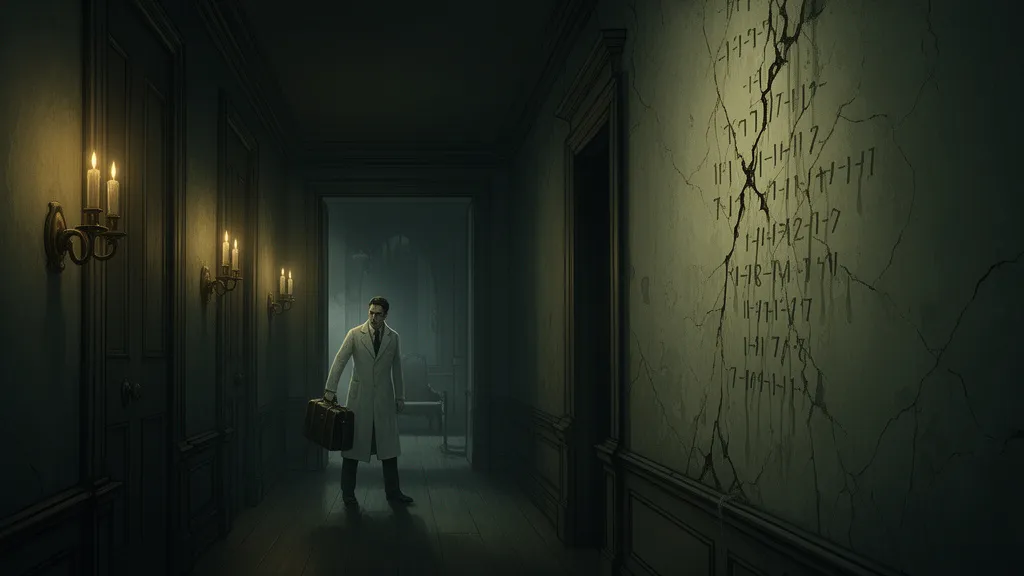
The call came at twenty past midnight, which Dr. Edmund Prale considered an objectionable hour for any summons that was not, strictly speaking, a matter of immediate mortality. The boy who delivered it — some under-footman pressed into the role of messenger, hatless, breathing hard — offered only the name Vellacourt, the manor, and the word child, and on the strength of those three items Dr. Prale dressed, collected his bag, and allowed himself to be driven through a darkness that seemed, on that particular November night, less an absence of light than a positive and deliberate condition.
Vellacourt sat four miles east of the village, set back from the road behind a line of elms that had grown so close together that passing through them was less like entering a drive and more like being admitted. Dr. Prale had attended the family perhaps twice in the preceding decade — a broken wrist, a case of influenza that had been, in his professional opinion, largely theatrical — and had formed the view that Vellacourt was a house that took itself rather too seriously. It rose from its grounds in a manner that suggested it had been placed there not by architects but by some process of geological grievance, all dark stone and uneven rooflines and windows that seemed, even when lit from within, to be looking outward rather than allowing one to look in.
The housekeeper, a Mrs. Gault, received him at the door. She had the face of a woman who had decided, some years previously, that composure was a thing to be maintained at all costs, and who was finding that decision increasingly expensive.
"The fire went out," she said, which was not the greeting Dr. Prale had anticipated.
"I beg your pardon?"
"In the long gallery. And the nursery. Both of them, at the same hour. The flues are sound — I had them checked in September." She paused. "There is also a smell."
He followed her through the entrance hall and up a staircase that was entirely too grand for midnight. The long gallery ran the width of the first floor, portraits ranked along either wall with the grim patience of people who have waited a very long time and intend to wait longer still. The cold was immediate and surprising, the kind of cold that does not merely indicate the absence of heat but seems to have opinions about it. And the smell — he caught it perhaps halfway down — was of wet wool and lamp oil, faint but unmistakeable, the sort of smell that belongs to a person rather than a room, and which had no business being where it was.
"How long has it smelled this way?" Dr. Prale asked.
"Since approximately eleven," Mrs. Gault said. "When Miss Cecily began knocking."
Miss Cecily Vellacourt was eight years old and entirely awake. She lay in the nursery bed with the sheet pulled to her chin with a precision that struck Dr. Prale as more deliberate than comfortable, her eyes open, her expression that of a child who has decided to be very calm about something she has not yet fully categorised.
Her mother, a pale woman in a wrapper whom Dr. Prale had not previously met, stood by the window and did not look at the walls.
"She won't sleep," the mother said. "She says someone is in the wall."
"I didn't say someone," Cecily said, with the particular patience of a child correcting an adult who has missed the point. "I said it answers."
Dr. Prale set his bag upon the chair that was provided for visitors and sat upon the edge of the bed, which creaked in a manner he found briefly distracting. He had, over the course of a twenty-three-year practice, developed what he privately considered an authoritative bedside manner: measured, reassuring, faintly paternal, the voice of a man who has seen everything and found it, on balance, explicable. He deployed it now.
"Tell me what you mean by answers, Miss Cecily."
She regarded him for a moment with the frank assessment children reserve for adults who may or may not be worth the effort. Then she knocked three times on the headboard: one, two, three.
The silence after was ordinary enough. Dr. Prale was prepared to nod pleasantly and begin his inventory of reassuring explanations — old pipes, settling timber, the acoustical peculiarities of large houses — when, from somewhere within the wall behind the headboard, came three slow taps in return.
One.
Two.
Three.
The mother made a sound that was not quite a word.
Dr. Prale sat very still. He was a man who trusted his senses, had been trained to trust them, had staked twenty-three years of diagnoses on their reliability. He therefore did not allow himself to doubt what he had heard, and found that this was worse than doubting would have been.
"How long has it been doing this?" he asked. His voice was, he was pleased to note, entirely level.
"Since I counted to a hundred," Cecily said. "At bedtime. I counted to a hundred and then it knocked a hundred times back. It took a long time." She considered. "It's more patient than people."
Dr. Prale stood, moved to the wall beside the headboard, and pressed his ear to the plaster. It was cold against his skin, colder than the room, colder than could be explained by the merely absent fire. He could hear nothing. He straightened, turned to Mrs. Gault, and asked, with the measured calm of a man requesting something perfectly ordinary:
"What is on the other side of this wall?"
"The corridor," she said. "And at the end of the corridor, the locked room."
"Locked since when?"
She met his eyes, and in them he saw that she was going to answer him precisely and without elaboration, and that this was because elaboration would require her to say things she had no intention of saying at twenty past midnight in front of the child.
"Since the autumn of last year," she said.
He gave the child a mild preparation — quite unnecessary, he suspected, since she appeared to be managing her nerves considerably better than the adults present — and sat with the mother in the corridor while Cecily slept, or appeared to sleep, or performed sleep with the practiced serenity she seemed to bring to most things.
The mother's name was Margaret. Her husband was away, which she mentioned once and did not explain. She told Dr. Prale, in the low steady voice of someone recounting facts rather than experiences, that the locked room had belonged to the governess who had left their employ the previous October. That the governess had left — she used the word left with a faint, deliberate emphasis that made it mean something other than departure — between one household inspection and the next, without notice, without collection of wages, without the small trunk that still sat inside the locked door.
"We wrote to her family," Margaret said. "In Shropshire. They had not heard from her. They were" — she paused — "not surprised."
Dr. Prale asked the question that courtesy had been deferring for some minutes. "Has anyone entered the room since October?"
"The key is missing," she said. "We assumed she had taken it."
He looked at the locked door at the end of the corridor. It was perhaps forty feet away, at the limit of the lamp's reach, and thus visible more as a suggestion of door than as a door itself: a darkness that was slightly more rectangular than the darkness around it.
He became aware, gradually, that the smell from the long gallery had followed him here. Wet wool. Lamp oil. The smell of a person in a place where no person was.
By morning, the household had assembled the evidence with the terrible efficiency of people who would very much prefer not to have found it.
The footprints began at the nursery hearth, which was stone-flagged and held moisture readily, and which was cold enough that the faint damp impressions — bare feet, small, the stride of someone moving without particular haste — had not yet entirely dried. They led out through the nursery door, along the corridor, and ended at the locked room, where they did not turn, and where there was no sign that the door had been opened, and where the key remained, as it had always been, missing.
The under-footman found this arrangement significantly more distressing than Dr. Prale considered professionally appropriate for a young man of his years. Mrs. Gault found it, if anything, less distressing than Dr. Prale would have expected, which was in some ways worse.
Cecily, when asked, said only that she had slept very well, thank you, and had not counted anything in the night.
Dr. Edmund Prale drove home through a morning that was clear and cold and resolutely ordinary, the elms releasing him with the same reluctance with which they had admitted him. He was a man who kept meticulous records: his ledger ran to some thirty volumes, each entry dated, signed, the diagnosis and treatment noted in his small, precise hand. He had recorded influenza and fractures and one case of what he had privately and always suspected was something rather worse than grief, though he had written nervous exhaustion and left it at that.
He thought, as he drove, about what he had heard in the wall.
He thought about the smell of wet wool in an empty gallery, and a child who counted to a hundred at bedtime, and three taps that had answered him with a composure he could only describe, and disliked having to describe, as patient.
He thought about the locked room, and the footprints that had arrived at it but not entered it, and the small trunk that sat inside with a governess's belongings and no governess to claim them.
That afternoon, he opened the current volume of his ledger to the entry for the night of the fourteenth, wrote the date, the name of the household, and the presenting complaint — child, disturbed sleep, possible auditory sensitivity — and sat for a long while with his pen above the page.
Then he closed the ledger, placed it on the shelf with the others, and poured himself a rather larger measure of brandy than was indicated by any prescription he had ever written.
In the morning, he told himself, he would decide what to write.
In the morning, he told himself, he would know what to call it.
The morning came and went, and he wrote nothing, and he did not, in any meaningful sense, decide.