The Bell That Rang for the Living
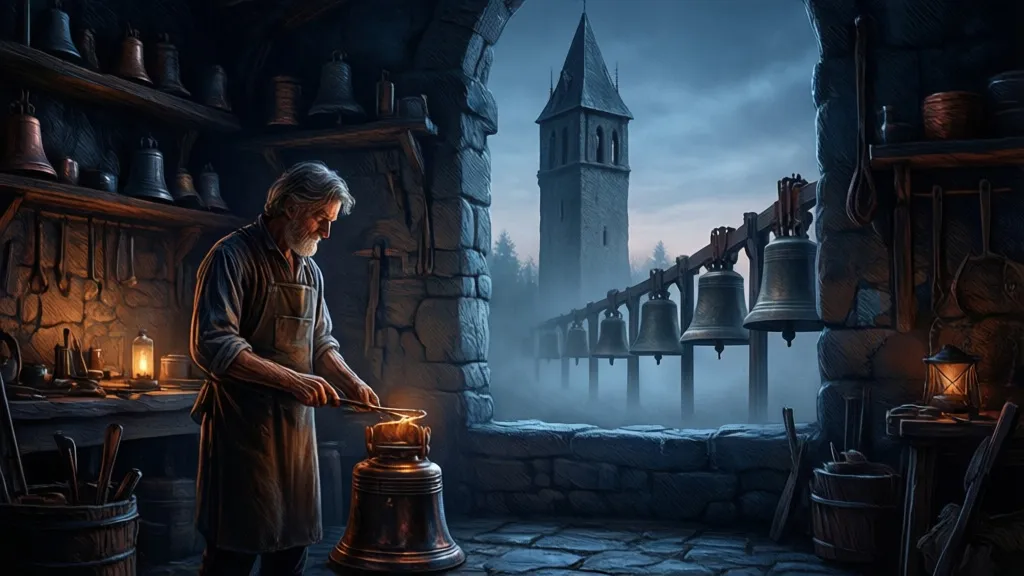
The bells had begun ringing at dusk, which meant Osric would climb the tower with a question he did not yet know how to ask.
They rang once each, starting with the smallest—the silver mouth that called the field hands home at harvest—and moving upward through bronze and hammered copper until at last the great bell of the tower, Memoriam, sounded a single stroke that rattled the shutters in the square below. Osric stood in his workshop with his hands full of wax and wire, listening to his life's work speaking without him, and felt the old familiar cold that meant the world was doing something it ought not.
He waited until the echoes died. The ropes hung perfectly still against the whitewashed walls. When he pressed his palm to the smallest bell's flank, the bronze was cool as river stones.
Someone had rung them without touching them, which meant someone had need of bells for reasons that were not about sound.
He took a lantern up the narrow stairs, though he could have climbed them blind. Fifty-three steps to the first landing, where the field bells hung in their cradles. Seventy more to the second tier, where the church bells waited in patient rows. Then the final ascent—a ladder more than a staircase—to the bell chamber itself, where Memoriam hung in darkness and the wind came through the open arches to whisper against bronze.
The lantern light found the child before Osric did.
She lay curled inside Memoriam's mouth, small enough to fit in the space where the clapper should have hung. She was wrapped in silk the colour of mourning—pale grey, nearly white—and her hair was dark as wax seals. When Osric leaned closer, he smelled rainwater and ash, the particular scent of things that have been washed clean and then burned anyway.
She was breathing. He watched her ribs rise and fall beneath the silk, steady as tides.
The burial cloth, he realized, was not wrapped around her. She wore it like a cloak, pinned at one shoulder with a clasp of carved bone. Someone had dressed her for a funeral she had not attended. Someone had hidden her where the dead were remembered and the living came to mourn, and trusted that a bellmaker would know what to do when he found her.
Osric did not know what to do.
He knew only that bells rang when the world wanted witness, and that witness was dangerous in a town where the mayor had lost three children to a fever that smelled of rainwater and left ash in the lungs.
By the time he descended, the square had begun to fill.
They came in twos and threes at first, then in greater numbers: the bereaved and the curious, the ones who had heard Memoriam and understood that the tower did not ring itself for small reasons. Osric stood in his doorway and watched them gather like moths around the fountain, their lanterns making constellations in the dark.
Among them was the widow mayor, Idena, who had buried her youngest daughter six days prior and her twin sons the week before that. She wore black still, though mourning in this town had become so common that half the square was dressed in shades of grief. When she saw Osric, she crossed the cobblestones with the particular purposeful gait of someone who has already decided what justice looks like.
"The bells rang," she said.
Osric nodded. "They did."
"All of them, in sequence. Ending with Memoriam." Idena's voice was flat, drained of inflection by exhaustion or sorrow or both. "That's the pattern for a death in the tower itself. For when a bellmaker passes and the bells must announce their own silence."
It was. Osric had learned it from his father, who had learned it from his mother, who had rung Memoriam for herself three hours before she died, so the town would know the tower had passed into new hands.
"I haven't died," Osric said.
"Then someone rang them. Someone in the tower." Idena looked up at the darkened chamber, where the arches opened onto sky. "Someone who knew the sequence. Someone who wanted us to come."
"Or someone who wanted us to look," said a voice from the crowd. Osric recognized Margit, the weaver, who had lost her husband to the fever and her apprentice three days later. "The sickness came from the east. It came with the refugees from the burned villages. And now bells are ringing themselves, and the mayor's asking questions instead of searching."
The crowd shifted, a slow restless movement like water finding a lower level. Osric saw oil lamps being lit, saw men moving toward the tower with hammers in their belts.
"We search," Idena said quietly. "But we search without fire. The bells are older than the fever. We don't burn what has been faithful."
Margit spat into the fountain. "My husband was faithful. He still choked on ash."
The crowd made a sound that was not quite agreement, not quite anger—something low and collective and dangerous, the voice of people who have lost too much to be careful about what they destroy next.
Idena turned back to Osric. "Open the tower," she said. "Let us see what rang the bells. If it's nothing, we go home. If it's something…" She did not finish. She did not need to.
Osric thought of the child in the silk shroud, breathing steady as tides.
He thought of the fever that had taken twenty-three people in as many days, and how the bodies had smelled of rainwater and ash, and how the child in Memoriam smelled exactly the same.
He thought of his father, who had told him once that bells rang for the dead but listened for the living, and that a bellmaker's task was to hear the difference.
"The child is not sick," he said.
The square went silent.
Idena's face did something complicated—grief and rage and desperate hope passing across it like weather. "You found a child."
"In Memoriam. Wrapped in mourning silk. Breathing."
"And the bells rang for her," Idena said slowly. "For a living child, in a dead child's clothes."
"For something," Osric said. "I don't know what."
Margit pushed forward, her lamp held high. "The fever came from the east. The refugees brought it. If there's a child hidden in the tower—"
"Then someone hid her there," Osric said. "Someone who knew the bells would ring. Someone who wanted us to find her."
"Or someone who wanted to spread the sickness," Margit said. "Someone who wanted the fever to reach the tower, where the bells are. Where everyone comes."
The crowd murmured, a rising tide of fear and anger.
Idena held up one hand. The murmuring stopped. She had buried three children in two weeks; she had earned her silence.
"Show me," she said to Osric.
They climbed together, Idena and Osric, leaving the crowd below. The men with hammers stayed in the square, though Osric saw them watching the tower's base, calculating where the fire would need to start to bring the whole structure down.
In the bell chamber, the child still slept.
Idena stood at the mouth of Memoriam for a long time, her lamp making shadows dance across bronze. When she finally spoke, her voice was very small.
"She looks like Merra," she said. "My youngest. Before the fever."
"She's not Merra," Osric said gently.
"I know." Idena reached out, stopped just short of touching the child's hair. "But she could be. She could be anyone's. All the children looked the same when the fever took them—small and pale and smelling of rain."
She withdrew her hand. "The refugees said the fever came from the river. That it rose in the night like mist and crept into houses, into lungs. They said it took the children first because children still believed in drowning."
Osric waited.
"They said some children survived," Idena continued. "The ones who were hidden. The ones who were wrapped in shrouds and laid in bells and dark places, where the fever couldn't find them because it thought they were already dead."
She turned to face him. In the lamplight, her eyes were very bright.
"Someone saved her," she said. "Someone knew the fever was coming here, and they hid a child in the one place that grief visits but does not linger. In the bells that ring for the dead but belong to the living."
"And rang the bells to bring us here," Osric said. "To make sure we found her."
"Or to make sure we understood." Idena looked back at the child. "That the fever can be survived. That hiding is not cowardice. That there are children still breathing in places we assumed were already full of death."
Below, in the square, the crowd was growing restless. Osric heard hammers striking stone, testing.
"What do I tell them?" Idena asked.
"That the bells rang true," Osric said. "That there is a child alive in the tower, and she will stay alive, and we will hide others if we must. That grief has taught us to recognize death, and we will not mistake breathing for burial."
Idena smiled, a small tired thing. "They'll want to see her."
"Then they'll climb," Osric said. "One at a time. In silence. And they'll learn what the bells already know—that the tower is not a tomb. It is a place where things are remembered, which means it is also a place where things survive."
By dawn, twelve families had climbed the tower.
By noon, the child had woken, and Idena had wrapped her in a blanket that was not a shroud.
By dusk, three more children had been found in the town—in cellars and wells and quiet places—wrapped in silk and smelling of rain, breathing steady as tides while the fever searched for them and found only darkness.
The bells did not ring again that day.
But Osric heard them anyway, a sound like memory, like the world noticing that something small and mortal had outlasted something vast and deadly, and finding this—as the bells always had—worthy of witness.