The Child Who Slept in the Fish Trap
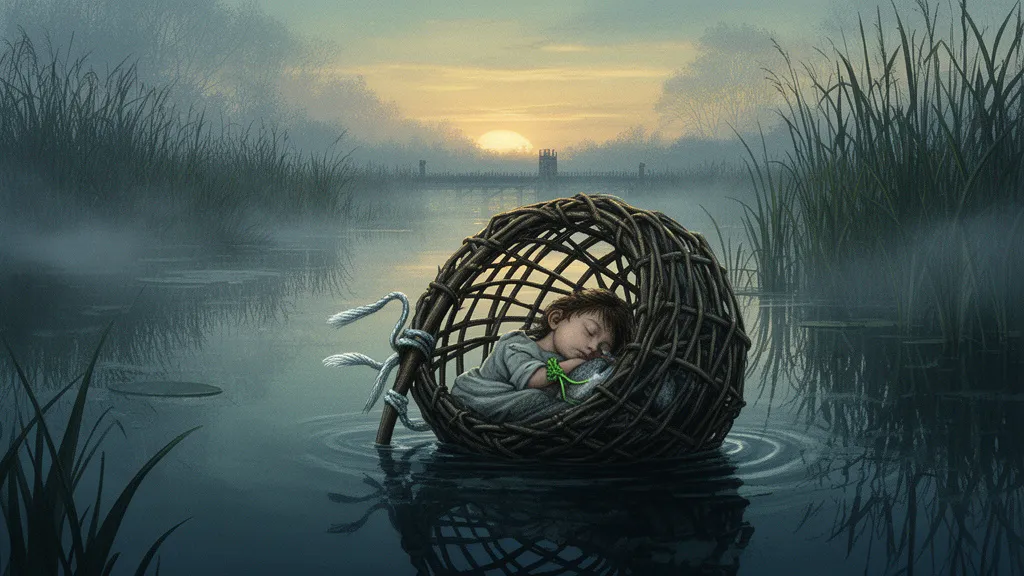
The child was sleeping inside the trap when you came down at dawn to check the weirs, which meant they had been there all night in water cold enough to stop a heart. The wicker was old, the kind your grandmother used, the willow twisted tight in patterns that had names once, and the child lay curled inside like something caught and kept. Their skin was cool as pond glass when you touched it. Not cold—just the exact temperature of standing water in autumn, when the surface hasn't decided yet whether to freeze.
A silver reed was tied through their left wrist with green thread.
You knew what that meant. Your grandmother had told you, back when the chapel still stood above the water and the bell still rang for harvests instead of drownings. A silver reed meant someone had made a promise to the marsh and the marsh had taken payment in a form that could breathe.
The child opened their eyes. They were the colour of silt after rain.
"Are you hurt?" you asked, though you already knew they weren't. Things that sleep in fish traps don't hurt the way children do.
They blinked once, slow as a heron.
You lifted them out—they weighed almost nothing, or perhaps the marsh simply didn't want to let go and you were stronger—and carried them back toward the village with the reed still tied to their wrist and the dawn coming up pale and uncertain behind the eastern fen.
That was when the bell started ringing.
The chapel had been underwater for sixteen years, ever since the autumn the river forgot which way the sea was and decided to stay. The whole building gone beneath the flood, stones and all, and the bell with it, bronze and silent under two fathoms of black water. You had watched it sink yourself, age twelve and bewildered, standing beside your grandmother while she sang one of the old burial songs and the priest wept into his hands.
The bell had not rung since.
It was ringing now.
You stopped walking. The child in your arms turned their head toward the sound, and the silver reed caught the light, and you understood with the cold clarity of someone who has lived too long in a place where the water makes its own decisions that you were holding either the end of something or the beginning of something, and there was no way to know which until it was too late to matter.
The village was waking. Doors opened. Faces appeared, pale and suspicious.
"The bell," someone said. Teren, the miller's son, his voice thin. "Why is it ringing?"
"Where's Miren?" you asked, though you weren't sure why you asked. Miren was the only one left who knew the burial songs, the only one your grandmother had taught before the water took her. Miren, who lived alone in the house by the flooded fields and walked the levees every morning to check for breaches.
Teren looked at you. His face did something complicated.
"She didn't come back last night," he said.
The bell rang and rang, and the child in your arms was still cool as pond glass, and the water at the village edge was higher than it had been at dawn.
You could see it creeping toward the doorsteps.
You took the child to your house because there was nowhere else to take them, and because the silver reed meant they were yours now in the way that debts are yours, whether you incurred them or not. You set them down beside the fire. They sat very still, watching the flames with the absorbed attention of something that had never seen fire before and was trying to understand what it wanted.
"Are you hungry?" you asked.
They looked at you. Blinked.
You gave them bread anyway. They held it in both hands, the reed dangling, and did not eat.
Outside, the water was rising. You could hear it against the threshold, a patient sound, the sound of something that has waited a long time and can wait longer. The bell had stopped ringing, finally, but the silence it left behind was worse.
Someone knocked.
It was Teren again, and behind him half the village, their faces tight with the expression people wear when they have decided something is someone else's fault and that someone is you.
"The child," Teren said. He was looking past you, at the small figure by the fire. "Where did it come from?"
"The fish trap," you said.
"The old ones?"
"Yes."
A murmur went through the crowd. You saw Dara, the brewer's wife, make a sign against drowning. Petran, who had lost two sons to the flood, spat into the water at his feet.
"It's brought the water up," Petran said. His voice was flat, factual. "It came, and the water rose. That's how it works. That's how it always worked, before."
"Before what?" you asked, though you knew.
Before your grandmother died. Before Miren stopped walking the fields. Before the village forgot what it had promised the marsh and the marsh forgot what it had promised back.
"Send it away," Dara said. Not unkindly. Just tired. "Put it back. Maybe the water will go down."
You looked at the child. They were still holding the bread, still watching the fire. The silver reed gleamed.
"I can't," you said.
"Why not?"
Because the reed was tied, and only the person who tied it could untie it. Because the child had been sent, and sending them back would mean going into the flooded fields to find Miren, who might be drowned already, who might have tied the reed herself and walked into the water singing. Because your grandmother had told you once that the marsh did not give without taking, and did not take without giving, and the only wrong thing was to refuse the gift.
You said none of this.
"I'm a healer," you said instead. "This is a child."
Petran's face hardened. The crowd shifted, water lapping at their ankles now, and you saw the moment they stopped being neighbours and became something older and more frightened.
"Then you'll drown with it," Petran said.
They left. The water kept rising.
By noon it was at the doorstep, and you understood that Petran had been right about one thing: the child had brought the water. Not as a punishment. Not as a curse. Simply as a fact, the way rain brings mud, the way winter brings ice. The child was the marsh's, and the marsh had sent them, and the water was following to see what you would do.
The child had finally eaten the bread. Now they were standing at the window, looking out at the flood.
"Do you have a name?" you asked.
They turned. Their eyes were still the colour of silt, but something in them had changed, some small recognition.
They opened their mouth and made a sound like water over stones.
You understood, then. Not the name—names were for things that stayed still, and this child was made of something that moved. But you understood what your grandmother had been trying to tell you, all those years ago, when she sang the burial songs and let the chapel sink.
The marsh does not take without giving.
Miren had gone into the fields and tied the reed and sent the child, knowing what it would cost. Knowing the water would rise. Knowing someone would have to choose.
You looked at the child. At the silver reed. At the water, lapping at the threshold.
"All right," you said.
You took the child's hand—the one with the reed—and you walked out into the flood.
The water was cold and purposeful, and it rose to your knees, your waist, your chest. The child walked beside you, easy as breathing, their feet finding stones you couldn't see. The village was behind you, watching from doorways and windows, and you did not look back.
The flooded fields were very still. Somewhere beneath the surface, the old furrows ran in straight lines, and the crops that had drowned sixteen years ago had composted into silt. You waded deeper. The child's hand was cool in yours, the reed pressing against your palm.
You found Miren in the place where the levee had broken.
She was sitting on the submerged stone wall, water to her shoulders, her face turned toward the eastern fen. She looked old and tired and utterly calm. When she saw you, she smiled.
"You brought them," she said.
"Yes."
"Good." She looked at the child. "Hello, little one. It's been a long time."
The child made the sound like water over stones.
Miren nodded, as if this explained everything. Perhaps it did.
"The marsh wanted to know," she said, speaking to you now, "if we still remembered. If anyone still knew the songs. If anyone still understood what was owed."
"And if we don't?"
"Then the water rises. Not as punishment. Just as fact. The way things return to themselves when nobody remembers what they were."
She reached out and touched the silver reed. It came loose in her hand, the green thread unraveling, and the child sighed—a long, deep sound, like wind over open water.
"But you do remember," Miren said. "Don't you?"
You thought of your grandmother. Of the burial songs. Of the chapel sinking and the bell falling silent and the years you had spent healing the small hurts of people who had forgotten what the larger hurts meant.
"Yes," you said.
Miren began to sing.
It was one of the old songs, the ones with no words, just sounds that shaped the water and gave it permission to rest. The child joined her, their voice high and clear and inhumanly pure, and you understood finally what you were witnessing.
Not a flood. A question.
Not a curse. A remembering.
The water began to recede.
It took three days to return to its old boundaries, and by then Miren was gone, walked into the eastern fen with the child and the silver reed and a song on her lips. You did not try to follow. Some debts are paid in person, and some are paid by letting go.
The village rebuilt. The bell stayed silent beneath the water, but sometimes at dawn you thought you heard it anyway, very faint, ringing not in warning but in recognition.
You learned the burial songs. All of them.
And every autumn, you went down to check the fish traps, just in case the marsh had another question to ask.