The Key That Tasted of Copper
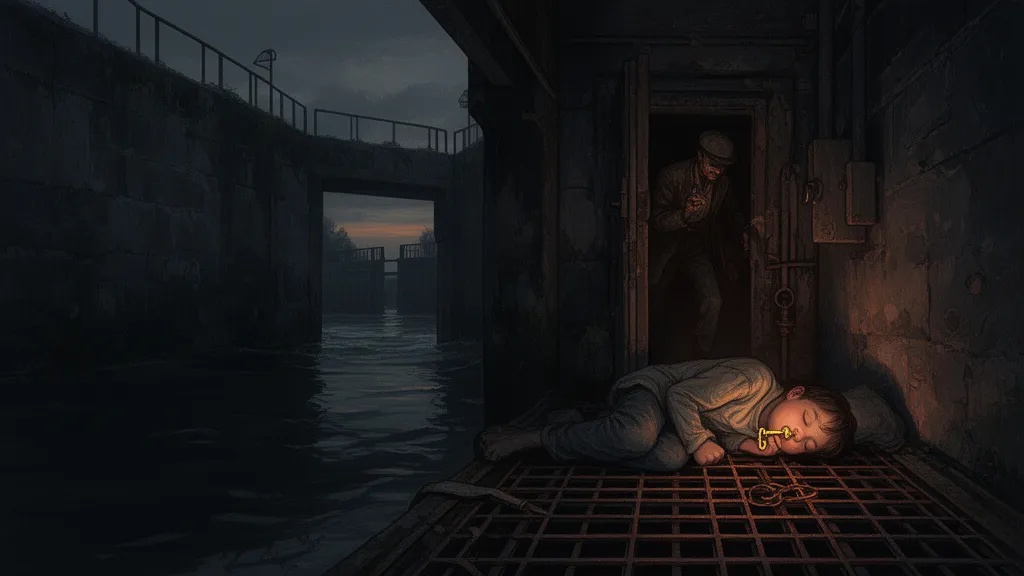
The child was asleep in the sluice chamber when Garrick came down at dusk to check the gates, which meant she had been there since at least the afternoon, when the water level began its slow climb toward the evening threshold. Her hair spread across the iron grating like riverweed, still wet, darker at the roots where the dampness had not yet surrendered to air. Between her teeth: a gold key, clenched so tightly he could see the metal had left impressions in her lips.
He did not touch her immediately. The sluice was a place of careful equilibrium—three gates holding back three levels of pressure, and the town below dependent on all three staying closed until the proper intervals. He had been keeper for eleven years, which was long enough to know that anything found in the chamber was there because the water had brought it, and the water did not bring things without intention.
The girl was perhaps eight, perhaps ten. Her dress had once been blue. Her feet were bare and marked with the pale crescents of old scars, the kind that came from walking places that did not want walking. Around her left wrist, a cord of braided grass, still green.
Garrick knelt. Listened to her breathing. It was steady, untroubled, the breath of someone who had chosen to sleep rather than been forced into it. When he reached for the key, her jaw tightened, and he withdrew his hand.
Above him, through the grating, the sky had gone the colour of tarnished silver. The evening bell would ring soon in the upper town, and after that the night watch would begin their rounds, and someone would notice the unusual stillness in the keeper's lantern, the way it had stopped moving through its usual sequence. He would need to explain why he had not yet opened the upstream gate for the midnight release.
He stood. Climbed the iron ladder to the control platform. The upstream gate was a wheel of black iron, its spokes worn smooth by a century of hands that had turned it at the appointed hours. He grasped it. Began to turn.
The mechanism groaned. The gate rose. Water rushed into the chamber below, dividing itself across the three channels that would carry it down into the lower basin, the place where the town's runoff gathered before spilling into the valley river. Garrick watched the levels. They should have been rising predictably, reaching the first marker within two minutes, the second within five.
They rose instead around his own knees.
He looked down. The water was coming up through the platform grating, cold and fast, smelling of iron and something older. Not flowing past. Rising. He released the wheel. The water continued. He could see, through the flood spreading across the platform, the girl below still sleeping, still dry, the space around her untouched as though the water recognized a boundary it would not cross.
Garrick descended. The water followed him down the ladder, arriving at each rung just as his boot left it, patient and unhurried. When he reached the chamber floor, it stopped at his shins and went no further.
The girl's eyes opened.
They were grey, the grey of deep water in winter, and she looked at him with the clarity of someone who had been awake the entire time and had simply not seen a reason to prove it. She sat up. Removed the key from between her teeth. Held it out to him.
"The lower lock," she said. Her voice had not yet broken into the uncertainties of youth; it was whole, rounded, certain of itself. "It's been waiting."
Garrick did not take the key. "There is no lower lock."
"There is." She rose. The water did not touch her. It parted slightly, making room. "You've walked past it every day for eleven years. You simply believed it was part of the wall."
She moved to the far corner of the chamber, where the stone met the floor in a join that Garrick had inspected, swept, occasionally scrubbed clean of moss. She knelt. Pressed her palm flat against a block he had touched a thousand times. The stone shifted.
Behind it: a keyhole, narrow and deep, its edges green with verdigris.
"What's it holding back?" Garrick asked.
The girl looked at him. "The basin isn't a basin. It's a throat. Something has been swallowing the town's grief for a very long time, and it's nearly full."
Garrick had lived in the lower quarter before becoming keeper, which meant he understood what lived in the runoff: the tears from the hospital, the wash-water from the mortuary, the rain that fell during funerals. Eleven years of it, and a century before that. All of it gathering in the dark below.
"If I open it—"
"It floods the lower quarter. The water comes up fast. Some will have time to climb. Some will not."
"If I keep it sealed—"
"The wall cracks. The whole thing comes through at once, not as water but as what it has become. Grief does not stay grief when you give it nowhere to go. It curdles. It grows intent."
The water around Garrick's legs had begun to hum, a low vibration that climbed through his bones. He could feel, beneath the platform, something shifting. Not moving toward them. Simply noticing they were there.
"Who are you?" he asked.
"I was born in the basin," the girl said. "Eleven years ago. My mother tried to drown herself in the runoff after my father died. She didn't know the water had stopped accepting grief. It gave her back to herself, and me with her. I've been swimming in it ever since. Growing. Learning its shape." She held out the key again. "It sent me up to find you. To give you the choice. It thinks you'll make the right one."
"What's the right one?"
"I don't know. I'm only the messenger."
Garrick took the key. It was heavier than gold should be, and warm, as though it had been held in a fist for a very long time. He walked to the keyhole. Knelt. The metal slid in smoothly, without resistance, and he understood immediately that this lock had been built to be opened, that someone had placed it here knowing that eventually the chamber would fill, the throat would gag, and a keeper would have to choose.
He thought of the lower quarter. The pottery studios in the old mill. The school where his daughter taught numbers to children who still believed numbers were a kind of magic. The bakery that opened before dawn, flooding the streets with warmth.
He thought of the wall cracking. Of what grief became when it turned.
He turned the key.
The lock released with a sound like an indrawn breath. Below, something vast exhaled. The water around his legs surged, reversed, began to drain toward the keyhole, pulling itself down into a passage he could not see. It moved quickly, purposefully, and the girl moved with it, stepping into the current as though it were a path she had always meant to walk.
"Wait," Garrick said.
"I was always going back," she said. "I only came up to deliver the key. But thank you. For opening it. For letting it go somewhere else."
"Where?"
"Where grief goes when you finally release it. Somewhere old. Somewhere that remembers what to do with sorrow."
She smiled at him once—brief, genuine, a child's smile unmarked by the weight she carried—and then the current took her, and she slipped through the keyhole as though it were a door wide enough for entire futures, and the water followed her down.
By dawn the chamber was dry, the keyhole sealed again behind its stone, and the upstream gate turned smoothly in Garrick's hands. He released the midnight surge six hours late. It flowed clear and cold into the basin, which received it without complaint, without hunger.
In the lower quarter, the pottery kilns burned steady. The children filed into school. The bakery sent its warmth into the streets, and Garrick, climbing the hill to his cottage, found his daughter waiting at the door with bread still hot in her hands and a question on her face about why he looked so tired.
He told her he had been up all night with the gates, which was true, and that everything was fine now, which was also true, and she believed him because the water still ran clear in the morning tap, and the town below continued its ordinary work of being alive.
He kept the key. He did not know why. It sat on his mantel, gold and heavy, and sometimes when he looked at it he thought he could taste copper, faint and lingering, as though he had held it between his own teeth and waited for someone to come ask him what he was keeping locked.