The Lantern That Was Not Yet Morning
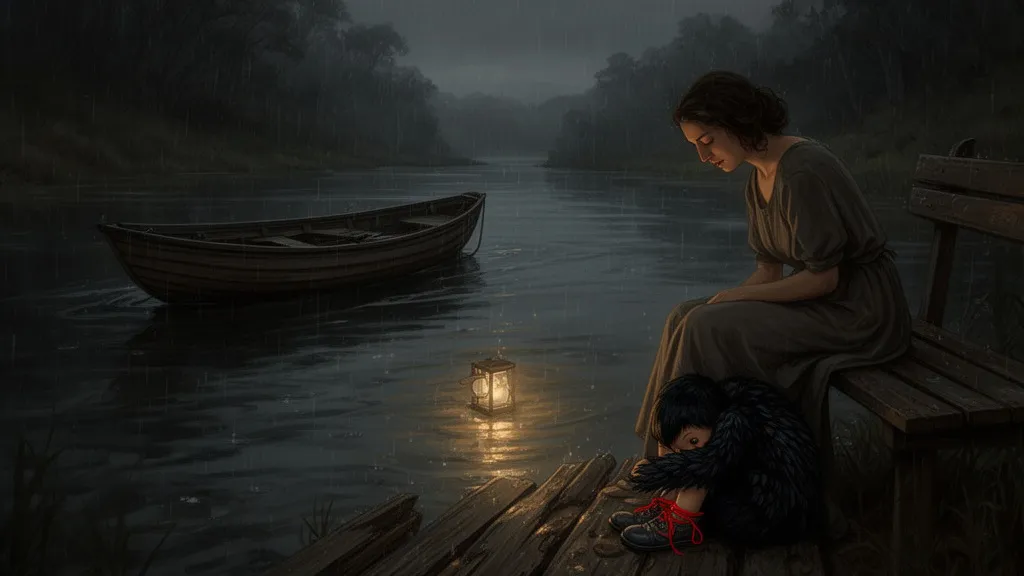
The rain had been falling for three days when Mirelle found the child beneath the bench of her skiff, which meant something had given up waiting for better weather.
The child was small and black-feathered, curled like a question mark against the wet boards. One shoe was full of river mud. The other had been tied shut with red thread, knotted three times in the style of binding charms, which was either very careful or very afraid.
Mirelle set down her oar. "You're not a stowaway," she said, because stowaways hid badly on purpose, wanting to be found before the open water. "You've been sent."
The child opened eyes that were too old for the small face they occupied. Lifted one thin arm. In the palm: a lantern no bigger than a plum, black iron worked with patterns that hurt to look at directly. The glass panels were fogged, but light leaked through the seams—thin, gold, persistent.
"The hill shrine," Mirelle said.
The child nodded once.
"And it goes to the far bank. Unopened."
Another nod. The child's hand trembled slightly, as though the lantern weighed more than flesh should be able to hold.
Mirelle looked at the sky, which was the color of wet slate and had no opinion to offer. The river was high and rising. The far bank was six hours away if the current held steady, eight if it turned contrary. The lantern leaked its gold light in a slow, patient pulse.
"All right," she said. "We go now."
The river had been old when the first ferries crossed it, and it remembered every crossing, which made it conversational in the way of things that have outlasted argument. Mirelle knew its moods the way she knew the ache in her wrists that meant rain, the way she knew her daughter's face though her daughter had been twenty years drowned.
The child sat very still in the bow, the lantern cradled against a chest that barely rose and fell. The black feathers were not decorative—they grew from the scalp in place of hair, soft and slick with rain. A hill-born child, then. A walker between. The kind the shrine kept and the valley did not speak of.
Mirelle pulled at the oars. The current took them, bore them forward. The rain made soft sounds against the water.
"Does it have a name?" she asked. "The thing inside."
The child's eyes flicked toward her, then away. A small shake of the head.
"Does it have a purpose?"
The child's mouth opened. Closed. Opened again. The voice, when it came, was barely a whisper beneath the rain. "It is not yet morning."
Mirelle frowned. "It's past dawn. Has been for hours."
"Not yet morning," the child repeated, and the trembling in the small hands grew worse.
The lantern pulsed. The light leaked brighter through the seams, gold turning to amber, amber edging toward something that might be white.
Mirelle pulled harder at the oars.
By noon the floodwater had reached the miller's field, which meant the landing at Crow's Bend would be underwater and she would have to try for the stone dock at Thresh.
The child had not moved. Had not spoken again. The lantern sat in those thin palms like a heartbeat made visible, light pooling and fading, pooling and fading.
Mirelle's wrists ached. The river was colder than it should be, even with three days' rain. Something was coming up from the deep places, the old channels where the current remembered shapes it had worn away centuries ago.
She thought of her daughter, who had drowned in summer when the river was low and placid. Who had gone under reaching for a reed-bundle toy and had not come up.
The river had kept her for three days before giving her back.
When Mirelle pulled her from the shallows, the small body had been wrapped in riverweed, and the eyes had been open, and in them had been a light very like the light leaking from the lantern now.
She pulled at the oars. The skiff moved forward. The rain continued.
The crowd had gathered at Thresh landing by the time Mirelle brought the skiff against the stone, which meant someone had seen them coming and word had spread in the way of small villages with long memories.
They did not call out. Did not rush forward. They stood in a half-circle on the dock, rain-soaked and silent, and their eyes were on the child and the lantern and the light that now shone steady through every seam, turning the rain to gold where it fell.
"The far bank," Mirelle said, shipping the oars. "That's where it goes."
An old woman at the front of the crowd shook her head. The movement was slow, deliberate. "The far bank is four hours yet, and the light is waking. You can see it. We can all see it."
"The shrine sent it sealed."
"The shrine," the old woman said, "is on the hill and has forgotten what the valley knows."
The child made a small sound, barely audible. The lantern pulsed, and the light that leaked from it painted shadows on the dock that were not the shadows of anything present.
Mirelle looked at the crowd. At the old woman. At the sky, which was darkening though it was only just past noon.
"What does the valley know?" she asked.
"That morning came once before," the old woman said. "Eighty years ago. That it came in a lantern like that one, carried by a child like that. That when it was opened, the river remembered it was older than drowning."
The crowd shifted. Someone murmured. Someone else made a sign against ill-fortune.
"And?" Mirelle said.
"And we had a year without flood. Without winter-fever. Without stillbirths." The old woman's eyes were steady. "The river was kind, for a year. Then it forgot again."
Mirelle looked at the child. At the thin hands that shook with effort, with exhaustion. At the small face that held too much age and too much sorrow.
"The shrine said it must reach the far bank," she said.
"The shrine," the old woman said, "does not bury children."
The rain fell. The lantern pulsed. The light leaked brighter, and now there were shapes moving in it, fish-silver and old.
Mirelle thought of her daughter wrapped in riverweed. Of eyes that had held light. Of twenty years carrying the river back and forth, back and forth, never losing another passenger, never letting the current take what it reached for.
"If I open it here," she said slowly, "what happens to the child?"
The old woman's face softened. "The child goes back to the hill. The light goes into the water. The bargain is kept, just differently."
"And if I take it to the far bank?"
The old woman said nothing. Did not need to. The answer was in the trembling hands, in the light that was now leaking in streams, in the small chest that barely rose and fell.
Mirelle looked at the river. At the water that had taken and given back. At the current that remembered everything.
She reached out. The child flinched, then stilled. Mirelle's hand closed over the small ones, over the lantern that burned like a sun trying to be born.
"What's your name?" she asked.
The child's mouth shaped a word. No sound came out, but Mirelle read it on the small lips: Wren.
"Wren," Mirelle said. "I'm going to help."
She found the latch. It was warm under her fingers. The child's eyes went wide.
"It is not yet morning," Wren whispered.
"I know," Mirelle said. And opened the lantern.
The light that poured out was not gold but white, white like snow that has never been touched, like the space between stars. It flooded the dock and the river and the rain-dark sky. It painted everything clean.
The river rose to meet it.
Not in flood, but in greeting. The water lifted in a column, in a shape that was almost human, almost something that might once have been a woman with riverweed hair and eyes full of old light. It bent toward the lantern, toward the light, toward the small child who held the empty iron frame and wept.
The light sank into the water. The water held it, turned it, wove it through the current like thread through cloth.
When it faded, the river was the same as it had always been. But it was also different, in a way that had no name.
Wren collapsed against Mirelle's shoulder. The child was breathing. The black feathers were slick with rain. The red thread on the shoe had come undone.
The old woman stepped forward. Touched Mirelle's arm. "The year is bought," she said. "But different this time. The river will remember what you chose."
Mirelle looked down at the child sleeping against her chest. At the empty lantern, still warm. At the river, which moved past the dock as it always had, patient and old and very nearly kind.
"Yes," she said. "I think it will."
She took Wren back to the cottage on the hill above the far bank, which was where the shrine had meant the child to go anyway, just by a longer road.
The rain stopped at sunset. By morning, the river had dropped to its usual height.
And for a year—though the valley would not know it was a year until the year had passed—the river was gentle. It gave up its drowned quickly. It did not flood. It remembered, the way very old things sometimes do, that it had once been grateful.