The Mill That Remembers Water
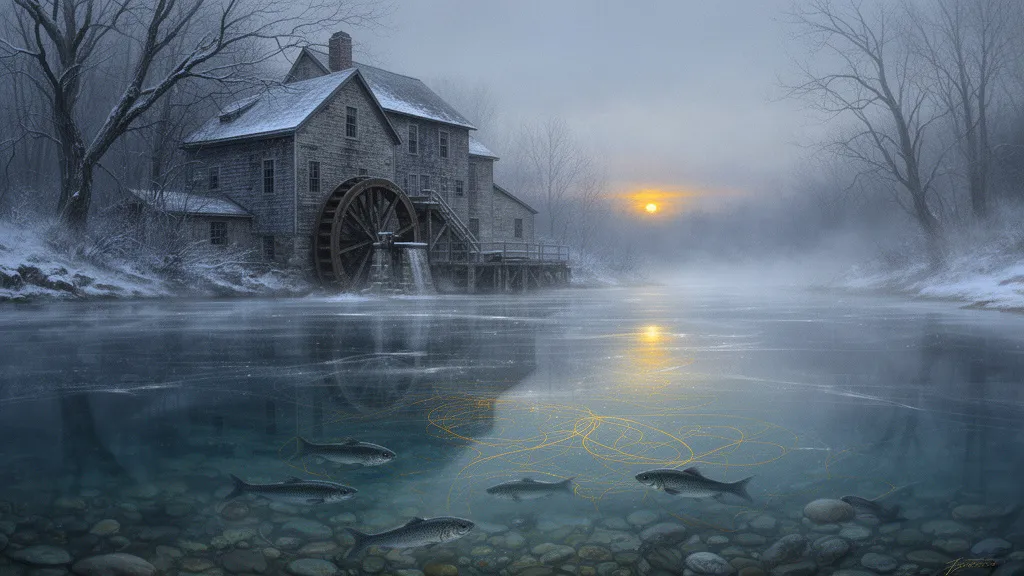
The river had forgotten how to flow.
Gareth woke to the absence of sound — the wheel silent, the rush gone quiet — and knew before he reached the window that something had changed its mind about being a river. Dawn had not yet broken, but the millpond lay flat and clear as winter glass, and through it he could see each stone on the bed, each weed standing still as though the world had stopped mid-breath.
The fish were there. All of them. Lying on their sides in neat rows like the dead laid out for viewing, and around each pair of gills, impossibly fine, a thread of gold.
He dressed without thinking, his hands remembering the motions while his mind caught on the edges of what he was seeing. The gold was not paint. It was not light playing tricks through water that had no business being this clear, this still. It was threaded through the flesh, the way his wife used to embroider her marriage cloth, pulling the needle through linen until the pattern emerged from what had been blank.
His wife, who had walked into the millstone room seven years ago and never walked out.
Outside, the air tasted of silt and old promises. The wheel hung motionless, dripping nothing. Gareth walked to the edge of the pond and knelt, reaching one hand toward the water that was not moving, had perhaps stopped being water entirely and become something else, some cousin substance that only looked the same.
His fingers touched the surface.
It was cold. It was glass. It was the river holding its breath and waiting for someone to speak the word that would let it exhale.
He pulled his hand back.
By midday the pond had dropped a foot. Not flowed away — simply lowered, as though something beneath were drinking it down in careful, measured swallows. The fish remained where they were, their gold threads gleaming brighter as the water thinned above them. Gareth stood in the doorway of the mill and watched the far bank emerge, mudflats appearing like old skin sloughed off to reveal what had always been underneath.
That was when he saw the child.
Barefoot on the stones, standing exactly where the current should have been strongest, where seven years ago Gareth's daughter had slipped from the bank and been pulled under before he could reach her. The child was perhaps eight years old, or perhaps older — the light was uncertain, and children grew at rates the river did not always respect.
Mud crusted their ankles in fine cracks, drying in patterns that looked almost deliberate. Their hair hung wet and dark, but their clothes were dry, and this bothered Gareth more than anything else, more than the clear water or the golden fish or the wheel that would not turn.
"Da," the child said, and their voice carried across the emptying pond without echo. "I need the key."
Gareth's daughter had called him Da. Most children in the village used Father or Papa, but Maren had liked the shape of the single syllable, the way it sat in her mouth like a smooth stone.
"The key," he said, and his voice sounded strange in his own ears, flattened by the absence of moving water.
"To the millstone room." The child tilted their head, and for a moment the light caught their face at an angle that was Maren's exactly, the way she used to look at him when he was being deliberately obtuse about something she considered obvious. "Before the water rises again."
"The water's falling," Gareth said.
"Yes," the child agreed. "That's why it will rise."
The logic of this was river logic, and Gareth had lived beside rivers long enough to know that river logic and human logic were related but not identical, like cousins who had stopped speaking after an inheritance dispute.
He turned and walked back into the mill.
The key hung where it had always hung, on a nail beside the upper grinding floor, next to the lever that controlled the sluice gate. He had not touched it in seven years. Neither, to his knowledge, had anyone else. The door to the millstone room opened from inside, if you knew how to work the catch — his wife had shown him once, early in their marriage, when the mill was still new to both of them and they were still discovering what they had inherited along with the deed and the waterwheel.
"It's for emergencies," she had said. "When the river remembers something important."
He had asked what kind of emergencies. She had only smiled and touched his cheek with flour-dusty fingers and said that rivers had long memories and mills were built to turn those memories into something useful, usually bread.
Gareth took the key from its nail. It was heavier than he remembered, or perhaps his hand had grown lighter in the years of not holding it. The iron was dark with rust that had somehow patterned itself into designs — whorls and spirals that looked almost intentional, almost like writing in a script he had never learned to read.
When he emerged, the child was standing on his side of the riverbed, still barefoot, still dry except for their hair. The mud on their ankles had dried completely now, flaking off in small pieces that fell to the stones and vanished before they landed.
"You'll want to hurry," the child said. Not unkindly. Simply stating a fact about time and water and the nature of things that had been waiting.
Gareth led them through the mill, past the grinding stones that had not turned since the wheel stopped, past the sacks of grain that were beginning to smell of damp and stillness. The door to the millstone room stood at the back, behind the main shaft, set so low in the wall that you had to stoop to reach it. He had never understood why it was built that way — why you would construct a door you had to approach on your knees.
Now, kneeling with the key in his hand and the child standing silent behind him, he thought perhaps he understood.
The lock turned easily. The door swung inward on hinges that did not squeak, opening onto darkness that smelled of river clay and something else, something older — the scent of deep water that had been still so long it had learned to think.
"She's been waiting," the child said quietly. "It was kind of her to wait this long."
Gareth did not ask who. He knew. The river knew. The mill had always known, in the way that mills know things — through the constant turning of wheel against water, stone against grain, the slow translation of motion into stillness, of something into something else.
He stepped through the doorway.
The millstone room was larger than it should have been, larger than the mill itself, opening downward into depths the building did not possess. Water pooled at the bottom of a long slope, perfectly still, perfectly clear, and in the center of the pool his wife stood with her hands full of golden thread.
She had not aged. She had not changed. She stood exactly as she had stood seven years ago when she kissed his forehead and told him she would be back before supper, and then walked through this door and closed it behind her.
"The river was forgetting how to turn the wheel," she said, as though they were continuing a conversation from minutes ago rather than years. "Someone had to remind it."
Gareth descended the slope. His boots found purchase on stone that felt older than the mill, older than the village, possibly older than the idea of grinding grain into flour. The child followed, their bare feet silent, their breathing the only sound in the vast space that was somehow contained within the mill's back wall.
"And now?" he asked.
His wife looked down at the thread in her hands. It was the same gold as the thread around the fishes' gills, spun fine as spiderweb, strong as cable. She had been weaving it into something — a net, perhaps, or a pattern whose purpose he could not yet see.
"Now," she said, "it needs to forget again. Just for a little while. Just long enough." She looked up, and her eyes were the color of deep water, and fond. "The river has been very patient. I promised it something in exchange. I promised it you would open the door when the time came."
"The child—" Gareth began.
"Is the river's way of knocking," his wife finished. "Rivers aren't good at doors. They prefer to wear them away over centuries. This was faster."
She held out the golden thread.
Gareth took it. It was warm in his hands, warmer than metal should be, pulsing gently like a living thing. He understood, suddenly, what the thread was for. What the room was for. What his wife had been doing all this time, standing in the still water beneath the mill, weaving the river's memory into something it could carry forward without drowning in what it had been.
Behind him, the child who was and was not his daughter made a small sound — not quite a sigh, not quite the first note of moving water finding its way back to song.
"The wheelhouse," his wife said. "Thread it through the main shaft. The river will remember how to flow. I'll remember how to come home. And you—" she touched his face, her hand as real as bread, as solid as stone, "—you'll remember how to let things turn again."
Gareth climbed back up the slope with the golden thread wound around his palms. The child waited at the top, and together they walked through the mill to where the great shaft stood silent. He unwound the thread carefully, passing it around the wood in a pattern his hands seemed to know without being told, a spiral that caught the last of the afternoon light and turned it into something the wheel would recognize as permission.
When the last length was tied off, the child smiled — Maren's smile, but older, belonging now to the river that had borrowed it — and stepped backward through the doorway to the millstone room.
The door closed.
The wheel began to turn.
The river rose, and flowed, and forgot it had ever been glass, and the fish swam upstream with their golden threads gleaming, and by evening his wife was standing in the kitchen, flour on her hands, asking what he wanted for supper as though she had only been gone long enough to check the grain stores.
Gareth hung the key back on its nail.
Outside, the wheel turned, and turned, and turned, grinding memory into bread, and silence into the sound of water that had remembered, briefly, what it meant to be still.