The Ring That Spoke Through Rising Water
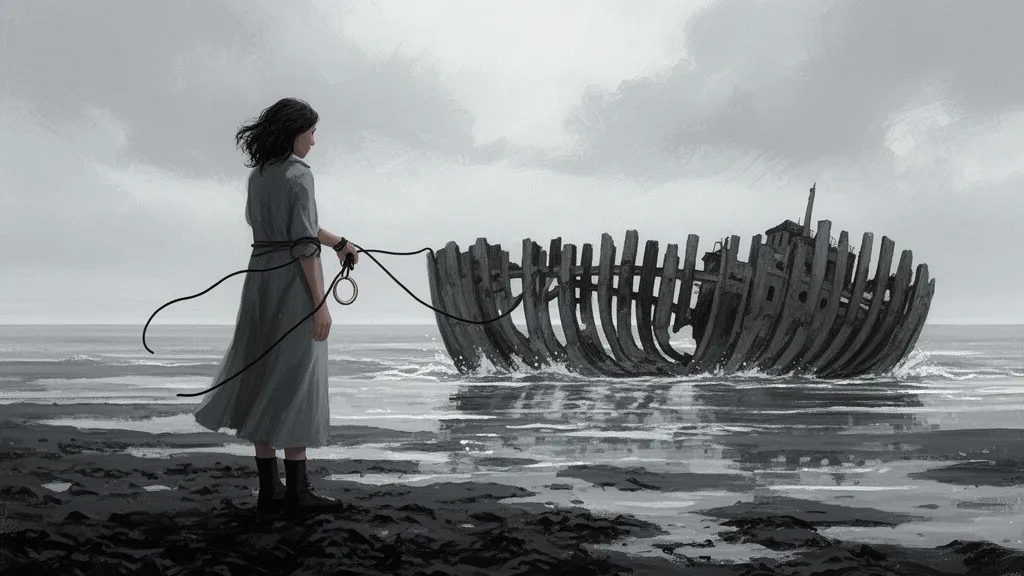
The woman arrived on the mudflats during the two-hour window when the river permitted crossing, which made her either desperate or well-informed. Kieran noticed the black thread first—a length of it wound seven times around her left wrist, the wedding ring hanging from it like a caught fish on a line.
She stood where the exposed ribs of the Millicent broke the surface, a fishing trawler that had gone down in the storm of '87 and never quite let go of the world. Her shoes were expensive and ruined. Her coat had been white once.
"I need passage," she said when he was close enough to hear her over the hiss of retreating water. "Not across. Back."
Kieran had been ferrying for eleven years, long enough to recognize the particular grammar of people who had come to return something. The river accumulated debts the way other places accumulated silt. This was how they were paid.
"The tide turns in seventy minutes," he said, which was his standard answer to unreasonable requests. "If you're not on this side of the bank by then, you'll be swimming."
"The ring," she said, and held up her wrist so the gold caught what remained of the afternoon light. "You carried the man who wore it. Three years ago, October, during the rain that wouldn't stop. He was already dead when you took him across."
Kieran remembered. Of course he remembered. The dead man had been heavy in a way that had nothing to do with weight, and the rain had fallen so hard it had erased the far shore until Kieran wasn't entirely certain he'd been rowing toward anything at all. The man's hands had been folded across his chest, and there had been a pale line around his ring finger where something had recently been removed.
"He didn't have a ring," Kieran said.
"No." The woman's voice was very steady. "I kept it. I thought—" She stopped, then started again with the blunt honesty of someone who had run out of better options. "I thought if I kept it, he wouldn't be entirely gone. But the river has been asking for it. Every night for six months, at low tide, when the bones of wrecked things show through. It asks in his voice."
The river made a sound then, a long exhalation against the mud, and Kieran heard beneath it something that might have been syllables. The woman heard it too. Her face went very still.
"It doesn't work like that," Kieran said, though he wasn't entirely certain what it was, or whether his certainty mattered to a river that had been asking questions in a dead man's voice. "The crossing only goes one direction. I can't take things back to the already-gone."
"You can," she said. "The dead man told me. Through the water. He said you were the only one who could, because you were the last living person to touch him before he arrived wherever the dead go. You're still—" She hesitated, searching for the word. "Connected."
Kieran looked at the ring. It was simple gold, worn thin on one side from years of being turned by an absent-minded thumb. The black thread was silk, he thought, or something older. It gleamed with a faint iridescence that had nothing to do with the failing light.
"Why the thread?" he asked.
"So I wouldn't lose it," she said. "So I'd feel the weight of keeping it."
The water was sliding back now, the tide turning earlier than it should have been. Kieran had lived by the river long enough to know its rhythms with the blind accuracy of a heart knowing its own pulse, and this was wrong. The lanterns on his dock—three of them, iron and glass, older than his tenure—were still twenty feet above the waterline. They should have stayed dry for another hour.
They would be underwater in minutes.
"The river is listening," the woman said quietly. "It's been listening since I arrived. I think it's been waiting."
Kieran wanted to tell her that rivers didn't wait, that they were the opposite of waiting, that they were the physical embodiment of relentless forward motion and eventual arrival. But he had carried the dead man through rain that had felt like a threshold, and when he'd reached the far shore—the real far shore, the one he couldn't see from the living side—he had helped lift the body onto the stone landing and had felt, just for a moment, the impression of enormous attention turning briefly toward him like a whale surfacing beneath a small boat.
The river had noticed him then. He had been trying to be unnoticeable ever since.
"If I take it," he said slowly, "where does it go?"
"Back to him." The woman was already unwinding the thread from her wrist, her fingers sure despite their shaking. "To wherever he is. You'll know the place. The thread will show you."
"I don't want to know the place," Kieran said, but he was already holding out his hand, because the water was climbing the legs of his dock and the lanterns were beginning to sway in a wind that had not been blowing a moment ago.
The ring was warm when she placed it in his palm. The thread trailed from it like a leash, black and gleaming and longer than it should have been. It didn't end. It simply continued past the edge of his vision into a direction that had nothing to do with the cardinal points he knew.
"Follow it at low tide," the woman said. "Row until you can't see the living shore. Then call his name—Thomas Harrow—and give the ring to whatever answers."
The water reached the first lantern. The flame inside didn't gutter. It simply changed color, from warm yellow to something pale and green, the light that phosphorescent fish carry in the deepest trenches.
"What happens to you?" Kieran asked.
"I go home," she said. "I've been carrying a dead man's ring for three years. I'd like to stop."
She turned and walked back toward the road, her ruined shoes leaving prints in the mud that filled immediately with water. The tide was rising faster now, enthusiastic, as though it had been given permission to remember something it had temporarily forgotten.
Kieran stood on the mudflats with the ring growing warmer in his hand and the thread unwinding from it like a path, like an obligation, like the first line of a story the river had been trying to tell him since the night he'd rowed a dead man through rain that wouldn't stop.
The second lantern changed color.
The thread tugged gently at his palm, patient as a river that had been flowing since before the first boats learned how to sink.
Kieran looked at his ferry, small and wooden and mortal, tied to a dock that would be underwater in minutes. He looked at the thread, black and gleaming and impossible to ignore. He thought about Thomas Harrow, heavy in the rain, his hands folded across his chest and a pale line around his finger where something beloved had been removed.
The river made a sound that was almost words.
Kieran had been a ferryman for eleven years. He knew how to row toward things he couldn't see. He knew how to trust the current when the shore disappeared. He knew, with the particular knowledge that came from living in the thin places between land and water, that some debts accumulated interest until they drowned you, and the only way to survive was to pay them before the tide turned.
He put the ring in his pocket. The thread followed it, warm against his hip.
"All right," he said to the river, to the dead man, to the woman walking away with lighter wrists. "All right."
The third lantern changed color.
The tide kept rising.
Kieran began preparing his ferry for a crossing that would happen at low tide, in the small hours when the river showed its bones and the dead made requests of the living, because he had been noticed once and there was no unnoticing, there was only the choice of what to do with the attention.
The ring was very warm now.
The thread showed him, faintly, the shape of a shore he had seen once before.
He would row toward it when the water remembered how to fall.