The Shadow That Wore Your Coat
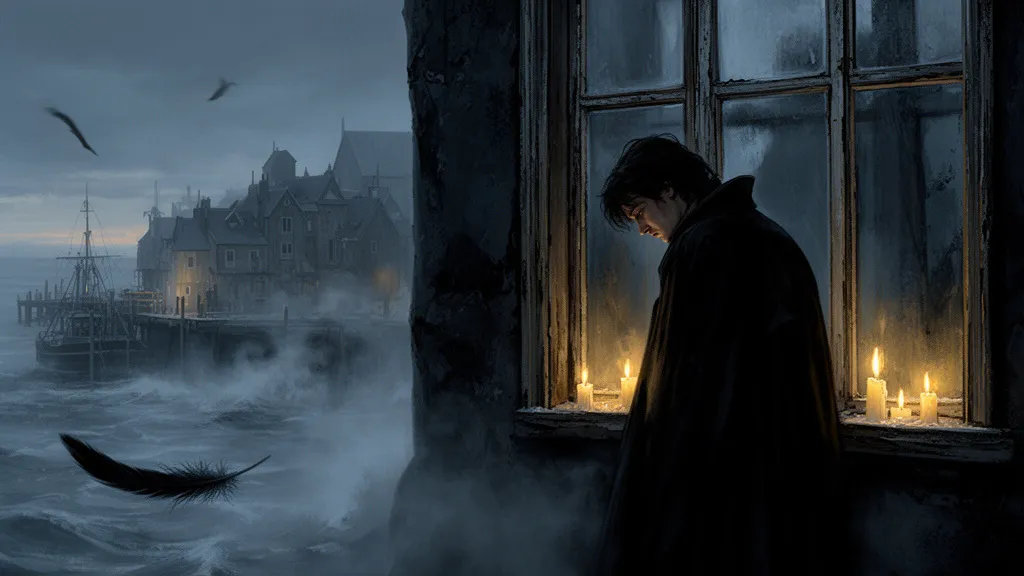
The candles began appearing on the sill three days after the funeral, which meant something had taken notice of the gap Thomas left behind.
You found the first one at dawn, half-melted, its wax pooled around a blackened wick. The second came with the evening tide, accompanied by a single feather so dark it seemed to swallow the lamplight. By the fourth morning, you stopped asking yourself how they arrived. The question had become why, and that was a question the town—salt-stiff and tight-lipped as driftwood—would not help you answer.
Mrs. Hallam, who sold fish at the harbour and knew every boat that left and returned, said only: "The sea gives back what it wants, when it wants." Then she wrapped your mackerel in yesterday's newspaper and would not meet your eyes.
The candles accumulated. You tried moving them to the kitchen table, but each morning they reappeared on the sill, drawn back by some tide you could not see. The feathers multiplied. You swept them into a jar and screwed the lid tight, but the next day there were more, arranged in a line along the windowsill like footprints.
On the seventh night, you stayed awake and watched.
The fog came first, rolling off the water in great pale banks that swallowed the streetlamps and the groyne and the fishing boats one by one. Then, moving through it with the slow inevitability of kelp dragged by current, you saw the shape.
It wore your old raincoat—the green one you had given Thomas because his own had torn and you preferred staying indoors anyway. The coat moved like something inhabited, but the figure inside it cast no reflection in the window glass. Where its face should have been, there was only a deeper grey, a absence that hurt to look at directly.
It placed a candle on the sill. Then a feather. Then it turned and walked back toward the water, and you understood with a cold clarity that shocked you into motion: Thomas had drowned, but his shadow had not.
You were at the door before you knew you had decided. The night air tasted of salt and rot and something older—the smell of things that live in the spaces between tide pools, that have never been entirely alive or dead. Your boots left prints in the wet sand, but when you looked back, the shadow's did not.
It moved ahead of you, always just visible through the fog, the green coat sodden and heavy with seawater that never quite dripped free. You followed it past the groyne, past the rocks where the fishermen's children were forbidden to play, past the boundary where the town's concern ended and the sea's indifference began.
The shoreline changed. The sand became softer, less certain. Your feet sank deeper with each step, and you realized the tide was not merely out—it had withdrawn, pulling back to expose a stretch of beach that should not exist, that the sea had kept hidden beneath itself for as long as anyone remembered.
The shadow stopped.
Ahead, sitting cross-legged on a barnacle-encrusted timber that might once have been a mast, was a child.
She could not have been more than seven. Her dress hung in tatters, grey as fog, and her hair was plastered to her skull in dark ribbons. Water ran from her sleeves in steady streams, but she did not shiver. She did not blink. She watched you approach with eyes that were too still, too old, eyes that had seen the bottom of something and chosen to return anyway.
Around her neck, on a leather cord gone green with algae, hung Thomas's wedding ring.
"He said you would come," the child said. Her voice was small and clear, a pebble dropped into deep water. "He said you always found what you were looking for, even when you should leave it lost."
You opened your mouth, but the words tangled. The shadow stood beside the child now, one hand—or the space where a hand should be—resting on her shoulder. The gesture was protective. Familiar.
"Who are you?" you managed.
The child tilted her head. "I was someone's daughter once. Then I went looking for shells too far from shore, and the current took me, and now I am something the tide brings back but cannot keep." She held up the ring. It caught the moonlight, spinning slowly. "He gave me this so I would not forget. So I could find my way when the church bell rings."
"When the bell—" You stopped. The church bell only rang at noon and dusk, marking the day's boundaries. "It doesn't ring at other times."
"It will," the child said. "Tomorrow. When the sun is high. The priest does not know why, but the bell knows. It always knows when someone is ready to cross."
The shadow moved. It reached toward you, and for a moment you thought you saw Thomas in the gesture—the way he used to touch your hand before saying something difficult, grounding himself in your certainty when his own failed him.
"He cannot come back," the child said. "His shadow can walk, but the sea has his weight, his warmth, everything that made him loud enough for the world to hear. It kept these things because he gave them freely."
"Gave them?" Your throat hurt. "He drowned. It was an accident."
The child's expression did not change. "He saw me in the water. He went in to pull me out, even though I had been there three years and was already something else. The sea was angry that he tried, so it kept him. But it let his shadow go, because shadows cannot be drowned, and it thought this was mercy."
The ring spun on its cord, glinting.
"You can take it back," the child said. "Call his shadow home. It will stay with you. Not alive, not him, but close enough that you might forget the difference on the very darkest nights. Or—" She stopped spinning the ring. "Or you can let me keep it. When the bell rings tomorrow, I will cross. His shadow will cross with me. Neither of us will be caught between anymore."
Somewhere behind you, the fog was beginning to thin. The tide would turn soon. The hidden beach would disappear beneath the water again, and anything left on it would be carried away or held down, the sea's choice, not yours.
You looked at the shadow. It had no face to read, no eyes to meet, but you felt its attention like a weight. Like Thomas's hand on your shoulder in the kitchen, steadying you when the news came that the boat had been found empty.
"He wanted me to have something," you said. Not a question.
The child nodded. "He wanted you to have what you needed. He was not certain which. Neither am I."
The wind shifted. Somewhere distant, across the water, you heard the first birds calling the morning in. In a few hours, the sun would rise. The town would wake. The church bell would ring at noon, and you would be standing in your kitchen or you would be standing here, and the difference would be everything or nothing, depending on what you believed shadows could carry.
You thought of the candles. The feathers. The patient, nightly visits.
You thought of Thomas, who had always given away more than he kept, who had loved with the reckless generosity of someone who did not understand that the world would one day ask for everything and accept no refusal.
You knelt in the wet sand.
"Keep it," you said. "Cross when the bell rings."
The child's expression did not change, but something in the air around her shifted—a settling, like a ship finally finding its anchor. She closed her small fist around the ring.
The shadow stepped forward. For a moment, just one, you felt something brush your cheek—cool, weightless, the memory of a touch rather than the touch itself. Then it moved past you, back toward the child, and wrapped itself around her shoulders like a coat.
Your coat. Thomas's coat. Something neither of you would need where you were going, and where she was going, and where he already was.
"Thank you," the child said.
You rose, your knees wet and aching, and turned back toward the town.
Behind you, the tide began its return. The hidden beach disappeared beneath the water, inch by inch, swallowing footprints and timber and the small figure in grey who sat waiting for a bell that would ring in daylight, calling her home to wherever drowned children and generous shadows cross when they are finally allowed to finish drowning.
By the time you reached your door, the sun was rising.
The windowsill was empty.
At noon, the church bell rang, and kept ringing, and no one in the salt-stiff town could explain why except to say that the sea gave back what it wanted, when it wanted, and sometimes what it wanted was to stop holding on.