The Shoe That Held Its Shape in Water
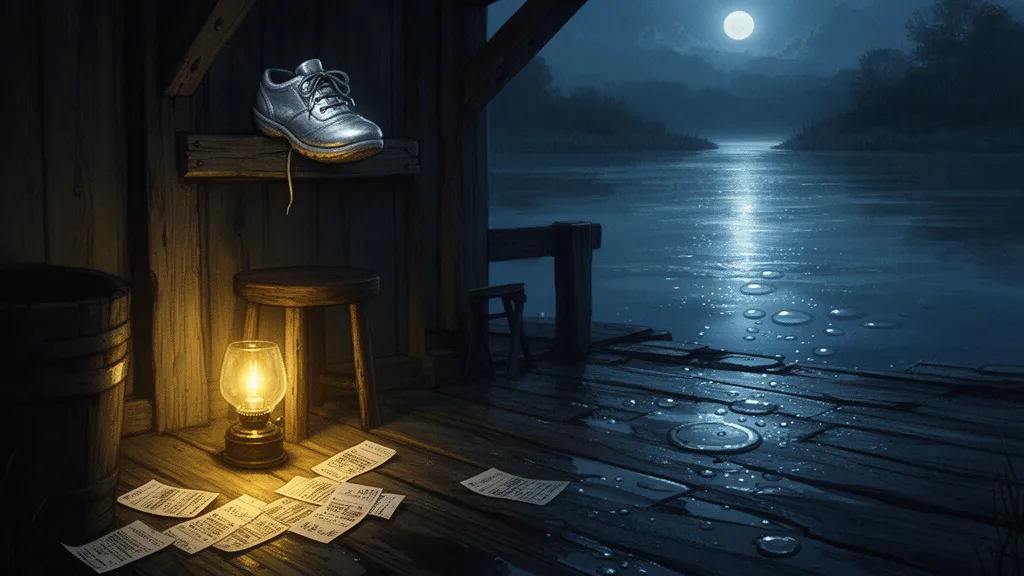
The shoe had been nailed into the corner behind the stool where Ilyssa counted evening receipts, which meant someone had entered while she was helping the last passenger cross. It was silver, child-sized, still damp enough to leave a crescent of muddy water spreading across the floorboards. The nail had been driven through the heel with considerable force—whoever had done this had not wanted it coming loose.
Ilyssa crouched and turned her lamp closer. The shoe did not behave like wet leather should. The water beaded on its surface without soaking in, and when she touched the toe, it held its shape absolutely, the way things do when they have been worn by someone who needed them to stay firm against the world.
The ferry rocked against its moorings. Outside, the harbor lamps were being lit—small yellow interruptions in the early dusk. Ilyssa had worked the ticket booth for seven years, which meant she knew what belonged in the space behind her stool and what did not. This shoe had not been here at dawn. She was certain of that with the certainty reserved for things one checks each morning without thinking: the cashbox lock, the log's first blank page, the floor's emptiness.
She worked the nail free with the pry-bar she kept for stubborn crates. The shoe came away cleanly, leaving only a small puncture in the wood. She turned it over. Inside the heel, etched in a hand too careful to be accidental, was a name: Calla Vey, Tidemark Lane.
Ilyssa knew the harbor district the way the river knew its stones—slowly, through years of patient attention—and there was no Tidemark Lane in any ledger or map she had studied.
She found the lane by asking the fishmonger who worked the stall closest to the old seawall. He was folding canvas when she approached, his hands moving with the rhythmic precision of someone who had performed this action ten thousand times and would perform it ten thousand more.
"Tidemark?" He did not look up. "You won't find it after sunset."
"I need to find it now."
"Then you'd best hurry. It keeps tide-hours, that street. Appears when the water's out, folds back when it rises. You've got maybe thirty minutes before the moon pulls it under again."
Ilyssa thanked him and walked quickly through the lower district, past the chandler's and the sailmaker's and the ropewalk that ran parallel to the pier. The rain had stopped an hour ago, but the streets still smelled of it—that particular scent of stone and old wood drinking deeply after a long thirst.
She found the lane where the fishmonger had indicated, tucked between two buildings she had passed a thousand times without noticing the gap. It was narrow, cobbled, descending at a gentle angle toward the waterline. The houses on either side were old in a way that suggested they had not so much aged as persisted—their stones bearing the smooth resignation of things that had outlasted their original purpose.
The house at the lane's end had a lamp burning in the upper window. Ilyssa knocked.
The woman who answered was younger than Ilyssa had expected, perhaps thirty, with dark hair plaited in the northern style. She looked at the shoe in Ilyssa's hands and stepped back to let her enter.
"You're the ferry clerk," the woman said. It was not a question.
"I am. This was left in my booth. The name inside led me here."
The woman nodded slowly. "She does that—leaves pieces of herself in places she thinks will keep them safe. Come upstairs. The wake is nearly ready."
Ilyssa followed her up a staircase that turned twice before opening into a room that smelled of lamp oil and rosemary and something else, something older, like rain-soaked earth that has not seen sunlight in a very long time. There was a table in the center, and on the table, arranged with considerable care, were the remnants of a child's life: a wooden horse with a cracked leg, a string of blue glass beads, a book of folk tales with water-damaged pages, and a second silver shoe, identical to the one Ilyssa carried.
There was no body.
"We keep them warm until midnight," the woman said, moving to the lamp and adjusting its flame. "That's the custom for children who drown in the harbor. You speak to them in the second person, as if they might still answer. By dawn, if the tide takes the offerings, they're considered released. If it doesn't—" She paused. "If it doesn't, they're still walking."
Ilyssa set the shoe on the table beside its twin. They matched perfectly, down to the pattern of wear on the soles. "Who was she?"
"Calla. My daughter. She went into the water three months ago, during the spring flood. They found her dress caught on the pilings near the old dock, but not her. Not the rest. The shoes washed up separately, weeks apart. I've been gathering her back, piece by piece."
The woman's voice was steady in the way of someone who has already spent all available grief and is now operating on something more fundamental—the simple, mechanical necessity of seeing a task through to its end.
Ilyssa looked at the table again. The objects were arranged in a pattern she recognized from older rituals, the kind the harbor folk practiced before the city council had decreed them obsolete and faintly embarrassing. This was a summoning. Or a sending. Or perhaps both, depending on which direction the tide was moving.
"Why my booth?" Ilyssa asked.
The woman smiled slightly. "Because you're listed. In the city's records. You exist in the official way—licensed, documented, counted. The dead need an anchor in the world of names and ledgers, or they drift too far to find their way back. She must have chosen you."
Ilyssa felt something shift in the room—not a physical movement, but a change in attention, as if the space had been waiting for someone to say this aloud and could now proceed to the next step of whatever process it had been holding in abeyance.
"If I hadn't brought the shoe—"
"Then she would have left something else. Somewhere else. Children who drown in tidal waters are persistent, and patient, and very good at finding the people who might listen."
Outside, the water was rising. Ilyssa could hear it against the foundation stones, that soft and rhythmic pressure that the city had learned to build around, the way one builds around an ancient tree whose roots have precedence.
At midnight, the woman began to speak.
She addressed the table, the objects, the empty space above them where a child might stand if children who drowned could be convinced to hold a shape the living could perceive. She spoke in the second person, as promised: You were seven when the water took you. You liked the blue beads best. You wore these shoes even when they pinched, because they made a sound on the cobbles like a secret language.
Ilyssa stood by the window and watched the harbor. The lane outside had already disappeared beneath the tide. They were, for the moment, on an island—a single house holding its position against the water's quiet insistence.
The woman spoke for twenty minutes, reciting a life in careful detail, and when she finished, she looked at Ilyssa. "You may stay or go. But if you go now, you'll need to be rowed out. The tide won't drop again until dawn."
"And if I stay?"
"Then you'll be counted among the witnesses. Which means, in the city's eyes, you'll have attended a wake for someone who was never officially found. Someone who, according to the harbor records, might still be walking."
Ilyssa understood then what the woman had meant about anchors and ledgers. To witness this was to exist in two record-systems simultaneously: the city's official accounting, which did not recognize the dead until their bodies had been confirmed and catalogued, and the older accounting, which recognized the dead the moment the water closed over them and considered their continued presence a matter of ordinary fact.
"What happens to me if I stay?"
The woman poured oil into the lamp, her hands steady. "You'll lose your place in the city's clear records. You'll become one of the threshold people—those who work the edges where the mapped world stops and the older one continues. The ferry will still run. But you'll see different passengers."
Ilyssa looked at the shoes on the table, side by side now, no longer separated by the distance between drowning and remembering. She thought about the seven years she had spent counting tickets and collecting fares and watching people cross from one shore to another, how all of that had felt like the periphery of something larger she could sense but not name.
"I'll stay," she said.
The woman nodded. She did not seem surprised.
They waited together until dawn, speaking occasionally in the second person to the space above the table, and when the light came through the window and the tide began its slow retreat, the shoes were gone. In their place was a single blue bead, sea-worn and shining.
The woman picked it up and closed her hand around it. "She's released," she said. "The water accepted the offering."
Ilyssa walked back to the ferry as the sun cleared the eastern docks. The lane had reappeared, glistening and empty, and when she reached her booth she found the nail hole in the floorboards had closed over, leaving only a slight discoloration in the wood—the kind of mark that might have been there for years, or might have appeared that morning, depending on which records you consulted and what you believed about the difference between drowning and departure.
She opened the ticket ledger. Her name was still there, but written now in a hand she did not quite recognize as her own, slightly more fluid, as if it had been traced by someone who had learned to write underwater and was still adjusting to the weight of air.
The first passenger arrived as the morning bell rang. She was old, wrapped in grey, and she paid with a coin that was damp and cold and smelled of the deep harbor.
"Across?" Ilyssa asked.
The woman nodded. "And back, eventually. That's how it works now, isn't it?"
Ilyssa marked the passage in her ledger. "Yes," she said. "That's how it works."
The ferry rocked gently against its moorings, and somewhere beneath the dark water, something small and silver caught the light and held it, the way things do when they have finally been returned to the element that made them.