The Shroud That Counted Its Own Silver
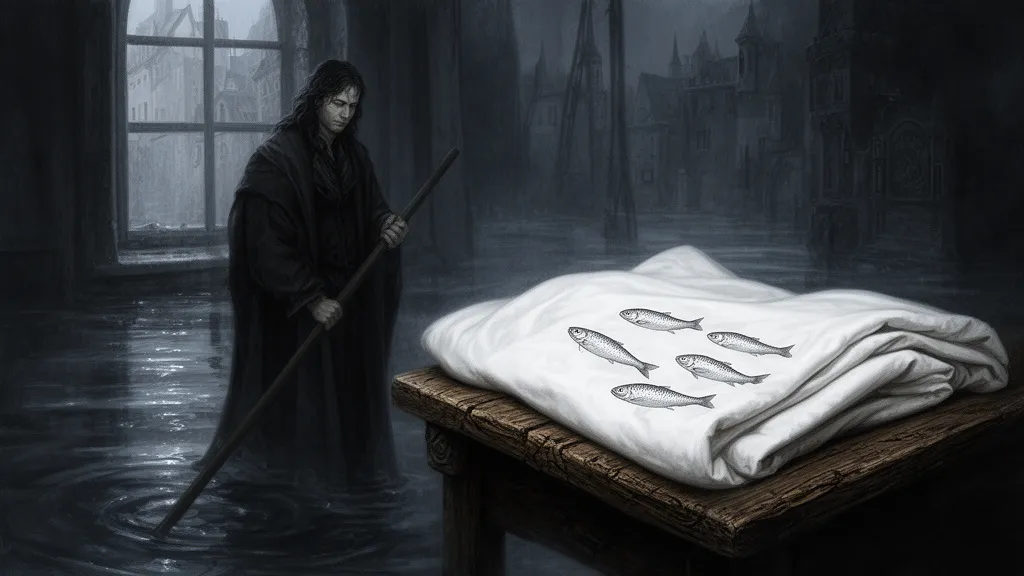
The ferryman kept his daughter's shroud in the smallest room of his house, which had once been a closet for nets and twine. He had moved them to make space for what would not move again. The shroud lay on a table of oak planks salvaged from someone else's shipwreck, wrapped in oilcloth because the city was made of water and water came through everything eventually.
Six silver fish had been stitched into the linen at the time of her drowning. The temple women had done the work, their needles moving in the prescribed pattern while the tide climbed the stone steps outside. They had used real silver thread because Marek was a ferryman and ferrymen paid in coin, not prayers. His daughter had drowned on a clear morning in spring. The river had simply opened and taken her, the way rivers sometimes did when they remembered they were older than the agreements people made about where water should stay.
Three weeks later, Marek unwrapped the oilcloth to look at her face one last time before the burning. He had promised himself he would not do this more than once. The face was as still as he had left it, grey and composed, the eyelids weighted with copper pennies.
But the third fish from the left—the one that should have been positioned over her heart—had moved.
It now rested two finger-widths to the right, as though it had tried to swim and been caught mid-current.
Marek did not touch the shroud. He wrapped it again and went to work because the ferry did not stop for grief or the disarrangement of embroidered fish. He carried merchants across the canal between the Dyers' Quarter and the Silk Market, old women to the temple steps, apprentices to the guildhalls that rose from the marsh on stilts of imported pine.
No one spoke of his daughter. The city had its own rules about mourning, and those rules included silence after the first week. Grief was considered a private architecture, best built behind closed doors.
But in the evening, when he returned to the small room, two more fish had moved.
The one that had been positioned near her shoulder now lay against the curve of her collarbone. The one at her hip had drifted upward, toward the place where the ribs began. The stitches that held them were unbroken. The thread had not frayed. The fish had simply traveled through the linen as though it were water, and the shroud had allowed it.
Marek sat on the floor and watched until the light failed.
At dawn, he carried the shroud—still wrapped, still heavy with the weight of the girl inside—to the Temple of the Counting Tide.
The temple stood at the city's eastern edge, where the marsh gave way to open water and the buildings were built on foundations of stone that predated the canals. The priestess who opened the door was young, but her eyes were old in the way that suggested she had looked into the ledgers long enough to understand that names were fragile things, easily lost.
"She is moving," Marek said.
The priestess did not ask who. She gestured for him to follow her into the registry, a narrow room lined with books that smelled of salt and ink. The windows faced the water. Below them, the tide was halfway up the bell towers.
"I will need her name," the priestess said.
Marek gave it: Lira Nadirovna, daughter of Marek, ferryman, registered on the ninth of Meadowmonth in the year the river took the Old Bridge.
The priestess opened a ledger bound in grey cloth and ran her finger down the column of names. She stopped. Her finger did not move.
"Lira Nadirovna is not recorded as deceased," she said.
Marek heard the words but did not understand them. "She drowned," he said. "Three weeks ago. The temple prepared her."
"Yes," the priestess said. She turned the page, scanned another column. "But she is recorded here under a different name." She looked up. "Lira Sorovna. Daughter of Sorin, merchant. Drowned on the same day, at the same hour, in the same stretch of river."
The room became very quiet. Beyond the windows, gulls called to one another in the rigging of distant boats.
"That is not her name," Marek said.
"No," the priestess agreed. "But it is the name in the ledger. And the ledger determines what the city remembers."
"How is this corrected?"
The priestess closed the book. "The body must be opened before witnesses," she said. "To prove the name. The correction must be witnessed by three who knew her living, and it must be completed before the evening tide reaches the bell towers. After that, the day's ledger closes and the name is fixed."
Marek thought of the fish, swimming beneath the linen. "When does the tide reach the towers?"
"Dusk."
Six hours.
"And if I do not correct it?"
The priestess looked at him with something that might have been pity, or simple recognition of a choice she had seen made before. "Then your daughter will remain in the ledger as someone else's child. The city will not remember her as yours. And whatever moves beneath the shroud will move under the wrong name, which means the river may not know what it has taken."
"And if I open it?"
"Then the witnesses will see what you have wrapped. And if what they see is your daughter, living or dead, the correction will be made. The river will know. The fish will stop."
Marek heard what she did not say: And if what they see is not your daughter, you will have opened a shroud before the prescribed time, and the peace of the dead will be broken, and the city does not forgive that.
He carried the shroud back through the Dyers' Quarter, past the stalls where women sold eel and cress, past the docks where the morning boats were unloading salt and timber and barrels of oil pressed from fish too small to sell whole. The dockworkers watched him. They knew what a shroud looked like, even wrapped in oilcloth.
By the time he reached his house, a small crowd had gathered outside.
Marek recognized them: Jelena, who had taught Lira to tie fishing knots. Old Besk, who had carved her a whistle from driftwood. Catryn, the baker's daughter, who had been her friend when friendship still meant walking along the canal edge and counting boats.
They did not speak. They simply stood, waiting, because the city ran on gossip and gossip ran faster than ferries.
Marek carried the shroud inside and set it on the table. The oilcloth crackled. He unwrapped it slowly, one fold at a time.
The shroud lay beneath. The linen was grey in the dim light. He could see the shape of her body beneath the stitching, the small rise of her chest, the narrow line of her legs.
All six fish had moved.
They now clustered near the throat, arranged in a pattern that looked less like decoration and more like a school preparing to swim upstream.
Marek counted them. Six. Not five. Not seven. The same number the temple women had stitched.
He went to the door and opened it. The crowd had grown. Fifteen people now, maybe twenty. They filled the narrow street, silent and patient.
"Come inside," Marek said. "Three of you. As witnesses."
Jelena came first. Then Besk. Then Catryn, who looked as though she might cry but did not.
They stood around the table. Marek placed his hands on the edge of the shroud. The linen was cool beneath his fingers. He could feel the weight of her body, still and heavy, and beneath that, something else. A tremor. A current.
"Before I open this," he said, "I need to know. If she is alive—if the ledger was wrong and she has been sleeping, not dead—what happens?"
Jelena looked at Besk. Besk looked at the priestess, who had followed them inside and now stood in the doorway, her grey robes wet at the hem where the tide was beginning to climb the street.
"If she is alive," the priestess said, "then the river made a mistake. And the river does not like to admit mistakes. It may try to correct itself."
"Meaning?"
"Meaning she may drown again. Properly, this time."
Marek's hands tightened on the shroud. The fabric creased beneath his fingers. He thought of the fish, swimming in place, unable to move forward or back.
He thought of the ledger, with its wrong name, and the way the city would remember his daughter as someone else's child.
He thought of the choice: preserve the body's peace, or open the shroud and see what moved inside.
Outside, the tide lapped at the threshold.
Marek looked at Catryn. She was fifteen, the same age Lira would have been if she had lived through spring.
"Did she ever tell you," Marek asked, "what she wanted to be called? If she could choose her own name?"
Catryn blinked. The question surprised her. She thought for a moment, her brow furrowing.
"Once," Catryn said slowly, "she told me she wanted to be called Nixwater. Because her father was a ferryman, and she thought it sounded like something that belonged to the river."
Marek closed his eyes. He heard the water rising in the street outside. He heard the fish moving beneath the linen, their silver bodies restless and unquiet.
He thought: The river gave her a name when it took her. Maybe that is the name in the ledger. Maybe Sorovna is simply what the river calls its daughters, and Lira is what I called mine, and neither of us owns her anymore.
He stepped back from the table.
"I will not open it," he said.
The priestess did not move. Jelena looked stricken. Besk simply nodded, as though he had expected this.
"Then the ledger will remain as written," the priestess said. "And your daughter will be remembered under the river's name, not yours."
"Yes," Marek said.
He wrapped the shroud again, one fold at a time, and carried it to the small room. He laid it on the table and closed the door.
Behind him, the tide reached the threshold and stopped, as though it had come to witness and was now satisfied.
That evening, after the witnesses had left and the priestess had returned to the temple, Marek unwrapped the shroud one last time.
The six fish were still.
They had arranged themselves in the original pattern, spaced evenly across the linen, and they no longer looked as though they were swimming. They looked like embroidery again. Like decoration. Like something the temple women had stitched to comfort the living, not guide the dead.
Marek rewrapped the shroud and carried it to the pyre at the city's edge, where the marsh met the open sea.
He burned it as the sun set, and the smoke rose grey and silver into the sky.
The river, which had been listening, said nothing.
But somewhere in the city's ledgers, written in the priestess's careful hand, a new entry appeared:
Lira Sorovna, daughter of the river, taken at dawn, returned at dusk. No correction needed. The ledger remembers.
And beneath it, in smaller script:
Six fish, accounted for.