The Shrouds That Walked at Midnight
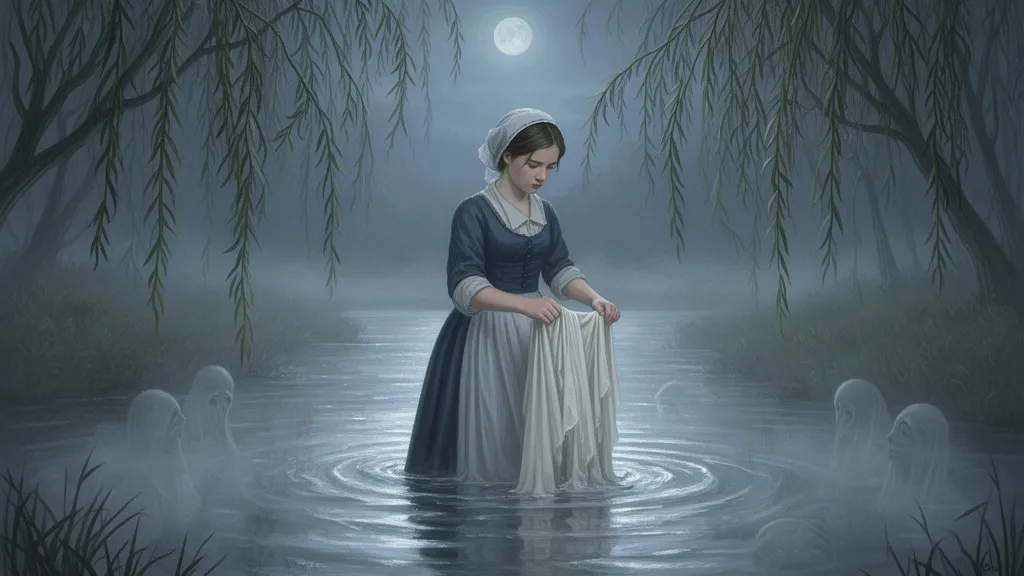
The river had been silver for three days, which meant someone had died upstream and the current carried grief like silt. Thea knew this the way she knew when bread would rise or when wool would felt—through her hands, through the cold morning water that numbed her fingers as she worked. She stood knee-deep in the shallows where the willows leaned low enough to brush her shoulders, and she wrung the shrouds until they stopped weeping.
She had washed eleven this week. The fever had come in autumn and lingered into winter, settling in lungs like snow that would not melt. The priest brought her the shrouds at first light, always bundled in oilcloth, always tied with the same length of black ribbon. She did not ask the names. The dead did not need her to know them.
But this morning, the shroud she lifted from the basket carried something strange beneath its hem—a dark crescent of mud, fresh and thick as potter's clay. Thea held the fabric up to the dawn and saw it clearly: soil pressed into the weave as if someone had walked through a garden and knelt among the furrows.
It had not rained in three weeks. The river ran low and the road was dust.
She scrubbed the mud away with lye soap and cold water, watching it dissolve into brown threads that the current carried toward the sea. The shroud came clean. It always did. But when she wrung it dry and folded it into her basket, she could still smell something faint and green beneath the linen—not decay, but rainwater. Fresh rainwater, as if it had fallen during the night and pooled in grass.
Thea walked back to the village with the basket balanced on her hip. The priest's house stood at the top of the hill, its garden enclosed by a high stone wall that had been old when Thea's grandmother was young. She had never been inside. The gate was always locked, and the priest was a careful man who kept his own counsel and his own hours.
She left the shrouds on his doorstep as she always did, folded and tied with the black ribbon he would use again tomorrow. But before she turned away, she bent and touched her fingers to the stone step. Damp. Not dew—dew did not pool in the corners like this, did not smell of turned earth and night-blooming flowers.
Someone had walked here. Recently. In bare feet.
She returned that evening with a lamp and a lie prepared—if the priest found her, she would say she had left a pin in the folds and feared it might wound him. It was a poor lie, but it was late and she was tired and the truth was something she could not yet name.
The gate was still locked. Thea set the lamp on the ground and climbed the wall the way she had climbed trees as a child, finding footholds in the old mortar, pulling herself up by the ivy that grew thick as rope along the stones. She scraped her palms and tore her skirt, but she reached the top and looked down into the garden.
It was smaller than she had imagined. A square of grass, a single yew tree in the center, and a stone bench beneath its branches. Nothing else. No flowers, no furrows, no mud.
But under the yew tree, on the grass that should have been brittle with frost, a girl lay sleeping.
She wore a shroud. The one Thea had washed this morning—Thea knew it by the way the hem fell, by the small repair she had made near the shoulder where the thread had frayed. The girl's hands were folded on her chest, and her feet were bare and clean, though the grass beneath them was dark with water.
Thea climbed down into the garden. Her boots made no sound on the wet grass. The air was thick and cool, and when she breathed she tasted rain that had not fallen, dew that had formed without night, the green exhale of growing things in a season that should have been dormant.
The girl did not wake. Thea knelt beside her and saw that she was young—perhaps sixteen, perhaps younger. Her skin was pale as milk, and her hair had been combed smooth and braided with the kind of care that spoke of love. There was no fever-flush in her cheeks, no sunkenness to her face. She looked as if she had simply lain down in the grass and decided not to rise.
Thea reached out and touched the girl's wrist. Warm. Not cold. Not dead.
But not alive, either. The pulse beneath her fingers was too slow, too faint, as if the girl's heart had been convinced to beat only enough to hold her in place—not enough to carry her forward, not enough to let her go.
"She's borrowed," a voice said behind her.
Thea turned. The priest stood in the doorway of his house, a copper basin in his hands. He was older than she had thought—his hair was white, and his hands shook slightly as he set the basin down on the bench. He did not look surprised to see her. He looked tired.
"For how long?" Thea asked.
The priest sat down beside the basin. In the lamplight, she could see that it was filled with water—clear water, very still, with something pale floating just beneath the surface. Not a reflection. A face. A name.
"A night," he said. "One night, and then they go back. The fever took them too quickly. Their families needed more time."
"Time for what?"
"To say goodbye. To finish what could not be finished. To sit with them one more time in the quiet."
Thea looked at the girl under the yew tree, at the way her hands were folded, at the peace in her sleeping face. "And you bring them here."
"I give them a place to rest," the priest said. "Between death and burial, there is a small space. The river knows it. The soil knows it. If you ask carefully, and if you tend the asking with the right words, you can hold them there for a single night. Not alive. But not yet gone."
He lifted the basin and held it out to her. "I'm old," he said. "And the work is heavy. I need someone who knows the river, who knows how to wash away what should not remain. I've watched you, Thea. You have steady hands."
Thea did not take the basin. She looked into the water and saw a name written there in pale ink—a name she almost recognized, a name that had not yet been spoken aloud but soon would be. Someone upstream, perhaps. Someone the fever had marked but not yet taken.
"And if I refuse?" she asked.
"Then you go home," the priest said, "and tomorrow I will bring you another shroud, and you will wash it as you have always done, and you will not ask questions."
Thea thought of the girl under the yew tree. She thought of the families who had sat with her for one more night, who had said the words they needed to say, who had held her hand and felt it warm again for a few hours before the morning came and took her back.
She thought of the river, and the way it carried grief like silt, and the way it always ran clear again by evening.
"If I help you," she said slowly, "can I keep one name out of the ledger? One person the fever cannot borrow, no matter what?"
The priest was silent for a long time. Then he nodded. "One name," he said. "And you will tend the rest."
Thea took the basin from his hands. The water was cold, and the name written there rippled and reformed as she held it. She did not speak the name aloud. She had learned, long ago, that some things were safer left unspoken.
"I'll need to learn the words," she said.
"I'll teach you," the priest said. "Starting tonight."
By dawn, the girl under the yew tree was gone. Thea washed the shroud in the river as the sun rose, and the water ran clear and silver, and the willows bent low to touch her shoulders. She wrung the fabric until it stopped weeping, and she folded it carefully, and she did not think about the name she had written in her own ledger—the one she would keep out of the basin, the one the fever would not be allowed to borrow.
Her sister's name. Still healthy, still laughing, still walking through the world with her own pulse and her own breath.
But the fever was patient, and the river was long, and Thea knew that some bargains were not made for comfort. They were made because the work had to be done, and someone had to carry it, and the dead deserved their single night of borrowed peace before the earth took them back for good.
She walked up the hill with the shroud in her basket, and the priest met her at the gate with a new name in his hands.