The Buried Line
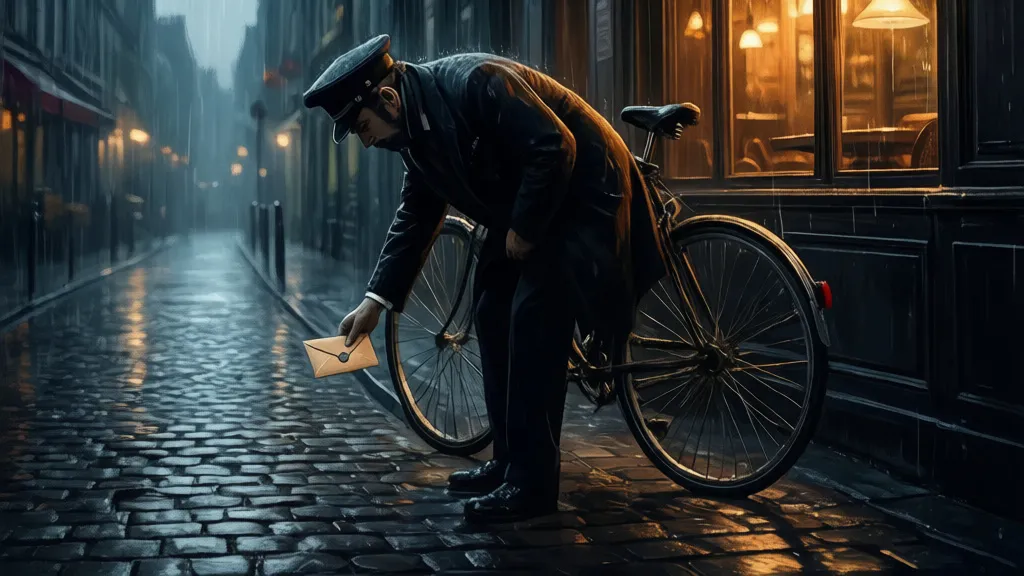
The envelope slides off my knee when I brake. Not my fault. The rain’s turned the cobbles to glass. I watch it skid under the bent bicycle wheel, white corner peeking out like a tongue.
I should leave it. But the café upstairs has a light on, and the man who owns it is the kind who notices things. Like envelopes. Like couriers who don’t deliver.
I pick it up. The paper’s damp, the flap unsealed. Inside, a ledger page. Numbers, dates, a name blacked out with marker so thick it bleeds through. Only one line matters: the one that isn’t blacked out. The one that says ‘Payment to V. Kovač, 12/11/20.’
Three years ago. The night I buried a man in the woods outside Anderlecht. His name was Viktor Kovač. Or at least, that’s what the papers in his pocket said.
I fold the page. Shove it back in the envelope. The café owner’s still upstairs. I can hear the clink of glasses, the hiss of the espresso machine. He’s waiting for this. And now I’m waiting for him to come down and ask why I haven’t delivered it.
The stairwell smells like boiled cabbage and wet wool. I take the steps two at a time, my boots squeaking on the linoleum. The café’s on the second floor, but the ledger page is burning a hole in my pocket. I need to move. Fast.
The door at the top is propped open with a brick. Inside, the café’s empty except for the owner, a man with a face like a bulldog and hands that could crush walnuts. He’s wiping down the counter, but his eyes are on the door. On me.
‘You’re late,’ he says. No hello. No thanks.
‘Had a problem,’ I say. ‘Envelope got wet.’
He doesn’t ask what kind of problem. Doesn’t care. Just holds out his hand. ‘Give it.’
I hesitate. The ledger page is still in my pocket. The name’s still there, staring up at me from the paper. Viktor Kovač. The man I buried. The man who shouldn’t be in any ledger, not after three years.
‘Now,’ the owner says. His voice is quiet. Dangerous.
I hand him the envelope. He flips it open, scans the page. His face doesn’t change, but his fingers tighten around the paper. ‘Where’s the rest?’
‘That’s all there was,’ I say.
He looks at me. Really looks. Like he’s seeing me for the first time. ‘You read it.’
I don’t answer. I don’t have to. The truth’s written all over my face.
He sighs. Pulls a cigarette from his pocket, lights it. The smoke curls around his head like a halo. ‘You’re a problem now,’ he says. ‘And problems need solutions.’
The back door leads to an alley. The alley leads to a street. The street leads to a tram stop. I don’t take the tram. I walk. Fast.
The ledger page is still in my pocket. The name’s still there. Viktor Kovač. The man I buried. The man who’s suddenly alive again, at least on paper.
I need to know why. I need to know who put him there. And I need to know before the café owner decides I’m more trouble than I’m worth.
The rain’s stopped, but the cobbles are still slick. My boots splash through puddles, sending up arcs of water. I don’t look back. I don’t need to. I know he’s there. Watching. Waiting.
I turn the corner. The tram stop’s ahead. A group of teenagers loiter under the shelter, smoking, laughing. They don’t see me. I don’t see them. My eyes are on the street. On the shadows. On the man who’s following me.
He’s not the café owner. He’s taller. Thinner. Wearing a coat that’s too big for him. He’s been behind me since I left the alley. Keeping his distance. Waiting for something.
I don’t wait. I run.
The stairwell’s different this time. Narrower. Darker. The smell of boiled cabbage is stronger, mixed with something else. Something sour. Rotten.
I take the steps three at a time, my breath coming in ragged gasps. The man in the coat is behind me. I can hear his footsteps, the rustle of his coat. He’s not running. Not yet. But he’s close.
The door at the top is locked. I don’t have a key. I don’t need one. I kick it open. The wood splinters, the lock gives way. I stumble into the room.
It’s an apartment. Small. Cluttered. A single lamp casts long shadows on the walls. A man sits at a table, a ledger open in front of him. He looks up when I burst in. His face is familiar. Too familiar.
‘You,’ he says. ‘I was wondering when you’d show up.’
I don’t recognize him. Not at first. Then I see the scar. A jagged line running from his temple to his jaw. The same scar Viktor Kovač had. The same scar I saw the night I buried him.
‘You’re dead,’ I say.
He smiles. It’s not a nice smile. ‘Not quite.’
The ledger’s open to a page. A page with a name. My name. And a number. A big number. Next to it, a date. Today’s date.
‘You’ve been busy,’ the man says. He taps the ledger with his finger. ‘Delivering envelopes. Following orders. Not asking questions.’
‘I ask questions now,’ I say. ‘Starting with why a dead man’s in your ledger.’
He leans back in his chair. ‘Because he’s not dead. Not really. Not in the way that matters.’
‘I buried him,’ I say. ‘I saw the hole. I saw the dirt.’
‘You buried a body,’ he says. ‘Not Viktor. Viktor’s been very much alive. Very much in business. Very much in need of a courier who doesn’t ask questions.’
I look at the ledger. At my name. At the number. ‘What’s the number for?’
‘That’s what you owe,’ he says. ‘For the body. For the burial. For the three years of silence.’
‘I didn’t agree to this,’ I say.
‘You didn’t have to,’ he says. ‘You just had to deliver the envelope.’
The man in the coat is in the doorway. He’s not alone. The café owner’s with him. And behind them, two more men. Big men. Men with hands like hams and faces like thunder.
‘You should’ve left the envelope,’ the café owner says. ‘Should’ve walked away.’
‘I tried,’ I say. ‘You didn’t let me.’
He shrugs. ‘Doesn’t matter now. What matters is the ledger. And the name in it.’
‘My name,’ I say.
‘Not just yours,’ he says. ‘Viktor’s. And now, everyone’s who’s ever done business with him. Including you.’
I look at the ledger. At the names. At the numbers. At the dates. Three years of payments. Three years of silence. Three years of burying bodies and delivering envelopes and pretending I didn’t know.
‘What do you want?’ I ask.
‘The ledger,’ the man with the scar says. ‘And the money. All of it.’
‘I don’t have it,’ I say.
‘But you know where it is,’ he says. ‘And you’re going to get it for us.’
The stairwell’s empty. The apartment’s empty. The ledger’s gone. And so are they.
I’m alone. Again. Always.
The rain’s started again. It patters against the window, a steady drumbeat. I look at my hands. They’re shaking. Not from the cold. From the ledger. From the names. From the number next to mine.
I pull out my phone. Dial a number I haven’t called in three years. It rings once. Twice. Then a voice answers. A voice I recognize. A voice I buried.
‘Hello, courier,’ Viktor Kovač says. ‘We need to talk.’
I hang up. The phone slips from my fingers, clatters to the floor. I don’t pick it up. I don’t need to. I know what he’s going to say. I know what he wants. I know what I have to do.
I look at the window. At the rain. At the city beyond. At the ledger. At the line. At the name.
I take a deep breath. Step into the rain. And start walking.
Because some lines aren’t meant to be buried. Some names aren’t meant to stay dead. And some couriers aren’t meant to deliver just envelopes.
They’re meant to deliver justice.
Or at least, a reckoning." }