The Drowning Ledger
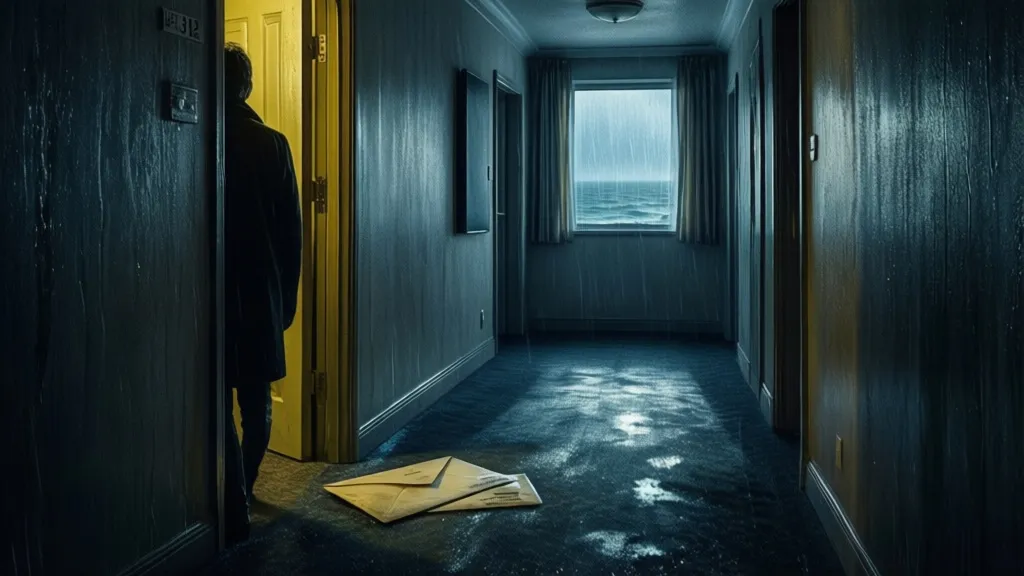
The envelope sticks to his fingers. Not sweat—something thicker. He peels it off, leaves a pale smear on his palm. Merde. The paper’s damp at the corners, the glue tacky. He checks the address again: Hôtel des Vagues, Room 312. Third floor, ocean view, minibar included. The kind of place where the towels smell like bleach and the Wi-Fi cuts out when it rains.
He takes the stairs. No cameras in the stairwell, just the hum of the vending machine on the second-floor landing, stocked with overpriced Orangina and condoms. The carpet squelches under his sneakers. Leak. Or worse. He doesn’t look down.
Room 312’s door is ajar. Not wide—just a sliver, like someone left in a hurry. The keycard dangles from the slot, still warm. He knocks. "Service." No answer. The minibar whines to life, a sudden bzzzt that makes him jump. Inside the room, the sink drips. Rust-colored water swirls in the basin, slow as a dying man’s breath.
He pushes the door open with his elbow. The shower’s running. Steam curls over the top of the frosted glass, thick enough to taste. Chlorine and something else. Copper. Wet wool. The kind of smell that clings to the back of your throat.
The envelope feels heavier now. He sets it on the dresser, next to a half-empty bottle of Pastis and a room-service plate crusted with aioli. The ledger inside is leather-bound, the kind with a clasp that snaps shut like a jaw. He doesn’t open it. Doesn’t need to. The last time he saw one like this, a man in a Barbour jacket paid him five hundred euros to lose it in a train station locker in Lyon. "Don’t look inside," the man said. "And don’t get caught."
The shower stops. A beat of silence. Then the sound of wet feet on tile—slow, dragging. The courier freezes. The envelope is still on the dresser. The ledger’s clasp glints under the bedside lamp. Too late to grab it. The bathroom door creaks open.
The man in the shower is naked. His skin is the color of old parchment, stretched too tight over his ribs. A single bullet hole sits above his left eye, small and neat, like a third nostril. Blood trickles down his face, mixes with the water still dripping from his hair. He’s alive. Barely. His lips move, but no sound comes out. His hand twitches toward the sink, fingers curling around the edge. The keycard in the lock is still warm because he was alive ten minutes ago. Maybe five.
The courier’s phone buzzes in his pocket. A text: "Delivery confirmed?" No name. Just a number he doesn’t recognize. The kind of number that changes every week.
He wipes his prints off the envelope with his sleeve. Leaves it on the dresser. Steps back into the hallway, pulls the door shut. The keycard stays in the lock. Let the maid find him.
The lobby smells like stale coffee and Gauloises. The receptionist is a kid with a Man U tattoo on his neck and a name tag that says Kévin. He doesn’t look up when the courier walks past. The TV above the bar plays a news ticker: "Body found in Vieux-Port hotel… police seek witnesses…" The volume’s too low to hear the rest.
Outside, the sun’s too bright. The harbor glints like a knife. He squints, checks his watch. 11:47 a.m. The police will be here soon. They’ll ask Kévin for the security footage. Kévin will shrug, say the cameras haven’t worked since the last grève. They’ll ask about the courier. Kévin will describe him: "Tall, skinny, looked like he hadn’t slept in a week." Close enough.
His phone buzzes again. "Where is it?"
He doesn’t answer. Instead, he walks to the harbor, past the fishermen hosing down their boats, past the old men playing pétanque in the shade. The ledger’s still in the hotel room. Or maybe the maid took it. Maybe the police. Maybe the man in the Barbour jacket already knows it’s gone.
A trash bin sits near the docks, bolted to the pavement. He lifts the lid. Inside: a half-eaten pan bagnat, a crushed pack of Gitanes, a used condom. He hesitates. The ledger’s worth more than his life. But the man in the Barbour jacket doesn’t make idle threats. Last time someone lost his package, they found the courier’s fingers in a bouillabaisse at Chez Fonfon.
His phone rings. Unknown number. He answers.
"You have something that doesn’t belong to you."
The voice is calm. Not angry. Worse than angry.
"I don’t have it," he says.
"Then where is it?"
"Hotel room. Third floor. Room 312."
A pause. The line crackles. "You’re lying."
"Check the dresser."
Another pause. Then: "Stay where you are." The line goes dead.
He drops the phone in the trash bin. It lands on the condom with a wet thunk.
The police arrive at 12:14 p.m. Two of them, young, bored. They ask Kévin for the security footage. Kévin shrugs. "Broken." They ask about the courier. Kévin describes him. The police nod, write it down. One of them lights a cigarette. The other checks his watch.
The courier watches from across the street, leaning against a Scooter rental sign. His hands shake. Not from fear. From the Pastis he stole from the dead man’s minibar. Stupid. He should’ve left it. Should’ve walked away clean.
A black Peugeot pulls up to the hotel. Tinted windows. The man in the Barbour jacket gets out. He’s not alone. Two others follow, both in suits, both with the same dead-eyed stare. They don’t look at the police. They don’t look at Kévin. They go straight to the elevator.
The courier’s stomach twists. He should run. But his legs won’t move. The Peugeot’s engine idles. The driver watches him in the side mirror. Waiting.
The elevator dings. The man in the Barbour jacket steps out, holding a ledger. Not the one from the dresser—the real one’s still in the room. This one’s a copy. The courier recognizes the leather, the clasp. The man must’ve had it on him the whole time. Backup.
A smile. Not a nice one.
The courier turns, walks toward the harbor. The Peugeot follows, crawling along the curb. He can hear the tires crunching over broken glass. The driver’s window rolls down.
"Get in."
He keeps walking.
"We can do this the easy way."
The harbor’s fifty meters away. The water’s dark, choppy. A ferry to Corsica blasts its horn. The sound echoes off the buildings, loud enough to drown out the Peugeot’s engine.
He breaks into a run.
The Peugeot accelerates. Tires screech. He dodges left, into an alley. The car can’t follow. Too narrow. He sprints, lungs burning. The alley spits him out near the fish market. The stink of oursins and diesel fills his nose. A vendor yells at him for knocking over a crate of moules. He doesn’t stop.
The Peugeot’s back on the main road. It pulls up beside him, matches his pace. The window rolls down again.
"You’re making this difficult."
He doesn’t answer. Just keeps running. The harbor’s close. The ferry’s still there. If he can make it to the dock—
A hand grabs his arm. Yanks him into the car.
The door slams. The locks click. The man in the Barbour jacket sits beside him, holding the copy ledger. The driver doesn’t look back. The car pulls away from the curb.
"You should’ve left it in the room," the man says.
The courier swallows. "I did."
The man flips the ledger open. Points to a page. A list of names. Dates. Numbers. "This isn’t the right one."
"What?"
"The real ledger’s still in the hotel. This is a copy. A good one, but not good enough." He taps the page. "See this? The ink’s too fresh. And this—" He runs his finger along the spine. "The binding’s machine-stitched. The real one’s hand-sewn."
The courier’s mouth goes dry. "I didn’t—"
"You didn’t look. That’s the problem." The man sighs. "We’ll get the real one later. Right now, we have other business."
The Peugeot makes a U-turn. The harbor shrinks in the rearview mirror. The ferry’s horn blasts again, farther away now.
The courier closes his eyes. Stupid. So stupid.
The man in the Barbour jacket pats his knee. "Don’t worry. We’ll get the real one. And then we’ll decide what to do with you."
The car speeds up. The city blurs past the window. Somewhere, a church bell tolls noon. The sound fades before it finishes.
They don’t go back to the hotel.
The Peugeot takes the Corniche, past the Plage des Catalans, past the Château d’If. The man in the Barbour jacket rolls down the window. Lets the salt air in. The ledger sits on his lap, closed. The courier watches it. Watches the man’s hands. The way his fingers drum against the leather. Like he’s counting.
The car stops at a calanque, a narrow inlet where the cliffs drop straight into the water. No houses. No people. Just rocks and sea and the sound of waves slapping against stone.
The driver gets out. Opens the courier’s door. "Out."
The courier steps onto the gravel. His sneakers sink into the loose rocks. The man in the Barbour jacket follows, holding the copy ledger. The other two stay in the car. The engine idles.
"You know what this is?" the man asks, tapping the ledger.
"A ledger," the courier says.
"No. It’s a life." He flips it open. Points to a name. "This man? He’s dead. This one? Prison. This one?" He taps another. "He’s got a bullet in his spine. Courtesy of me."
The courier doesn’t look. Doesn’t want to know.
"You delivered for me before," the man says. "Twice. Both times, no problems. But today—" He shakes his head. "Today, you got curious."
"I didn’t—"
"You touched the envelope. You felt the damp. You wondered. That’s the problem with curiosity." He snaps the ledger shut. "It’s a habit. And habits get you killed."
The courier swallows. "What do you want?"
The man smiles. "I want you to deliver one last thing."
He hands the courier the ledger. The leather’s warm. Like a body.
"Take it to the water," the man says. "Walk in until it’s over your head. Then let it go."
The courier stares at him. "You’re joking."
"Do I look like I’m joking?"
The driver steps forward, hands in his pockets. The courier looks at the water. It’s dark. Deep. The kind of water that doesn’t give things back.
"And if I don’t?"
The man in the Barbour jacket sighs. "Then we do it the hard way. And trust me—you don’t want that."
The courier takes the ledger. The leather sticks to his fingers. He walks to the water’s edge. The rocks are slick. His sneakers fill with seawater. The ledger’s heavy. Too heavy to float.
He turns back. The man in the Barbour jacket watches him. Arms crossed. Patient.
The courier takes a step. Then another. The water’s cold. It soaks through his jeans. His phone buzzes in his pocket. He ignores it. The ledger drags at his arm. Like an anchor.
When the water’s up to his chest, he stops. The ledger’s still in his hand. The pages are starting to bleed. The ink runs, turns the water black.
He looks back one last time. The man in the Barbour jacket nods. "Good boy."
The courier lets go.
The ledger sinks. The water swallows it whole. No bubbles. No trace. Just the sea, dark and hungry.
He turns, wades back to shore. The man in the Barbour jacket hands him a towel. A Lacoste one, monogrammed. Nice.
"Clean slate," the man says. "Next time, don’t touch the envelope."
The courier dries his hands. The towel’s rough. Smells like detergent. Like nothing.
The Peugeot’s waiting. The driver holds the door open. The courier gets in. The man in the Barbour jacket slides in beside him. The car pulls away.
The courier watches the calanque disappear in the side mirror. The water’s still. No sign of the ledger. No sign of anything.
His phone buzzes again. He pulls it out. A text: "New delivery. 14:00. Same terms."
He deletes it. Puts the phone back in his pocket.
The man in the Barbour jacket lights a cigarette. Offers him one. The courier shakes his head.
"You’ll get used to it," the man says.
The courier doesn’t answer. He watches the road. The city blurs past. Somewhere, a church bell tolls. The sound fades before it finishes."