The Ibis Envelope
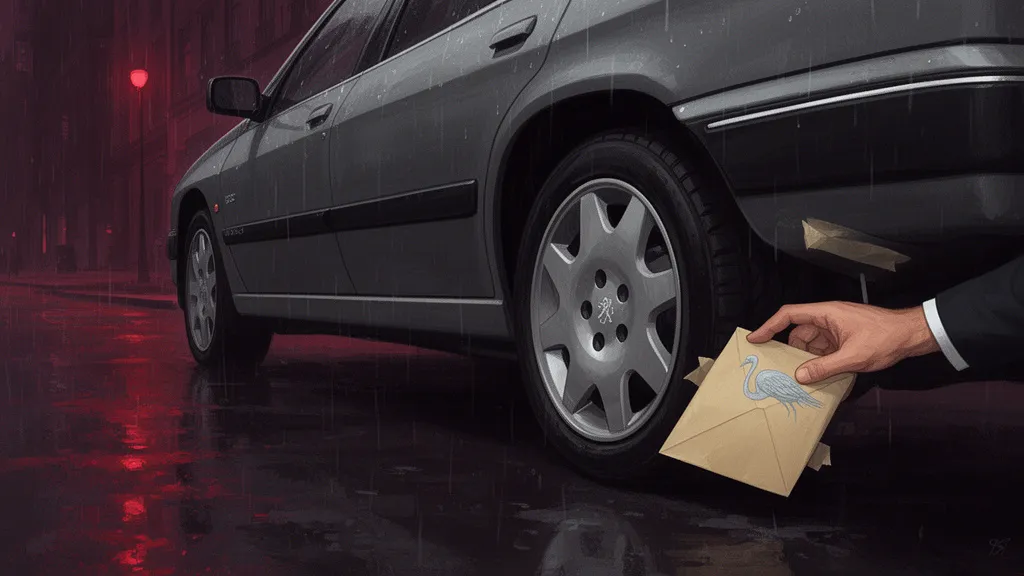
The Peugeot’s engine ticks like a bomb.
I crouch, fingers numb. Rain drips from the wheel arch onto my wrist. The manila envelope is taped there, warm from the block, stamped with a crest I don’t recognize—a silver ibis on a red field. Not local. Not real, probably. The kind of thing you print on stationery when you want to look like a place that doesn’t exist.
I peel it off. The tape leaves a sticky residue on my thumb. No address, no name. Just the crest, and the heat.
The drop was supposed to be a locker at the Part-Dieu station. That’s what the text said: Locker 17, 23:00. No envelope, no money. Standard. I’ve done it a hundred times. But the locker was empty, the key in my pocket suddenly useless. Then the second text: Change of plan. Peugeot 308, level -2, P4. Under the wheel.
I don’t ask why. I don’t get paid to ask why.
The hotel is on Rue de la République, between a sex shop and a kebab place that’s been there since the ‘90s. The lobby smells like bleach and old cigarettes. The woman at the desk doesn’t look up when I walk in. She’s watching a game show on a tiny TV, her fingers tapping the counter in time with the canned laughter.
I slide the envelope across the desk. She glances at the crest, then at me. Her eyes are the color of wet pavement.
"Room 412," she says. "Elevator’s broken."
The stairs are narrow, the carpet stained with things I don’t want to identify. The envelope feels heavier in my hand. I knock on 412. No answer. I knock again. The door creaks open an inch, not latched.
Inside, the room is dark. The air is thick, sweet. Copper and something floral—cheap air freshener trying to cover it up. I push the door open with my foot.
The man is on the bed, fully dressed, one arm dangling off the side. His skin is the wrong color, grayish under the yellow light of the bedside lamp. His eyes are open. They don’t blink.
I don’t touch him. I don’t need to. The smell does the work for me.
The envelope is still in my hand. I look at it. Then at the dead man. Then at the envelope again.
Fuck.
I take the stairs two at a time. The woman at the desk is still watching TV. I slam the envelope down in front of her.
"He’s dead," I say.
She doesn’t look up. "Room 412?"
"Yeah."
"Huh. Must’ve missed the checkout."
"He’s dead."
She sighs, mutes the TV. "You a cop?"
"No."
"Then it’s not your problem."
I want to hit her. I don’t. I walk out.
The rain has stopped, but the streets are still slick. My phone buzzes in my pocket. Unknown number.
You delivered it. Good. Now forget the room number.
I delete the message. My hands are shaking. Not from fear. From the cold. From the stupid.
I should’ve left the envelope where I found it.
My apartment is a studio above a laundromat on Rue des Archers. The stairs smell like detergent and mildew. I take them slow, listening. The key turns in the lock. The door swings open.
The woman in the green wool coat is sitting on my couch.
She’s holding a key. My key. The one I keep taped under the mailbox.
"You’re late," she says.
I don’t ask how she got in. I don’t ask who she is. I ask, "What do you want?"
She smiles. It doesn’t reach her eyes. "The envelope."
"I don’t have it."
"But you touched it."
I sit down on the edge of the bed. The springs creak. "It’s at the hotel. With the dead guy."
She tilts her head. "That’s unfortunate."
"For him, yeah."
She stands, smooths her coat. "You’re going to get it back."
"Why would I do that?"
"Because if you don’t," she says, "I’ll tell the police you were the last one to see him alive."
I laugh. It sounds hollow. "They’ll ask why I didn’t report it."
"And you’ll say you panicked. That you’re just a courier. That you didn’t know."
"They won’t believe me."
She shrugs. "Maybe not. But they’ll investigate. And investigations are messy. Expensive. Time-consuming."
I look at her. Really look. She’s not young, not old. Her coat is expensive, but her shoes are scuffed. She’s not a cop. Not a lawyer. Something in between. A fixer, maybe. Or a cleaner.
"Who are you?"
"Someone who doesn’t want that envelope in police custody," she says. "And you’re going to make sure it isn’t."
The hotel is quieter now. The night shift has started, the kind of quiet that hums with exhaustion. The woman at the desk is new—a kid, early twenties, chewing gum like it’s a job requirement.
I don’t ask for the key. I don’t need to. I walk past the desk, take the stairs. The carpet sticks to my shoes.
Room 412 is still unlocked. The dead man is still dead. The envelope is on the nightstand, next to a half-empty bottle of whiskey and a room-service menu.
I pick it up. It’s lighter than I remember. I don’t open it.
The woman in the green coat is waiting in my apartment when I get back. She’s made tea. Two cups on the table, steam curling into the air.
"You took your time," she says.
I toss the envelope onto the couch. "Here. Happy?"
She doesn’t touch it. "Open it."
"No."
"I wasn’t asking."
I sit down. The tea is too sweet. I drink it anyway. "What’s in it?"
"Something that doesn’t belong to you."
"Then why not just take it from the dead guy?"
She smiles. "Because he was already dead when I found out about it."
"Convenient."
"For you, maybe."
I pick up the envelope. The flap isn’t sealed. Just tucked in. I slide my finger under it, pull out a single sheet of paper. A printout. A name. An address. A date.
And a number. A very large number.
I look at her. "What is this?"
"A problem," she says. "One that’s now yours."
The address is in Villeurbanne, a warehouse near the old textile district. The kind of place that’s half-abandoned, half-repurposed into artist studios and illegal raves. The number on the paper matches a unit on the second floor.
The name on the printout is the dead man’s. The date is tomorrow.
I don’t go in. I watch from across the street, from the doorway of a shuttered bakery. The rain has started again, fine and cold. My coat is still damp from earlier.
A black van pulls up. Two men get out. They’re not wearing uniforms, but they move like they are. One has a limp. The other has a tattoo on his neck—a spider, or maybe a star. It’s hard to tell in the dark.
They go inside. The door doesn’t close all the way.
I wait. Five minutes. Ten. The rain gets heavier.
Then the screaming starts.
Not loud. Not dramatic. Just a man’s voice, cut off sharp. Then silence.
The two men come out. One is carrying a duffel bag. The other is wiping his hands on a rag. They get in the van. Drive away.
I don’t follow them.
The envelope is still in my pocket. I pull it out, look at the crest. The ibis stares back, indifferent.
The woman in the green coat is waiting when I get back. She’s sitting in the dark, the only light coming from the streetlamp outside.
"You didn’t go in," she says.
"No."
"Smart."
"What was in the warehouse?"
She doesn’t answer. Instead, she picks up the envelope, pulls out the paper. She folds it carefully, puts it in her pocket.
"You’re done," she says.
"Just like that?"
"Just like that."
I want to believe her. I don’t.
The next morning, I check the news. No bodies found in Villeurbanne. No reports of gunshots, no police tape. Nothing.
I make coffee. The envelope is gone. The woman took it. I don’t know why I expected otherwise.
My phone buzzes. Unknown number.
You did well.
I delete the message. I don’t reply.
The woman in the green coat is gone. The key to my apartment is on the table, next to an envelope. This one is white, unmarked. Inside is a stack of cash—euros, used, non-sequential. Enough to make my hands shake again.
I count it. Twice. Then I put it in a shoebox under the bed.
I don’t touch it for a week.
On the eighth day, I buy a train ticket to Marseille. One way. I don’t tell anyone. I don’t pack much. Just the cash, a change of clothes, and the key to my apartment, which I leave in the mailbox on my way out.
The train leaves at 14:23. I get on. I don’t look back.
The envelope is warm when I find it. Taped under the seat in front of me, just like the last one. The crest is different this time—a black swan on a blue field. The paper inside is blank.
I don’t open it. I don’t deliver it.
I get off at the next stop.
The rain starts again before I reach the platform." }