The Key in My Pocket
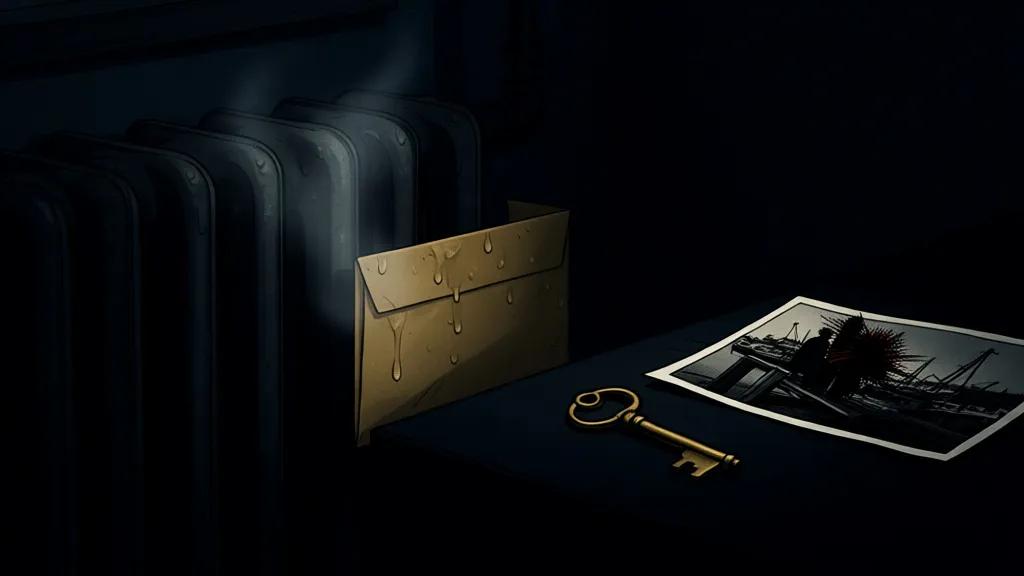
The radiator hisses like a cat that doesn’t want to be touched.
I press my palm against the pipes. Warm, but not scalding. The manila envelope tucked behind it is warmer. Damp at one corner, like it’s been sweating.
I pull it free. The paper sticks to my fingers for a second before letting go with a wet sound. No stamp, no address. Just my name in block letters, written with a Sharpie that bled through the other side.
Inside: a list of container numbers, all starting with MSC—Mediterranean Shipping Company. A dockside photo, one face scratched out with something sharp. And a key. Small, brass, the kind that fits a door lock. Not the warehouse. Not the office. My apartment.
I turn the key in my fingers. The teeth are worn smooth in places. Like it’s been used a lot.
The photo is a grainy print, the kind you get from a security camera. Three men standing by a stack of containers. One of them is me. I’m not looking at the camera. I’m looking at the man whose face is now a mess of ink and scratches. He’s holding a clipboard, smiling like he’s just told a joke.
The other man is a stranger. Tall, broad, a scar running from his temple to his jaw. He’s not smiling.
I flip the photo over. Nothing. Just the date, written in the same block letters as the envelope. Two days ago.
I check my watch. 4:17 PM. The next inspection wave starts at 5:00. Forty-three minutes. Not enough time to call the cops, even if I wanted to. Not enough time to do anything but sit here and sweat.
I shove the envelope into my desk drawer. The key goes into my pocket. It’s heavier than it should be.
The ferry terminal clock is a relic. Big, round, the hands painted gold. It’s always five minutes slow. Right now, it says 4:32. My watch says 4:37.
He’s leaning against the wall under the clock, smoking. The cigarette trembles between his fingers. His left hand is wrapped in a handkerchief, dark with blood. The knuckle is split open, raw.
I don’t recognize him at first. Not until he looks up. Then I see the scar.
"You’re late," he says. His voice is rough, like he’s been shouting. Or crying.
"I didn’t know I was coming."
He flicks the cigarette away. It lands in a puddle, hisses. "You got the envelope."
"Who are you?"
"Name’s Varga. Used to work for your friend in the photo."
"The one with the scratched-out face?"
He nods. "That’s the one."
"What happened to his face?"
Varga flexes his injured hand. The handkerchief shifts, shows more blood. "He’s dead. That’s what happened."
We walk. Not toward the docks. Not toward my office. Just away from the clock, away from the crowds. Varga limps a little. I don’t ask.
"You’re a customs broker," he says. "You make things disappear."
"I make paperwork disappear. That’s all."
"Same thing."
"Not even close."
He stops. Turns to face me. His eyes are bloodshot. "You want to argue semantics, or you want to know why your key fits your apartment?"
I don’t answer. He keeps walking.
"Your friend—let’s call him Monsieur X—he was moving things. Not containers. Not paperwork. People."
"Migrants?"
"No. Worse."
"Worse how?"
Varga doesn’t answer. He lights another cigarette. The match flares in the dim light of the alley. "He needed a clean route. Somewhere no one would look. So he used your name. Your company. Your apartment."
"For what?"
"Storage."
The key burns in my pocket.
"What’s in my apartment, Varga?"
He exhales smoke. "You don’t want to know."
"I already don’t want to know. Tell me anyway."
"Money. Passports. A gun. And a girl."
"A girl."
"Not like that. She’s a courier. Or she was."
"What happened?"
"She got greedy. Took something that wasn’t hers."
"What did she take?"
Varga flicks the cigarette away. "The wrong thing."
We’re close to my apartment now. I can see the building from here. The lights are off. No one’s home. No one should be home.
"How do I know you’re not lying?"
"You don’t."
"Then why should I trust you?"
He holds up his injured hand. "Because I’m the one bleeding. Not you."
The key turns in the lock. The door swings open. The apartment smells like sweat and cheap perfume.
Varga pushes past me. "Stay here."
I don’t. I follow him inside.
The living room is a mess. Takeout containers, empty bottles, a duffel bag spilling clothes. The bedroom door is closed. Varga knocks. Once. Twice.
"It’s me," he says. "Open up."
No answer.
He tries the handle. Locked.
"Move," I say.
I kick the door. It splinters around the lock. Inside, the room is dark. The curtains are drawn. The air is thick, stale.
Varga flips the light switch. Nothing happens.
"Power’s out," he mutters.
I step inside. The bed is unmade. The sheets are twisted. There’s a shape under them. The duffel bag from the living room is on the floor, unzipped. Inside: stacks of euros, a few passports, a Glock 17.
Varga pulls the sheet back.
The girl is young. Early twenties, maybe. Dark hair, pale skin. She’s not breathing. Her lips are blue. Her fingers are curled into claws.
"Shit," Varga says. He presses two fingers to her neck. "She’s cold."
"How long?"
"Hours."
I look around the room. A small wooden box sits on the nightstand, the kind that holds jewelry. Or something smaller.
Varga picks it up. Opens it. Inside, a USB drive. No label.
"This is what she took," he says.
"What’s on it?"
"Something that gets people killed."
We hear the sirens at the same time. Distant, but getting closer.
Varga pockets the USB drive. "We need to go."
"Where?"
"Anywhere but here."
I grab the duffel bag. The money is heavy. The gun is heavier. I tuck it into my waistband, under my jacket.
We take the back stairs. The sirens are louder now. Closer. We hit the street just as the first police car turns the corner.
Varga grabs my arm. "This way."
We run. Not toward the docks. Not toward the ferry terminal. Just away. Away from the sirens, away from the apartment, away from the girl on the bed.
The USB drive burns in Varga’s pocket. The money burns in mine.
"What now?"
He doesn’t answer. He’s looking at his phone. The screen lights up his face. A text message. One word:
Run.
We don’t stop running until we hit the old port. The water is black, oily. The boats rock gently, like they’re asleep.
Varga leans against a lamppost. He’s breathing hard. His hand is bleeding again.
"Who sent the text?"
"The people who killed your friend."
"And the girl?"
"Collateral damage."
I look at the duffel bag. The money. The gun digging into my back. "What do they want?"
"The USB drive."
"And if they get it?"
He smiles. It’s not a nice smile. "Then they kill us."
I adjust the gun under my jacket. It’s cold against my skin.
Varga eyes me. "You know how to use that?"
"No."
"Good. Don’t."
"Why not?"
"Because if you shoot someone, you become the problem. Right now, you’re just a guy who found a dead girl in his apartment."
"I didn’t find her. You did."
"They don’t know that."
We sit on a bench. The night is warm. The air smells like salt and diesel.
"What’s on the USB drive, Varga?"
He doesn’t answer. He’s staring at the water.
"Fine," I say. "Don’t tell me. But I’m not giving it to you."
He turns to look at me. "You don’t have a choice."
"I have the gun."
"And I have the key to your apartment. The one that fits the lock. The one that says you were involved."
I don’t say anything. He’s right.
The text comes at 11:47 PM. A location. A time. No name.
Midnight. The warehouse on Rue des Catalans. Come alone.
Varga shows me the screen. "You’re not going."
I look at the gun under my jacket. "I don’t have a choice. If I don’t show, they’ll come to me."
He doesn’t argue. Just nods.
The warehouse is old. The paint is peeling. The windows are broken. The door is unlocked.
I step inside. The air is thick with dust. The floor creaks under my feet.
A voice from the darkness:
"You’re late."
I turn. A man steps into the light. Tall, broad, a scar running from his temple to his jaw. The man from the photo. The one who wasn’t scratched out.
"Who are you?"
"The man who’s going to kill you if you don’t hand over the USB drive."
"I don’t have it."
"Then you’re useless."
I hear the click of a hammer being cocked. I keep my hands where he can see them.
Varga steps out of the shadows. He’s holding the USB drive. "He doesn’t have it. I do."
The man with the scar smiles. "Good. Now we can all go home."
Varga tosses the drive. The man catches it. He doesn’t look at it. He looks at me.
"You should’ve walked away."
I don’t say anything. I’m too busy watching Varga. He’s not looking at the man with the scar. He’s looking at me. His hand is in his pocket. His fingers are moving.
The shot is loud. The man with the scar drops the USB drive. He clutches his chest. Blood seeps between his fingers.
Varga pulls his hand out of his pocket. He’s holding a gun. A different gun. Smaller.
"You said not to shoot," I say.
"I lied."
I keep my hands visible. The Glock digs into my back, but I don’t reach for it.
The man with the scar is on his knees. He’s gasping. Blood is bubbling at his lips.
Varga picks up the USB drive. He wipes it on his shirt. "You should go."
"What about you?"
"I’ll be fine."
"What’s on the drive, Varga?"
He smiles. It’s the same smile as before. Not nice. "Something that gets people killed."
I leave. I don’t look back. The night is still warm. The air still smells like salt and diesel.
I don’t go home. I don’t go to the office. I go to the docks. I find an empty container. I climb inside. I close the door.
The darkness is complete. The silence is absolute.
I sit down. I wait.
The key is still in my pocket. The money is still in the duffel bag. The gun is still digging into my back.
I don’t know what’s on the USB drive. I don’t know who Varga really is. I don’t know if the girl in my apartment was a courier or a victim or something in between.
But I know one thing:
I’m not walking away.
Not this time." }