The Key in the Moulds
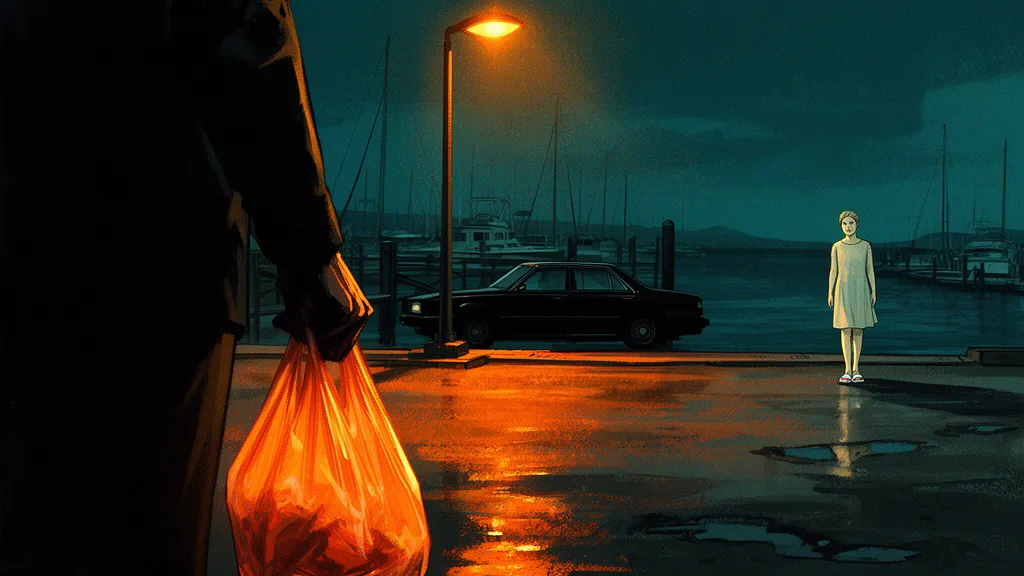
The plastic bag sticks to my thigh. Not sweat—heat. Like it’s still alive.
I shift my weight. The marina light flickers. Sodium orange, then nothing, then back. Each time it dies, the woman in white sandals gets closer. She’s circling the wrong car. A black Audi, not the grey Peugeot I was told to watch for. Three loops now. I count them like breaths.
The bag is warm because the money is fresh. That’s what he said. Fresh from the press, still warm from the machine. I didn’t ask which machine. I never do.
I check my watch. 3:17 AM. The quay is empty except for the woman, me, and the sound of water lapping against hulls. Somewhere a rope creaks. A boat named La Sirène rocks in its slip, its mast tapping against the dock like a metronome counting down.
The woman stops. She’s looking at me now. Not directly—just enough to let me know she’s looking. Her sandals are the kind you buy at a market stall, the soles thin enough to feel every pebble. The kind that say I don’t belong here without saying a word.
I adjust my grip on the bag. The plastic crackles.
The man who gave it to me was named Didier. Or maybe it was Daniel. He had a scar above his eyebrow and a habit of licking his teeth when he lied. He didn’t lie about the money. He lied about the rest.
Just deliver it to the Peugeot. Grey. Plate ends in 7K. You’ll see it.
I saw the Audi instead. And the woman. And now I’m wondering if the Peugeot exists at all.
The light flickers again. When it comes back, she’s gone.
I exhale. Then I open the bag.
No money.
A set of dental molds, upper and lower, still damp. The kind you make at the dentist, the kind that smell like mint and regret. Nestled beside them, a key. Brass, stamped with a number: 312. No hotel name. No logo. Just the number, like it’s all I’m supposed to need.
I touch the molds. They’re cold now. The warmth is gone.
A sound. Not the rope. Not the water.
A splash.
I look toward the harbor. The La Sirène is still rocking, but the rhythm’s off. Like something just climbed out of the water and didn’t bother to be quiet.
I don’t want to know. But I do.
I walk to the edge of the quay. The water is black, the kind of black that swallows light. Then I see him. Didier. Or Daniel. Face down, one arm outstretched like he’s reaching for something. His jacket billows around him, dark and heavy. His shoes are gone.
The woman in white sandals steps out from behind a stack of crates. She’s holding a phone. Not to her ear—just in her hand, the screen glowing blue. One of her sandals is missing. The other is caked with mud.
She sees me seeing her.
I don’t wait for her to decide what to do. I run.
The key is in my pocket. The molds are in the bag. The bag is still in my hand. I don’t dump it. Not yet.
Room 312.
I don’t know the hotel. But I know Marseille. And I know how to find a room when I have the number.
I take the back streets. No lights. No cameras. The kind of streets where the only people out at this hour are the ones who don’t want to be seen.
The first hotel I try is the Hôtel des Anges. No room 312. The clerk looks at me like I’m trouble. I am.
The second is the Pension Mirabeau. The woman at the desk is knitting. She doesn’t look up when I ask. Non, monsieur. Pas de 312 ici.
The third is the Grand Hôtel de la Mer. It’s not grand. The lobby smells like bleach and old cigarettes. The man behind the desk is reading a newspaper. He doesn’t lower it when I walk in.
Room 312.
He turns a page. Third floor. Elevator’s broken.
I take the stairs.
The hallway is narrow. The carpet is worn. The walls are the color of weak tea. Room 312 is at the end. The door is ajar.
I push it open with my foot.
The room is dark. The curtains are drawn. The air smells like disinfectant and something else—something metallic.
I flip the light switch. Nothing.
I step inside. The door clicks shut behind me.
A bed. A nightstand. A lamp. The lamp is on the floor, the shade cracked. The bulb is still warm.
On the nightstand, a phone. Not a hotel phone—a burner. The kind you buy at a tabac, the kind that rings once and then stops.
It rings.
I don’t answer. I don’t move.
It rings again.
I pick it up.
You’re late.
A man’s voice. Not Didier. Not Daniel. Someone else.
Who is this?
You have something that doesn’t belong to you.
The key?
The molds.
I don’t say anything.
Didier was a fool. He thought he could keep them. He thought he could sell them twice.
The woman in the white sandals?
A pause. Then a laugh. She’s not the police.
Who is she?
Someone who doesn’t like loose ends.
I look at the door. It’s still shut. But I can hear the hallway. The creak of a floorboard. The sound of someone breathing.
What do you want?
The molds. And the key. Bring them to the Café des Étoiles in one hour. Alone.
Or?
Or the woman in the white sandals will find you before the police do. And trust me, you don’t want that.
The line goes dead.
I put the phone down. I look around the room.
The bed is unmade. The sheets are twisted. There’s a stain on the pillow. Not blood. Something darker. A smear of red wax. A broken seal. Like something was opened in a hurry.
In the bathroom, the mirror is fogged. The sink is wet. A toothbrush. A razor. A tube of toothpaste, squeezed from the middle. A single white sandal on the counter. The mate to the one the woman lost in the mud.
And on the floor, half-hidden under the towel rack, a small metal case. The kind dentists use. The kind that holds dental molds.
Empty.
I pick up the sandal. It’s still damp. The sole is caked with the same mud from the quay.
I know what’s in that room now. Not just the molds. Not just the key. Something worse. Something that got Didier killed. Something that’s worth more than money.
I leave the room. I take the stairs. I don’t look back.
The woman in the white sandals is waiting in the lobby. She’s sitting in a chair, her legs crossed. The other sandal is back on her foot. She’s reading a magazine.
She looks up when I walk in. She smiles.
You found it.
I don’t smile back.
You’re not police.
No.
Who are you?
Someone who cleans up messes.
Didier’s mess?
Yours, now.
I don’t have the molds. But I have the key. And I know what they were for.
What happens if I walk out of here?
She closes the magazine. You won’t.
Why not?
Because you know what’s in that room.
I do.
I don’t want to.
But I do.
I sit down.
One hour.
She nods. One hour.
The Café des Étoiles is on the corner of Rue Saint-Sébastien and Rue des Trois Mages. It’s the kind of place that’s always open, the kind of place where the coffee is bad and the pastries are stale. The kind of place where no one asks questions.
I order an espresso. It tastes like ash.
The woman in white sandals isn’t here. Neither is the man on the phone.
I wait.
At 4:12 AM, a man walks in. He’s wearing a suit. Not a cheap one. The kind that says I have money, but I don’t want you to know how much. He sits at the table next to mine.
You have it?
I slide the key across the table. He picks it up. He doesn’t look at it.
The molds?
Gone. But you already knew that.
He studies me. Then he nods. No. It doesn’t.
He stands. He leaves a twenty-euro note on the table. For the coffee.
I don’t touch it.
He walks out.
I finish my espresso. It’s cold now.
The sun is coming up. The sky is the color of a bruise.
I walk to the quay. The La Sirène is still there. The water is still black.
Didier is gone.
The police will find him eventually. They’ll ask questions. They’ll look for witnesses.
I won’t be one of them.
I light a cigarette. The pack is almost empty.
The woman in white sandals is leaning against a lamppost. She’s wearing different shoes now. Black. Practical.
You did good.
I don’t say anything.
You want to know what this was about?
No.
She smiles. Smart.
She walks away.
I stay.
The marina light flickers one last time. Then it goes out.
I don’t know what was in room 312.
I don’t want to know.
But I know this: the next time someone hands me a warm bag, I’m going to open it before I take the job.