The Key to Bastia
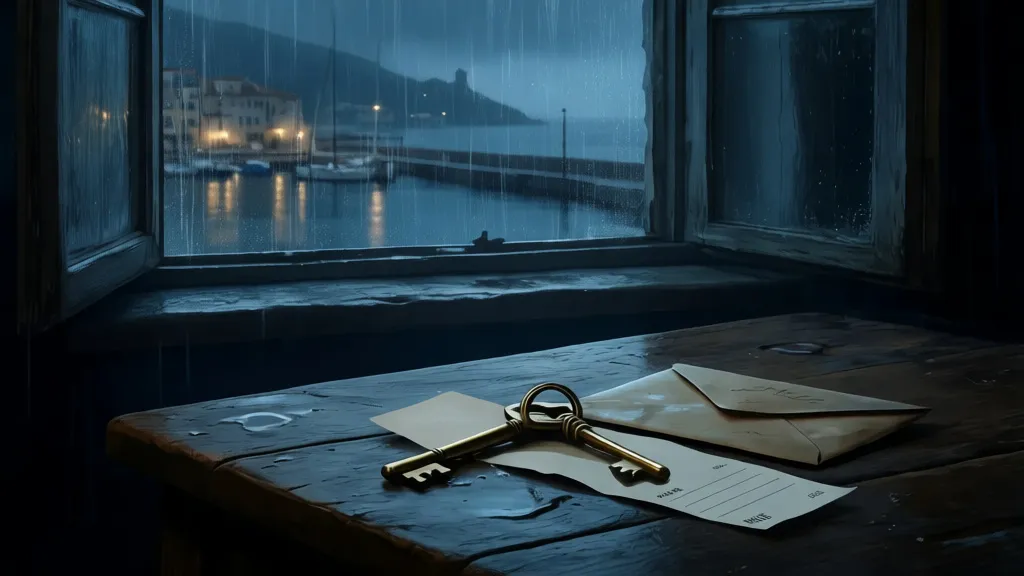
The envelope is damp where the glass sat. Not condensation—something older, like the table itself is sweating. I peel it off with two fingers, leave the tape curled on the underside like a dead insect’s legs.
Inside: a key, a receipt, a name.
The key is brass, unmarked. The receipt is from the Hôtel des Îles, Bastia, last night’s date. The name is mine, but not the one I use now. Lucien Vasseur. Eight years since anyone called me that. Eight years since I left Corsica with a duffel bag and a promise to never come back.
I fold the receipt into a square, tap it against my thumbnail. The café hums around me—espresso machines, the clink of spoons, a radio playing Marseille la nuit too low to hear the lyrics. No one is looking. No one ever looks.
The ferry leaves at 21:45. That gives me six hours.
I walk to the Vieux Port, hands in my pockets. The key digs into my palm. The name sits in my mouth like a stone.
Lucien Vasseur. Last seen in Ajaccio, standing over a man who wasn’t breathing. Not my fault, not really. But the gendarmes don’t care about context. They care about bodies.
The receipt says Chambre 12. No note. No explanation. Just the key, the room, the name.
I stop at a tabac, buy a pack of Gauloises I don’t want. The cashier doesn’t ask why I’m sweating. He’s seen worse.
The police station on the Canebière is a block of yellow light. Inside, the air smells like stale coffee and regret. I could walk in. Drop the envelope on the desk. Say, I think this is for me.
But the last time I trusted the police, I spent three days in a cell while they decided I wasn’t worth the paperwork. And the man on the floor? He was still there when they let me go.
I light a cigarette. The smoke tastes like ash and old decisions.
The ferry terminal is all glass and echoes. I show my ID—Mathieu Lefèvre, clean, boring—to the woman at the counter. She doesn’t look up. The key burns in my pocket.
Chambre 12. Maybe it’s a message. Maybe it’s a trap. Maybe it’s nothing.
I buy a ticket. One way.
The boat pulls away at 21:47. I stand at the rail, watch Marseille shrink into a smear of lights. The sea is black, endless. Somewhere ahead, Corsica waits.
I think about the man in Ajaccio. His name was Pascal. He had a wife, a kid. A habit of talking too much.
The key is cold in my hand.
Bastia at dawn. The Hôtel des Îles is a sagging building near the port, the kind of place where the sheets smell like bleach and the past. The night clerk doesn’t ask for ID. He just hands me the key to Chambre 12 and goes back to his newspaper.
The room is small, dark. A single bed, a chair, a window overlooking the alley. The walls are thin. I can hear the couple next door arguing in Corsican.
I sit on the bed. The key fits the lock in the desk drawer.
Inside: a gun, a passport, and a photograph.
The gun is a .38, loaded. The passport is French, in the name of Lucien Vasseur. The photograph is of Pascal, smiling, his arm around a woman I don’t recognize. She’s holding a baby—Pascal’s kid, now seven years older.
I pick up the gun. It’s heavier than I remember.
The knock comes at 07:12. Not a cop knock. Too quiet. Too sure.
I put the gun in my waistband, cover it with my shirt. The passport goes in my pocket. The photograph I leave on the bed.
The door opens before I reach it.
A man stands there. Tall, dark suit, no tie. His face is familiar, but I can’t place it. He smiles. It doesn’t reach his eyes.
"Lucien," he says. "Or should I say Mathieu?"
I don’t answer. The gun digs into my spine.
"You took your time," he says. "We were starting to think you wouldn’t come."
"Who’s we?"
He steps aside. Behind him, in the hallway, stands Pascal’s wife. She’s not holding the kid’s hand. Instead, the boy sits on the floor of the hallway, playing with a toy car, oblivious. She’s holding a knife.
"You remember my husband," she says. Her voice is flat. "You left him in a warehouse. The police said it was an accident."
I swallow. The gun is a lump of ice against my skin.
"It was," I say.
She doesn’t blink. "Then why are you here?"
The man in the suit clears his throat. "Because we have a job for you, Lucien. One last job. Then we’re square."
I look at the kid. He’s still playing with the car, humming to himself. Too young to understand.
"What kind of job?"
The man smiles. "The kind that pays enough to disappear."
I think about the ferry ticket in my pocket. One way. No return.
"And if I say no?"
Pascal’s wife steps forward, close enough that I can smell her perfume—something floral, expensive. The knife glints in the dim light.
"Then you don’t leave this room," she says.
The man in the suit sighs. "Family," he says. "You understand."
I do. That’s the problem.
The job is simple. Drive a van to Ajaccio. Pick up a package. Deliver it to a warehouse near the port. No questions. No stops.
The van is waiting in the alley. The keys are in the ignition. The package is in the back, wrapped in plastic, the size of a small suitcase. Pascal’s wife hands me a burner phone.
"Call when it’s done," she says. "Then you get the kid."
I look at the boy. He’s still playing with the toy car, now in the backseat of the van. She’s using him as collateral. Smart.
I drive. The kid hums a tune I don’t recognize. The package doesn’t move. Doesn’t make a sound.
The warehouse is empty. The lights flicker. I carry the package inside, set it on the table. The burner phone rings.
"Open it," the man in the suit says.
I cut the plastic with my keys. Inside: stacks of cash. Euros, bound in white paper bands. More money than I’ve ever seen.
"Take what you want," he says. "Then walk away. The kid’s waiting at the café near the port. Don’t make us come looking for you."
I take one stack. Fold it into my pocket.
"That’s it?"
"That’s it," he says. "We’re square now. But Lucien?"
"Yeah?"
"Don’t come back."
The line goes dead.
The café is a dingy place with sticky tables. The kid sits in the corner, sipping a Coke. He looks up when I walk in, but doesn’t smile.
"You’re done?" he asks.
"Yeah," I say. "I’m done."
He nods, like that’s the answer he expected. Then he slides a piece of paper across the table. It’s a ferry ticket to Genoa, under his name. Pascal Vasseur.
"My mom said to give you this," he says. "She said you’d know what to do."
I look at the ticket. Then at him. "You’re not coming with me?"
He shakes his head. "I’m staying with my uncle. The one in the suit."
I don’t ask why. I already know.
The boat docks in Genoa at dusk. I hand the kid the stack of cash. He takes it, tucks it into his backpack without counting.
"What’s your name?" I ask.
"Pascal," he says.
I don’t correct him.
He gets off the ferry, walks toward the city lights. I watch until he’s out of sight. Then I light a cigarette and walk the other way.
The key to Chambre 12 is still in my pocket. I drop it into the harbour. It sinks without a sound.
Somewhere, a phone rings. I don’t answer.
The money is enough to start over. Again.
I think about Pascal. About the kid. About the knife in Pascal’s wife’s hand.
I think about the ferry, the key, the name I left behind.
Then I walk into the train station and buy a ticket to Berlin.
The past is a country I don’t visit anymore."