The Last Ferry for Lucien
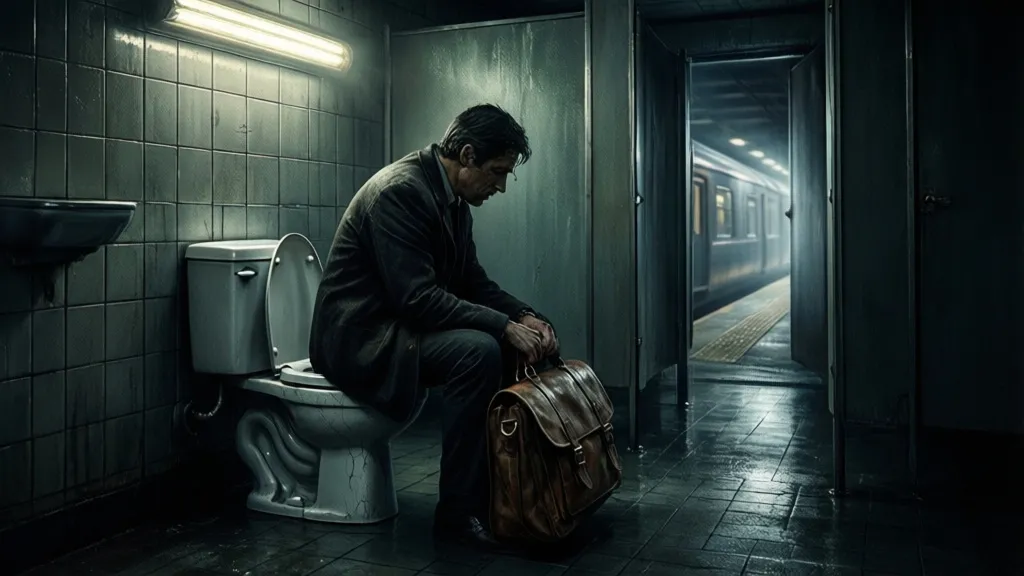
The leather sticks to my thigh. Not sweat—something older, like the bag itself is bleeding dye.
I shift on the toilet seat, knees pressed against the stall door. The fluorescent tube above me buzzes like a trapped wasp. Three minutes past the meet time. The satchel’s brass clasp digs into my palm. I don’t open it. Rule one: you don’t look unless the client tells you to look.
Outside, the station’s PA system crackles. A woman’s voice, smooth as olive oil, announces the 14:27 to Lyon. The words dissolve into static. I count the tiles on the wall—twelve by twelve, grout the color of old teeth. My watch ticks. The second hand stutters on the six.
A knock. Not on the stall door. On the wall.
I freeze. The knock comes again—three sharp raps, then two slow. A rhythm. Not random. I don’t answer. The satchel’s weight shifts against my leg, sudden and wrong, like something inside just woke up.
The lock rattles. Not the stall lock—the main door to the restroom. A hinge creaks. Footsteps. Small. Too light to be him.
A voice, high and clear: «Monsieur? Vous attendez quelqu’un?»
I don’t turn. The mirror above the sink is cracked, but I can see her in the corner of it—a girl, maybe ten, in a navy school blazer. The blazer’s too big, sleeves rolled up to her elbows. A key dangles from her fingers, brass catching the sickly light.
«Il ne viendra pas.» She says it like she’s commenting on the weather. He’s not coming.
I exhale through my nose. «Who sent you?»
She shrugs. The key spins. «Prenez ça. C’est pour vous.» Take this. It’s for you.
I don’t move. The satchel burns against my thigh. The girl steps closer. Her shoes are scuffed, soles worn thin. She smells like school glue and the sea.
«Le dernier ferry part à vingt heures.» The last ferry leaves at eight. «Vous avez le temps.» You have time.
I take the key. Her fingers are cold. She doesn’t let go right away. Just stares at me, unblinking, like she’s waiting for me to do something. Then she’s gone, the restroom door swinging shut behind her with a sigh.
The locker is in the basement, past the vending machines that hum like dying refrigerators. The key turns smooth, no resistance. Inside: a passport, waterlogged, the photo peeling at the edges. A man’s face, dark hair, stubble. The name reads Lucien Moreau. The birthdate makes him thirty-eight. The ring is gold, thin, the kind you buy in a hurry. Salt crusts the groove where the stone should be. I rub it with my thumb. The salt doesn’t dissolve.
No money. No note. Just the ring and the passport, like a bad punchline.
I check my watch. 15:42. Four hours until the ferry.
The address on the passport’s last page is in the Panier, the old quarter. Narrow streets, laundry strung between balconies, the smell of fried sardines and cat piss. Number 17 is a door with peeling blue paint, the kind of place that doesn’t have a buzzer. I knock. A dog barks somewhere inside. No answer.
A woman leans out of the window next door, smoking. She eyes the satchel. «Vous cherchez Lucien?»
I nod. «Oui.»
She exhales smoke through her nose. «Il est parti.» He’s gone. «Il y a trois jours.» Three days ago.
«Où?»
«Personne ne sait.» Nobody knows. She flicks ash onto the cobblestones. «Mais sa femme…» But his wife… She jerks her chin toward the door. «Elle est là. Elle attend.»
I knock again. This time, footsteps. Slow. The door opens a crack. A woman’s face, pale, eyes red-rimmed. She’s younger than I expected. Mid-twenties, maybe. Her hair is pulled back in a messy bun, strands sticking to her neck. Her hands tremble against the doorframe.
«Oui?»
I hold up the satchel. «Je… j’ai quelque chose pour Lucien.» I have something for Lucien.
She stares at the bag. Not at me. At the bag. Her fingers tighten. «Il n’est pas là.» He’s not here.
«Je vois ça.» I see that. I shift my weight. The satchel feels heavier. «I was supposed to meet him. At the station.»
She doesn’t move. Doesn’t blink. Just watches the satchel like it might bite her. Then, quiet: «Vous êtes le coursier?» You’re the courier?
I nod.
A beat. Two. She steps back, opens the door wider. «Entrez.»
The apartment is small. One room, a kitchenette, a bed unmade. A suitcase sits open on the floor, half-packed. Clothes spilling out. A child’s drawing is taped to the fridge—a stick figure family, all holding hands. The father’s head is a scribble of black crayon.
The woman—Lucien’s wife—sits on the edge of the bed. Her hands shake as she picks at a loose thread on the bedspread. «Il est mort.» He’s dead.
I don’t react. I’ve heard worse. But the way she says it—flat, like she’s reading a grocery list—makes my skin prickle.
«Comment?»
«Noyé.» Drowned. «Dans le Vieux-Port. Ils ont trouvé son téléphone dans sa poche. L’écran était fissuré.» In the Old Port. They found his phone in his pocket. The screen was cracked.
I think of the salt in the ring’s groove. The waterlogged passport. The girl in the school blazer, her voice too calm.
«Pourquoi moi?» Why me?
She looks up. Her eyes are dry. «Parce qu’il a laissé quelque chose pour vous.» Because he left something for you. «Dans le sac.» In the bag. «Quelque chose qu’ils ne doivent pas trouver.» Something they must not find. «Vous êtes le seul qui peut le faire sortir d’ici.» You’re the only one who can get it out of here.
I don’t ask what it is. The satchel’s weight answers for her.
Outside, the streets are louder. Tourists with ice cream cones, old men playing pétanque, the hum of scooters. I walk fast, the satchel slapping against my thigh. The passport burns in my pocket. The ring is a cold weight in my palm.
The ferry terminal is a concrete slab by the water. The last boat to Algiers leaves in ninety minutes. I buy a ticket. The woman at the counter doesn’t look at me twice.
I find a bench by the dock. The satchel sits between my feet. I don’t open it. I don’t need to. Lucien’s wife said it all—something they must not find. The ferry’s my only way out. The satchel’s my only cargo.
A seagull lands on the railing. It watches me. I watch it back. The gull tilts its head. I tilt mine. We’re both waiting for something to happen.
The girl from the station is sitting on the bench next to me. I don’t jump. I don’t even look at her. She’s eating a baguette, crusty and fresh. Crumbs fall onto her blazer.
«Vous partez?» You’re leaving?
I nod. The gull flies off, squawking.
«C’est bien.» That’s good. She takes another bite. «Il faut toujours partir avant qu’ils ne vous trouvent.» You should always leave before they find you.
«Qui ça, ‘ils’?» Who’s ‘they’?
She shrugs. «Les gens qui veulent ce qu’il y a dans le sac.» The people who want what’s in the bag.
I look at her. Really look. Her blazer is too big, but her shoes are new. Expensive. The kind of shoes a kid shouldn’t have. The kind of shoes a kid gets when someone’s paying them to do something.
«Tu travailles pour qui?» Who do you work for?
She smiles. It’s not a child’s smile. «Pour personne.» For no one. «Et pour tout le monde.» And for everyone.
I don’t press. Some things you don’t ask twice.
The ferry’s horn blares. Time to board. The girl stands, brushes crumbs off her blazer. She holds out her hand. I stare at it. Her palm is clean. No dirt. No salt.
«La bague.» The ring.
I give it to her. She pockets it without looking. Then she’s gone, swallowed by the crowd.
I pick up the satchel. The leather is warm now. Alive.
The gangplank creaks under my feet. The water below is black, oily. I think of Lucien Moreau, his phone in his pocket, the screen cracked. I think of his wife, her hands shaking as she packed his suitcase. I think of the girl, her voice too calm, her shoes too new.
I don’t look back.
The satchel stays with me. The ferry pulls away from the dock. Marseille shrinks in the distance, a smear of white and blue under the setting sun.
Somewhere, a gull cries. I don’t answer." }