The Ledger and the Rain
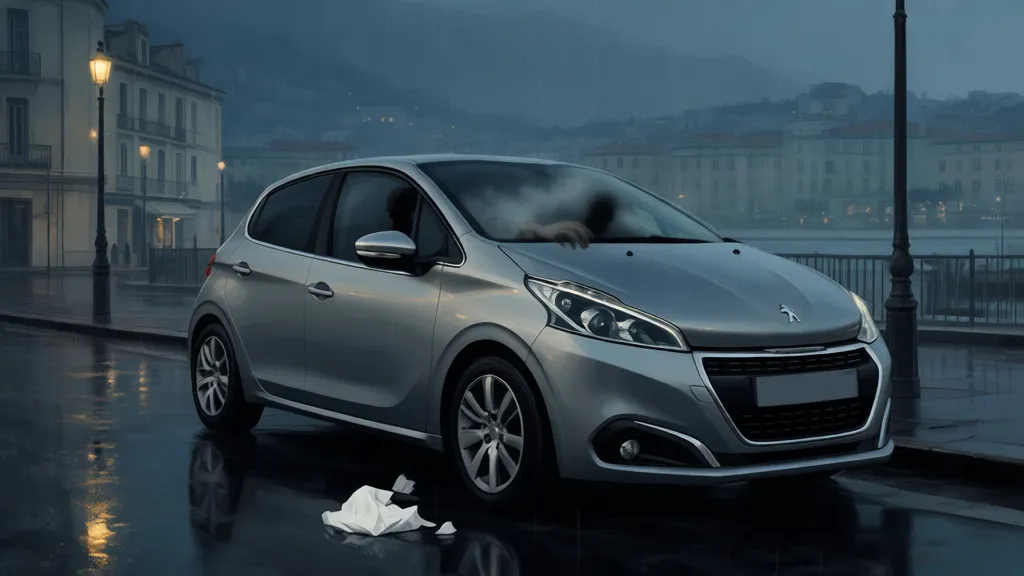
The napkin is already stiff when I open the door.
Not just blood. Rain, too. The kind that falls sideways in Marseille, the kind that soaks through your jacket in three minutes. The napkin is crumpled in his fist, Café des Anges printed in blue ink that’s bled into the fibers. His other hand rests on the seatbelt buckle, fingers curled like he was about to unclip it when whatever happened happened.
I don’t touch him. Not yet.
The car is a silver Peugeot 208, parked half on the curb outside Rue des Catalans. No ticket. No broken glass. Just the dead man, the napkin, and the smell of copper and wet wool. The keys are still in the ignition. I turn them. The engine coughs, then dies. The fuel gauge needle trembles just above empty.
I check the glove box. Registration, insurance, a pack of chewing gum, a phone. And, tucked behind the manual, a wallet. I leave it for now.
The phone rings.
No caller ID. Just a vibration that rattles the plastic against the registration papers. I let it ring out. Thirty seconds later, it starts again.
The café is two streets away.
I order an espresso. The barista doesn’t look at me. He’s too busy watching the rain slide down the window, the way it turns the street into a smear of headlights and neon. I unfold the napkin on the counter. The blood has dried in a dark halo around the edges, but the center is still damp. The blue ink is smudged, but I can make out the address: 12 Rue du Lacydon, 20h.
I sip the espresso. It tastes like burnt sugar and regret.
The phone rings again. I answer.
"You’re late."
A man’s voice. Not angry. Not even impatient. Just stating a fact.
"He’s not coming," I say.
Silence. Then: "Who is this?"
"The courier."
Another pause. "Where is he?"
"In the car."
"Alive?"
I don’t answer. The line goes dead.
12 Rue du Lacydon is a warehouse.
Not the kind with rusted corrugated iron and graffiti. This one has fresh paint, security cameras, and a keypad by the door. The rain has stopped, but the pavement is still slick, reflecting the streetlights in long, wavering streaks. I walk past twice. No one follows me. No one watches from the windows.
The phone rings again. Same number. I answer.
"You’re early," the voice says.
"I’m curious."
"About what?"
"What’s inside."
A laugh. Not a happy one. "You don’t want to know."
"I already do."
A pause. Then a beep in my ear. A text message: 4729. The keypad by the door flashes green. The lock clicks.
I hang up. Push the door open.
Inside, the warehouse is empty.
Not just empty of people. Empty of everything. No crates, no pallets, no forklifts. Just a concrete floor, fluorescent lights, and a single metal desk in the center of the room. On the desk, a ledger. A key. And a gun.
The ledger is leather-bound, the kind you’d find in a banker’s office a hundred years ago. The key is small, brass, the kind that fits a safety deposit box. The gun is a Glock 17, loaded.
I pick up the key. It’s warm.
The phone rings.
"Take the ledger," the voice says. "Leave the key."
"What’s in the ledger?"
"Names. Dates. Amounts."
"And the key?"
"Insurance."
I flip open the ledger. The first page is a list of names, all in the same neat handwriting. Some I recognize—politicians, businessmen, a judge. Some I don’t. Next to each name, a date and a sum. The amounts are all in the millions.
The last entry is today’s date. The name is blank. The amount is €500,000.
"Who was he supposed to meet?"
"Does it matter?"
"It does to me."
"Then you’re dumber than you look."
I hang up. The gun is still on the desk. I pick it up. It’s heavier than I expected.
The dead man’s name is Laurent Vasseur.
I go back to the glove box. This time, I take the wallet. Driver’s license, credit cards, a photo of a woman and a kid. The kid looks about five. The woman is smiling. Laurent isn’t.
The phone rings again. I don’t answer.
Instead, I drive to the address on the license. It’s a small house in La Pomme, one of those neighborhoods where the streets are too narrow and the buildings lean into each other like they’re sharing secrets. The lights are on. I park across the street. Watch the house. Wait.
An hour later, the woman from the photo comes out. She’s wearing a raincoat, carrying an umbrella. She walks to the corner, checks her watch, then goes back inside. Five minutes later, she comes out again, this time with the kid. They get into a little Renault. Drive away.
I follow.
They go to a hospital.
Not the big one downtown. A smaller one, the kind with peeling paint and flickering lights. The woman parks in the lot. Takes the kid’s hand. Walks inside.
I wait ten minutes. Then I go in after them.
The kid is in a room on the third floor. He’s hooked up to machines. Tubes in his nose, wires on his chest. The woman sits beside the bed, holding his hand. She doesn’t look up when I walk in.
"He has leukemia," she says. "The treatment’s expensive."
I don’t say anything.
I pull a copy of the ledger from my jacket—pages I tore out before leaving the warehouse. Hand them to her.
"What’s this?"
"Insurance."
She flips through the pages. Her hands are shaking. "They’ll kill us."
"Not if they don’t know where you are."
She looks at me. Really looks. "Who are you?"
"The courier."
She nods. Like that explains everything. Maybe it does.
The phone rings one last time.
I’m back in the warehouse. The key is in my pocket. The gun is in my hand. The original ledger is still on the desk.
"You took something that doesn’t belong to you," the voice says.
"I took something that does."
"You don’t understand what you’re dealing with."
"I understand enough."
Silence. Then: "You have until midnight."
The line goes dead.
I put the gun in my pocket. Walk out of the warehouse. The rain has started again. It’s coming down harder now, the kind that soaks through everything.
I get in the Peugeot. Drive.
The fuel gauge is on empty. The engine sputters. I make it to the hospital parking lot before it dies.
I leave the key on the dashboard. The ledger on the passenger seat. The gun in the glove box.
I walk away.
The phone rings again. I don’t answer.
Somewhere, a clock is ticking. Somewhere, people are waiting. Somewhere, a debt is coming due.
But not for me. Not tonight." }