The Locker at Three
The dish towel is pink at the knuckles.
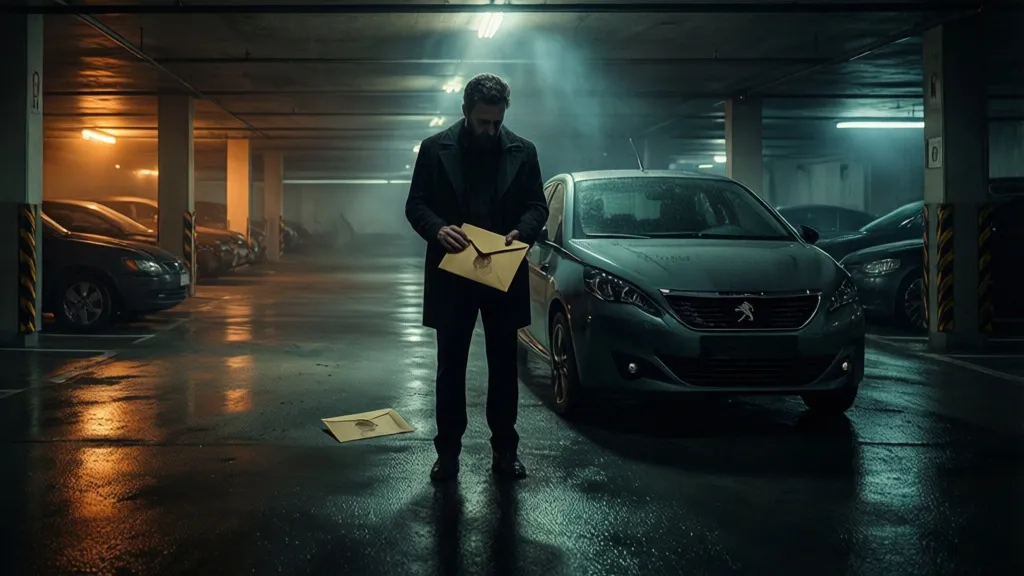
Fabien doesn’t look at his hand. He looks at the envelope. Manila, A4, sealed with a strip of packing tape that’s already peeling at one corner. No address. No stamp. Just a greasy thumbprint where someone pressed too hard.
The parking garage smells like diesel and sea salt. The sodium light above flickers—tick, tick—like a metronome counting down to something. He found the envelope on the passenger seat of his Peugeot, tucked under the wiper blade. Someone had been in his car. Someone who knew he’d be here, in this exact spot, at this exact time.
Three a.m. The hour of bad decisions.
Fabien flexes his fingers. The pain is a dull throb, like a toothache in his bones. He wrapped his hand in the towel after the last job—some idiot at the docks dropped a pallet of Moroccan tile on it. The bleeding stopped, but the swelling didn’t. Now the towel is stiff with dried blood, the pink fading to brown at the edges.
He should leave the envelope where it is. Walk away. Go home. Sleep.
But the bar downstairs is already open. Le Dernier Verre. The kind of place where men drink pastis at dawn and pretend they’re not waiting for something. The kind of place where the person who left the envelope is probably sitting right now, nursing a beer, watching the door.
Fabien picks up the envelope. It’s light. Too light for cash. Too heavy for a note.
A car engine growls on the ramp below. Headlights sweep the concrete pillars. He ducks behind his Peugeot, heart hammering. The car passes—some kid in a BMW, bass thumping, windows down. The music fades. The sodium light flickers again.
He exhales.
The envelope is still in his hand when he reaches the bar.
Le Dernier Verre is all dark wood and nicotine stains. The air smells like anise and old sweat. A jukebox in the corner plays something slow and French—Gainsbourg, probably, or maybe Barbara. The bartender, a woman with a face like a closed fist, wipes a glass with a rag that’s seen better days.
Fabien slides onto a stool. "Pastis."
She pours without looking at him. The liquid turns cloudy as she adds water. He takes a sip. The licorice burns his throat.
"You’re late."
The voice comes from the corner. A man in a leather jacket, face half-hidden in shadow. He’s got a cigarette between his fingers, unlit. The kind of man who doesn’t smoke but holds one anyway, like a prop.
Fabien doesn’t turn. "I didn’t know I had a curfew."
"The envelope."
"What envelope?"
The man exhales through his nose. Not a laugh. Not quite. "You’re a customs broker, Fabien. You know how this works. Someone gives you something. You don’t ask questions. You pass it along."
"I don’t work for free."
"No one said you did." The man flicks the cigarette. It spins end over end, landing in an ashtray with a soft tink. "But the man you were supposed to deliver it to? He’s dead."
Fabien’s fingers tighten around his glass. "That’s not my problem."
"It is now." The man leans forward. His jacket creaks. "See, the thing about dead men? They don’t pay. And the people who do pay? They don’t like loose ends."
A beat. The jukebox clicks, switches to another song. Édith Piaf, this time. Something about regrets.
Fabien takes another sip. The pastis tastes like poison. "How much?"
"Enough."
"Not good enough."
The man sighs. He reaches into his jacket. Fabien tenses—but all he pulls out is a phone. He taps the screen, slides it across the bar. A photo. A body. Face down in an alley, one arm twisted behind his back. Blood pooled under his head like a black halo.
"That’s your guy," the man says. "Name was Vasseur. Worked the night shift at the port. Found him this morning."
Fabien doesn’t look at the photo. He looks at the man’s hands. Clean nails. No rings. A watch that costs more than Fabien’s car. "You’re not a cop."
"No."
"You’re not a dockworker either."
The man smiles. It doesn’t reach his eyes. "I’m the guy who makes sure things get where they’re supposed to go."
"And where’s that?"
"Somewhere safe." The man taps the envelope. "Open it."
Fabien hesitates. Then he slides a finger under the flap. The tape peels away with a soft rip. Inside: a single key. Brass, old-fashioned. No label. No number. Just a key.
"What’s it for?"
"A locker. At the port. Locker 17."
"And what’s in it?"
The man shrugs. "Something you’re going to deliver. For me."
Fabien turns the key in his fingers. It’s cold. Too cold. Like it’s been sitting in a freezer. "And if I say no?"
The man doesn’t answer. He just looks at the bartender. She reaches under the counter, comes up with a shotgun. Not pointed at anyone. Just resting on the bar, like a napkin.
"Jesus," Fabien mutters.
"No one’s shooting anyone," the man says. "Not yet. But you’ve got a choice, Fabien. You can walk out of here with that key. Or you can walk out of here with a hole in your knee. Either way, you’re leaving with it."
Fabien swallows. The pastis burns all the way down. "You’re a real charmer, you know that?"
The man shrugs. "I’ve been called worse."
Outside, the sodium light is still flickering.
Fabien’s hand throbs. The dish towel is damp again, fresh blood seeping through. He flexes his fingers. The pain is sharp now, like needles. He should go to a hospital. He should burn the key. He should get on a boat and sail to Algeria and never come back.
Instead, he gets in his car.
The key goes in his pocket. The envelope goes in the glove compartment. He starts the engine. The Peugeot coughs, sputters, then roars to life. He pulls out of the garage, tires squealing on the concrete.
The port is a maze of cranes and shipping containers, all lit up like a Christmas tree. He knows the place like the back of his hand—every gate, every guard rotation, every blind spot where a man can slip through unnoticed. He parks near the admin building, kills the engine. The key is a weight in his pocket.
He gets out. The air smells like salt and rust. Somewhere in the distance, a ship’s horn blares. He walks.
The lockers are in a windowless room near the loading docks. Old, unused. The kind of place where things get stashed and forgotten. The key fits into the first lock he tries. Locker 17. He turns it. The door swings open.
Inside: a duffel bag. Black, nylon, zipped shut. He unzips it.
Cash. Stacks of it. Euros, mostly. Some dollars. A few passports—French, Italian, Moroccan. And at the bottom, a single sheet of paper. A name. An address. A time.
Khalid Benali. Rue des Catalans. 10 a.m.
Fabien stares at the bag. His hand is bleeding again. The dish towel is soaked through. He should leave. He should take the money and run. But the name on the paper—he knows it. A smuggler. A middleman. A man who moves things that aren’t supposed to be moved.
And Vasseur, the dead man, worked for him.
Fabien zips the bag shut. He slings it over his shoulder. The weight is reassuring. Solid. He locks the locker, pockets the key. He’ll come back later. Take what he needs. Burn the rest.
He steps out of the room. The hallway is empty. The port is quiet. Too quiet.
Then he hears it.
Footsteps.
Not the slow, lazy steps of a guard on patrol. These are quick. Purposeful. Someone who knows where they’re going.
Fabien ducks behind a stack of pallets. The footsteps get closer. A shadow moves past the door. A man in a leather jacket. The same man from the bar. He’s holding a phone to his ear, speaking in a low voice. "Yeah. He’s here. Locker 17."
Fabien’s stomach drops.
The man hangs up. Pockets the phone. He doesn’t go into the locker room. Instead, he leans against the wall, arms crossed, waiting.
Fabien doesn’t move. Doesn’t breathe. The dish towel is dripping blood onto the concrete. A slow, steady plink, plink, plink.
Then another set of footsteps. Heavier. Slower. A man in a suit, expensive, tailored. He’s got a briefcase in one hand. The other hand is in his pocket. Probably holding a gun.
The man in the leather jacket nods. "He’s got the bag."
The man in the suit doesn’t smile. "Good. Let’s go."
They walk past the locker room, down the hall, toward the loading docks. Fabien hears the clink of the briefcase opening. The rustle of cash being counted. Then the sound of a car engine starting.
He counts to ten. Then he runs.
The Peugeot’s tires scream as he peels out of the port. The duffel bag is on the passenger seat. The key is in the ignition. The dish towel is on the floor, forgotten.
He doesn’t know where he’s going. He just knows he can’t stay.
The burner phone in the bag rings. He ignores it. It rings again. He picks it up. "What?"
A voice, smooth, amused. "You’re not very good at this, are you?"
"Who is this?"
"Khalid Benali. You’ve got something of mine."
Fabien’s grip tightens on the wheel. "I don’t have anything."
"The bag, Fabien. The money. The passports. The information."
"I don’t know what you’re talking about."
A sigh. "Let me make this simple. You bring me the bag. I let you live. You keep the bag. I kill you. Slowly."
Fabien swallows. The road ahead is dark. The streetlights flicker. "Where?"
"Rue des Catalans. Ten a.m. Don’t be late."
The line goes dead.
Fabien tosses the phone onto the seat. The duffel bag stares at him, accusing. He should dump it. He should call the cops. He should do anything but what he’s about to do.
But the money is there. The passports. The chance to disappear.
And Fabien has never been good at walking away.
He checks the rearview. No one’s following. Not yet.
He turns onto the coastal road. The sea is black, endless. The sodium lights of the port fade behind him.
Somewhere ahead, a man is waiting. A man who kills people for a living.
Fabien flexes his fingers. The pain is gone. All he feels is the cold.
He drives.