The Orange Envelope
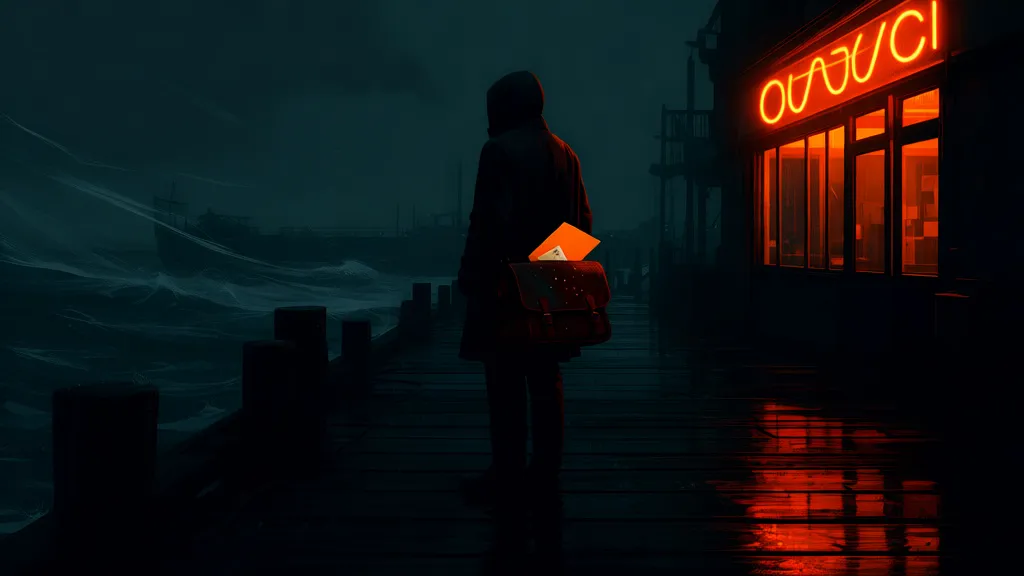
The satchel slaps my hip like a drunk friend. I pull it around front. The leather’s slick with something that isn’t rain. My fingers come away sticky, smelling of diesel and oranges.
I don’t open it. Not yet.
The docks at 11:17pm. Wind off the water, sharp enough to cut through the cheap wool of my jacket. The envelope inside the satchel is damp. Not soaked—just enough to make the paper cling to itself. I run a thumb along the seal. Still intact. Still addressed to Juge Moreau, Tribunal de Grande Instance, Chambre 12. Still my problem.
I check the time on my phone. 11:18. The café’s neon sign flickers above me, the é in Café buzzing like a dying insect. Inside, the usual: espresso machines hissing, dominoes slapping on Formica, the low hum of men who’ve given up on sleep. I order a pastis. The bartender slides it across the counter without looking at me. His eyes are on the TV, some football match from last season.
I take the glass to the back booth. The envelope sits on the table between us, sweating. I peel back the flap just enough to see the corner of a photograph. Black and white, grainy. A man in a suit, mid-stride, his face half-turned away. Not Moreau. Someone else. Someone I don’t recognize.
The pastis burns. I don’t drink it.
The stairwell smells like piss and old cigarettes. My shoes stick to the steps. Three flights up, the echo of footsteps above me—someone climbing faster, not bothering to hide it. I stop. The footsteps stop. I climb. They climb. We do this all the way to the fourth floor, where the door to Chambre 12 is propped open with a fire extinguisher.
Inside, the lights are off. The only glow comes from the streetlamp outside, slicing through the blinds in thin, yellow stripes. The desk is empty. The chair is empty. The envelope in my satchel feels heavier.
A voice from the corner: "You’re late."
I turn. A woman in a black coat, standing where the shadows are thickest. She steps forward. The light catches her face—sharp cheekbones, lips pressed into a line. She knows my name.
"Luca," she says. "They told me you were reliable."
"Who’s they?"
She ignores me. "The envelope wasn’t meant for Moreau. It was meant for you."
"Bullshit."
"Open it."
I don’t. Instead, I pull out my phone, dial the number I was given. It rings once. Twice. Then a voice, rough and tired: "You’re not supposed to call this number."
"Where’s Moreau?"
"Gone. The drop’s been moved."
"To where?"
A pause. Then: "The old warehouse on Quai de la Tourette. But Luca—"
I hang up. The woman in the black coat is still watching me. "You believe me now?"
"I believe you’re full of shit."
She smiles. It’s not a nice smile. "Then deliver the envelope. See what happens."
The warehouse is a skeleton. Rusted beams, broken windows, the skeletal remains of a crane leaning over the water like a drunk man over a toilet. The door’s padlocked, but the lock’s been cut. Fresh. The metal glints under my phone’s flashlight.
Inside, the air is thick with the smell of salt and something older—rot, maybe, or just the stink of a place that’s been left to die. My footsteps echo. The woman in the black coat is gone. I didn’t see her leave. Didn’t hear her go.
A voice from the dark: "You’re early."
I turn. A man steps out of the shadows. Tall, broad, wearing a suit that’s too nice for this place. His tie is loose, his collar undone. He’s holding a gun. Not pointing it at me. Just holding it. Like it’s a phone he’s about to make a call with.
"Where’s Moreau?" I ask.
"Not here." He gestures with the gun. "The envelope, Luca."
I don’t move. "Who are you?"
"Someone who’s been waiting for you." He takes a step forward. The light catches his face. I recognize him now—the man from the photograph. The one in the grainy black and white. The one who wasn’t Moreau.
"You’re not a magistrate," I say.
"No." He smiles. "But you already knew that."
I did. I think I did. The envelope was too light. The photograph was too staged. The whole thing smelled wrong—like diesel and oranges, like something that had been pulled out of the water and left to dry in the sun.
I hand him the envelope. He takes it, flips it open. Pulls out the photograph. Studies it. Then he looks at me.
"You know what this is?"
"No."
"It’s insurance." He tucks the photograph back into the envelope. "Someone wanted Moreau gone. They used you to do it."
"Why me?"
"Because you’re invisible." He taps the envelope against his palm. "Because no one cares about the guy who delivers the bad news."
I should run. I should have run the second I smelled the diesel. But I don’t. I stand there, watching him, waiting for the rest of it.
"The woman in the black coat," he says. "She’s the one who set you up. She’s the one who’s been following you."
"Why?"
"Because she works for Moreau. Or she did." He shrugs. "Now she works for someone else."
"And you?"
"Me?" He laughs. "I work for the highest bidder."
He raises the gun. Points it at me. I don’t flinch. I’ve been expecting this since the café. Since the stairwell. Since the first time I smelled the oranges.
"You’re not going to shoot me," I say.
"No?"
"No. Because if you wanted me dead, I’d already be dead."
He lowers the gun. Smiles. "Smart boy."
Then he tosses me the envelope. I catch it. The paper is still damp. Still smells like the sea.
"What do you want me to do with it?" I ask.
"Burn it," he says. "Or deliver it. I don’t care."
"And Moreau?"
"Moreau’s already gone." He turns, walks back into the shadows. "But Luca—"
I wait.
"Next time," he says, "don’t open the envelope."
Then he’s gone. The warehouse is silent. The only sound is the water lapping against the docks outside, the distant hum of a ship’s engine, the slow drip of something leaking from the ceiling.
I open the envelope again. The photograph is still there. The man in the suit, mid-stride, his face half-turned away. But now I see it—the logo on his briefcase. The name of the shipyard in the background. The date stamp in the corner, faded but legible.
It’s not Moreau in the photograph. It’s the man who just left. The man with the gun. The man who told me to burn the envelope.
I put the photograph back. Seal the envelope. Tuck it into my satchel.
Outside, the wind is colder. The neon sign of the café is still flickering. The é still buzzing like a dying insect. I walk past it, toward the water. Toward the shipyards. Toward the place where the photograph was taken.
The envelope is still damp. Still smells like diesel and oranges. Still my problem.
I keep walking.