The Red Shoe
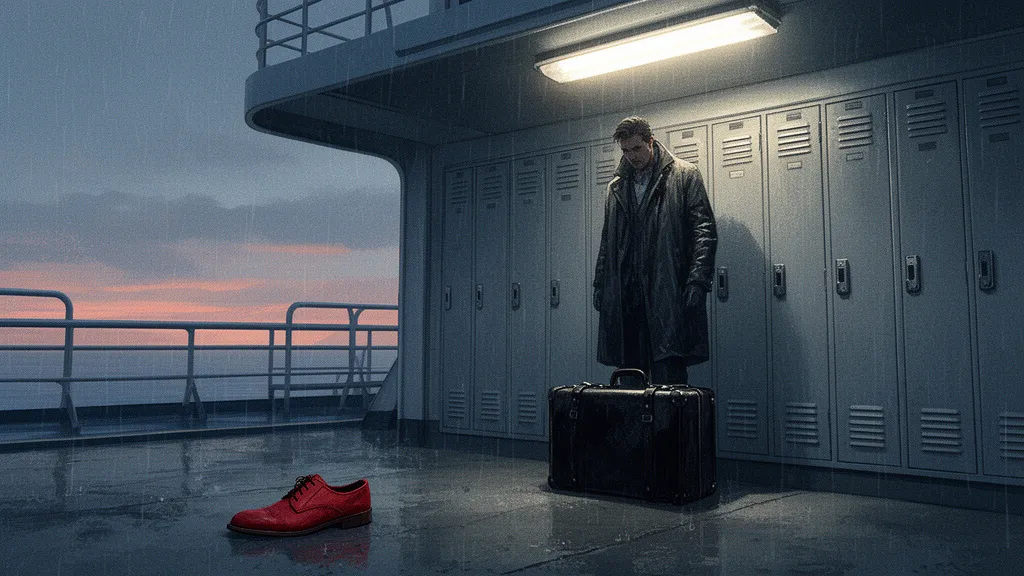
Rain beads on the case. Black leather, scuffed at the corners. My split lip stings when I lick it.
The locker hums. Fluorescent light buzzes like a dying insect. I check the time—05:47. The ferry from Tunis docks at 06:15. The man I’m supposed to meet, some guy named Karim, is already twenty minutes late.
I shift my weight. The concrete is cold through my soles. My jacket smells like wet wool and last night’s kebab.
The case is heavy. Too heavy for cash. Too light for a body.
I knock on the locker door. Hollow sound. Like knocking on a coffin.
No answer.
The phone rings before I touch the case.
Not my phone. The one inside. I hear it through the leather—a muffled, insistent trill. I unzip the case just enough to see the screen glowing through the gap. Unknown number.
I answer.
"You’re early." A man’s voice. Calm. Smoker’s rasp.
"Karim didn’t show."
"Karim’s dead."
I look around. The terminal is empty except for a cleaner pushing a mop in slow circles. The mop bucket sloshes. The sound echoes.
"Who is this?"
"Open the case."
I do. Inside, nestled in foam, is a child’s red shoe. Plastic. Cheap. The kind you buy at a market stall. The phone lies beside it, still connected.
"What the fuck is this?"
"Delivery’s changed. You’re taking the shoe to the address I’ll send. No stops. No questions."
"I don’t do kids."
A pause. Then, softer: "You do now."
The line goes dead.
The address arrives via text. A warehouse in La Joliette. I know the area—docks, cranes, the kind of place where things disappear. The kind of place where I disappear.
I zip the case. The red shoe is still there when I look again. Like it’s mocking me.
The first passengers trickle in. A family with too many suitcases. A backpacker with a guitar. They don’t look at me. I don’t look like a man holding a child’s shoe. I look like a courier. Just another guy with a job.
I light a cigarette. The smoke tastes like ash and bad decisions.
The warehouse is a rusted cube. No signs. No lights. Just a padlock on a chain-link gate. I park the scooter—stolen, of course—and kill the engine. The silence is worse than the rain.
I knock. Three times. Hard.
The door creaks open. A woman stands there. Tall. Dark hair pulled into a tight bun. She’s wearing a leather jacket, but her hands are steady. No rings. No fear.
"You’re late," she says.
"Traffic."
She doesn’t smile. "Give me the case."
I don’t move. "Who’s the kid?"
"Not your concern."
"It is if I’m walking into something I can’t walk out of."
She exhales. "The shoe is a message. Nothing more."
"Messages don’t need couriers."
"This one does."
I hand her the case. She opens it. Just a glance. Then she zips it back up.
"You’re done," she says.
"That’s it?"
"That’s it."
I don’t believe her. But I don’t have a choice.
I walk back to the scooter. My hands are shaking. Not from the cold.
The phone rings again. Same number.
I answer.
"Good job," the voice says. "Now forget the shoe."
"Easy for you to say."
"No. It’s not."
Click.
I ride. The rain picks up. The scooter’s headlight cuts through the dark like a knife.
I don’t go home. I go to a bar. Le Comptoir. Thierry’s place. He’s wiping glasses with a rag that’s seen better days.
"You look like hell," he says.
"Feel like it."
He pours me a pastis. I drink it in one go. The anise burns.
"You ever deliver something you wish you hadn’t?" I ask.
Thierry doesn’t answer. He just refills the glass.
The next morning, I wake up on Thierry’s couch. My head is pounding. My lip is still split.
I check the news on my phone. Nothing about a missing kid. Nothing about a body in the warehouse district.
I light a cigarette. The smoke curls around my fingers.
The red shoe is still in my head. Bright. Cheap. Plastic.
I should forget it. But I know I won’t.
Three days later, I’m back at the ferry terminal. Not for a job. Just to look.
The locker is empty. Cleaned out. Like nothing ever happened.
I buy a coffee. Black. No sugar. The barista gives me a weird look. I must look like a ghost.
Then I see her. The woman from the warehouse. She’s sitting at a table near the window. Reading a newspaper. Like she’s waiting for a train.
She looks up. Sees me. Doesn’t smile.
I walk over.
"You following me?" I ask.
"No."
"Then what are you doing here?"
She folds the newspaper. "Waiting for the next ferry."
"You don’t look like a tourist."
"I’m not."
I sit down. She doesn’t stop me.
"Who was the kid?"
She doesn’t answer right away. Then: "A girl. Six years old. Her father owed money."
"And the shoe?"
"A reminder."
"Of what?"
"That debts get paid."
I lean back. The chair creaks.
"You work for them?"
"I work for myself."
"Bullshit."
She almost smiles. "You’re still alive, aren’t you?"
I don’t have an answer for that.
I leave before the ferry arrives. I don’t want to know where she’s going.
I walk. The streets are wet. The city is waking up. A baker pulls up the shutter on his shop. The smell of fresh bread hits me like a punch.
I light another cigarette. The smoke mixes with the cold air.
The red shoe is still in my head. I know it always will be.
I flick the cigarette into a puddle. It hisses.
Then I keep walking.