The Salt Key
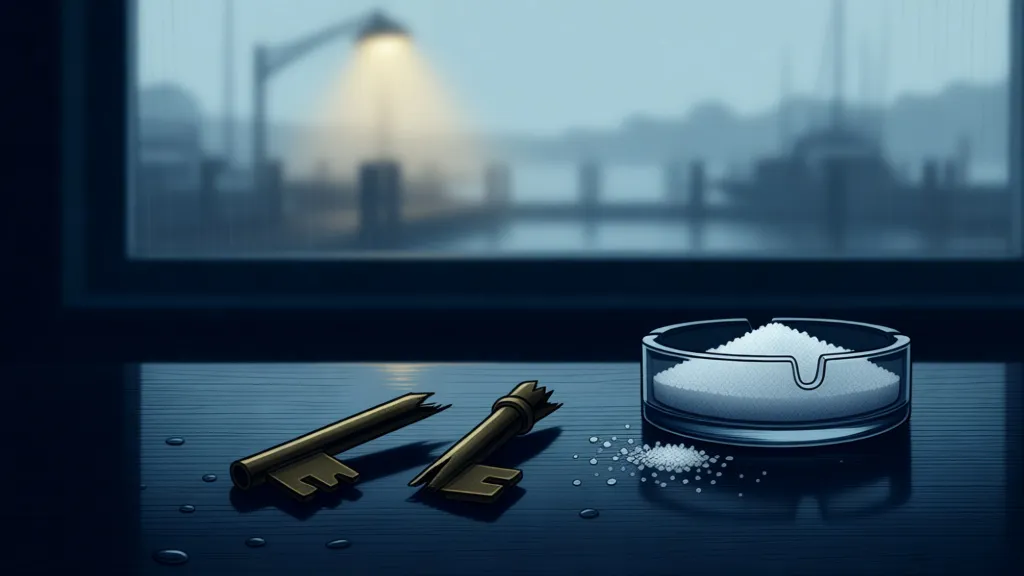
The lock clicks. Not the smooth turn of a well-oiled barrel—this is the sound of brass grinding against brass, the key fighting the tumblers like it’s got a grudge. Merde. I pull it free, the teeth bent at a forty-five-degree angle. The ashtray’s full of salt. Not cigarette ash. Salt. Coarse, white, the kind that comes in fifty-kilo sacks from the docks. It’s crusted around the broken key like it’s been there a while, but the desk’s still damp under my palm.
I don’t open marinas at dawn. Not usually. But the call came at 4:17 a.m., a number I didn’t recognize, a voice that wasn’t quite a voice—more like a man speaking through a wet sock. "Locksmith. Now. Vieux-Port office. Key’s in the door." Then the line went dead. No name, no explanation, no please. Just the kind of request that makes the back of your neck itch.
The ledger’s open to yesterday’s date. The page’s been torn out clean, the spine still holding a few ragged threads. The last entry before the gap reads "23:45 – Locker 17, duplicate issued to M. Voss (ID: FR-782-914)." The ink’s smudged, like someone tried to wipe it away with a thumb. Or a sleeve. Or a tongue.
I pocket the broken key. The salt I leave. Some messages aren’t for me.
The shop’s on Rue Caisserie, wedged between a halal butcher and a storefront that sells nothing but phone cases shaped like saints. The bell above the door jingles at 11:42 a.m. I know it’s him before I look up. The way he stands—feet planted too wide, hands clasped behind his back like he’s afraid they’ll wander off—screams harbor inspector. Or cop. Or someone who’s used to being lied to and hates it.
"You’re the locksmith," he says. Not a question. His French is too precise, the kind of accent that comes from years of filling out forms in triplicate. His cuffs are dark at the edges, the fabric stiff with saltwater. The plastic bag in his hand drips onto my tiles. Ploc. Ploc.
"Depends on who’s asking."
He doesn’t smile. "Inspector Duvall. Port Authority." He sets the bag on the counter. It slumps like a deflated lung. Inside, something heavy shifts. A shoe. Black leather, scuffed at the toe. A man’s shoe. The kind that costs more than my rent.
"You recognize this?"
I don’t touch it. "Should I?"
Duvall’s eyes flick to the ledger, still open on the desk. "Locker 17 was accessed last night. The key was returned broken. The duplicate’s missing."
"People break keys all the time."
"Not like this." He taps the bag. The shoe inside rolls. "Not when the locker’s been underwater."
I let that sit. The fan on the wall hums, pushing around air that smells like WD-40 and old coffee. Outside, a scooter backfires. Duvall doesn’t flinch.
"You issued a duplicate to a M. Voss," he says. "I need to know who he is."
"I don’t ask for life stories. Just IDs."
"The ID was fake."
"Then I don’t know what to tell you."
He leans in. The bag drips again. Ploc. "The man who was in that locker is dead. The man who locked him in is still out there. And you, monsieur, are the only one with a key that fits."
I don’t move. But my fingers brush the duplicate in my pocket. Warm. Smooth. The kind of key that doesn’t belong to me but feels like it does.
Duvall leaves at 12:14 p.m. He takes the bag. He doesn’t take the ledger. He doesn’t ask about the salt. But before he goes, he pauses at the door. "One more thing," he says. "That name—Duvall. It’s not mine. Just something I borrowed for the day."
I don’t react. But the back of my neck itches again.
I lock the door behind him. Flip the sign to Fermé.
The duplicate key burns in my pocket.
The marina office is quiet. Too quiet. The kind of quiet that makes you listen for the things that aren’t there—the hum of the fridge, the buzz of the neon sign, the sound of someone breathing on the other side of the door.
I don’t turn on the lights.
The ledger’s still open. I run my finger down the column. Locker 17. "Duplicate issued to M. Voss." Below it, in smaller print, "Client requested extra copy for ‘associate.’ No ID provided. Paid in cash. €200."
The associate. The one who didn’t want to be on the books.
I pull out the duplicate. It’s new. No scratches. No salt. Just a key that fits a lock that’s been underwater.
The phone rings. Once. Twice. I let it go to voicemail. The message clicks on. A voice, rough as sandpaper:
"You’ve got something that doesn’t belong to you. Bring it to the warehouse on Rue du Chantier. Alone. One hour. Or the next bag I drop off won’t have a shoe in it."
The line goes dead.
I play it again. The voice isn’t Duvall’s. Too deep. Too calm. The kind of calm that comes from knowing exactly how much trouble you’re in and not giving a damn.
The warehouse on Rue du Chantier is the kind of place that doesn’t have a name on the door. Just a number—17—painted in peeling red. The roll-up gate’s half-open, the metal groaning like it’s been kicked one too many times. Inside, the air smells like diesel and wet cardboard.
A man leans against a forklift. He’s got a face like a closed fist—all sharp angles and no give. In his hand, a knife. Not a big one. Just a little folding blade, the kind you buy at a gas station. He flips it open. Closed. Open. Closed.
"You’re late," he says.
"Traffic."
He grunts. "Key."
I pull out the duplicate. Hold it up. The light from the high windows glints off the brass. Then I let it slip through my fingers—just a little. Like I’m nervous. He reaches for it. I pull it back, palm a second key from my sleeve, and toss him the decoy. The one I filed down last night. The one that won’t turn in any lock.
He catches it. Doesn’t even look at it. Just pockets it and nods toward the door. "Pleasure doing business."
I don’t believe him.
The walk back to the shop takes twenty minutes. I don’t rush. I don’t look over my shoulder. I just walk, and I think about salt.
Salt in the ashtray. Salt on Duvall’s cuffs. Salt in the water that filled Locker 17.
The marina’s not far from the sea. But the lockers aren’t near the water. They’re on the second floor. Above the high-tide line.
Unless someone wanted them to flood.
The shop’s still locked when I get back. The sign’s still flipped to Fermé. I let myself in. The ledger’s where I left it. The torn page’s still missing.
I sit at the desk. Pull out a fresh sheet of paper. Write down what I know:
- A cop—or someone who used to be—ends up dead in a locker.
- A man with a borrowed name shows up with a wet shoe and a story that doesn’t hold water.
- A man with a knife wants the key to the locker that killed them both.
I tap the pen against the paper. Then I add a fourth line:
- The salt wasn’t an accident.
The phone rings. I don’t answer. The machine picks up. A voice, smooth as oil:
"Monsieur Duvall. Or whatever your name is. You should’ve taken the key when you had the chance. Now we’re going to have to do this the hard way. Check the ledger again. Page 47."
I hang up. Then I pull out the duplicate key. The real one. The one that’s still warm in my pocket.
Outside, the sun’s high. The Vieux-Port glitters like it’s made of broken glass. Somewhere, a boat horn blows. Somewhere else, a locker door creaks open.
I put the key in the ledger. Close the book. Lock it.
Then I walk to the marina. Alone."