The Warm Box
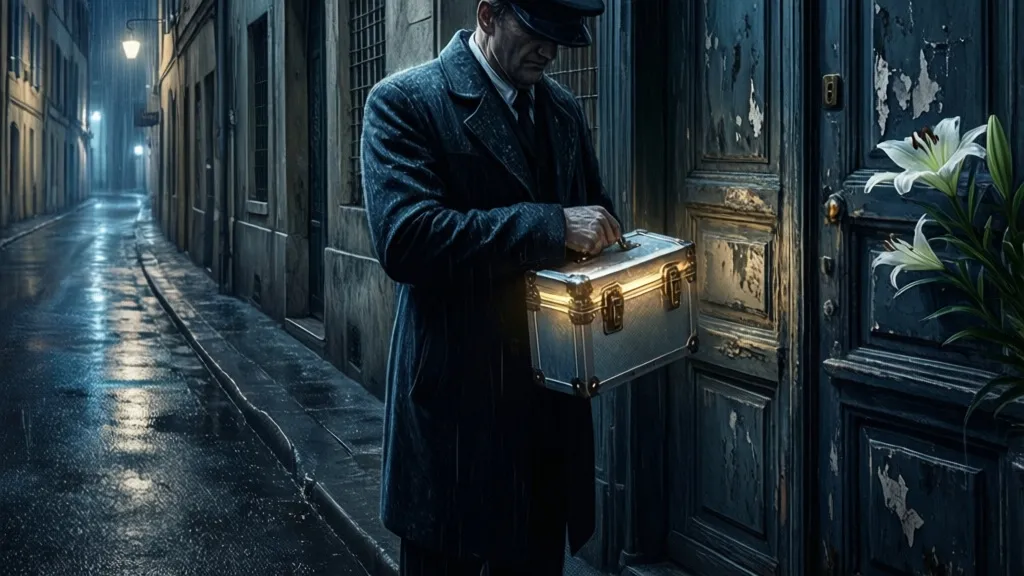
The lockbox hums against my ribs like a second heart. Not the steady thump of my own, but something smaller, faster—panicked. I adjust the strap, feel the heat through my shirt. The rain hasn’t let up since Toulon, and the leather of my gloves is starting to split at the seams.
Rue des Catalans 17. The number’s still there, stenciled in peeling black, but the rest is gone. Soot streaks climb the doorframe like ivy. A bouquet of white lilies leans against the threshold, their stems wrapped in damp newspaper. Someone’s been here recently. Someone who didn’t know the place was already dead.
I check the slip again. Delivery before 0500. No signature required. No mention of heat. No mention of the man upstairs, bare feet slapping against floorboards like he’s trying to outrun something.
The bell’s broken. I knock. Three sharp raps, the way my old man taught me—polite, but not like you’re asking permission.
The door opens before I can pull my hand back. A woman in a blood-spotted apron stares at me. Her hair’s tied up in a scarf, but strands have come loose, sticking to her neck. She doesn’t say anything. Just looks at the box, then at me, then back at the box.
"Delivery," I say. My voice sounds too loud in the narrow hallway.
She wipes her hands on her apron. The blood’s fresh. Not hers, I don’t think. The smell of copper and something sharper—ammonia, maybe—hits me before the draft from inside does.
"You’re early," she says. Her accent’s thick, the kind that comes from growing up in the hills above Cassis. Not Marseille proper. Not the kind of voice you expect in a place like this.
"Traffic was light."
A lie. There’s always traffic. But the truth—I took the long way because I was hoping the address would be wrong—won’t help either of us.
She reaches for the box. I shift it away, just enough. The heat’s worse now. Like holding a live thing.
"You sure this is the right place?" I ask.
Her eyes flick to the lilies. "It’s the right place."
Upstairs, the pacing stops. A floorboard creaks. The woman doesn’t look up.
I should leave. Drop the box, walk away, let the rain wash the whole thing off me. But the slip’s still in my pocket, and the rules are clear: No abandoned deliveries. No questions. The agency doesn’t care about heat or blood or men who pace in bare feet. They care about the fee.
And then there’s the other thing. The thing I saw when I turned onto the street.
A flash of light. Not lightning. Too quick, too yellow. A camera. Someone on a balcony across the way, leaning over the railing with a phone. I didn’t see a face, just the glow of the screen, the way it lit up the rain for half a second.
By noon, my face will be on every dock in the port. A wanted notice, but not from the cops. From people who don’t bother with extradition.
The woman’s still waiting. Her hands are steady. Mine aren’t.
"You want it or not?" I ask.
She takes the box. Her fingers brush mine. The heat’s worse than I thought. Like something’s alive in there. Something that’s been handled recently. Too recently.
The door closes before I can step back.
The rain’s heavier now. The first ferry horn sounds in the distance, low and mournful. I should be on it. Should be halfway to Algiers by sunrise, not standing in a soot-streaked doorway with the smell of blood in my nose.
I light a cigarette. The match flares, then dies. The smoke tastes like ash and salt.
The camera flash wasn’t the only thing I saw. There was a car, too. Parked half a block down. A black Peugeot, the kind that doesn’t belong in this neighborhood. No plates. Engine running. A man in the driver’s seat, watching the door. Watching me.
I take a drag, exhale slow. The cigarette’s already half gone. I should move.
Instead, I knock again.
The woman answers faster this time. The box is gone. Her apron’s cleaner. The blood’s been wiped off, but not all the way. There’s still a smear near the hem, dark against the white fabric.
"You forget something?" she asks.
"Who’s upstairs?"
She doesn’t answer. Just stares at me like I’m the one who’s out of place.
"The man pacing," I say. "Bare feet. Like he’s waiting for something."
Her mouth tightens. "You don’t need to know."
"I think I do."
A pause. Then, quiet: "My brother."
"He expecting a delivery?"
"No."
"Then why’s he up there?"
She steps forward. The doorframe’s narrow, but she fills it. "Because the box wasn’t for him. It was for me."
I don’t ask what’s in it. I don’t want to know. But I can guess. The heat. The blood. The way she held it like it was something precious.
"You should go," she says. "Before the sun comes up."
I should. But the Peugeot’s still there. The man inside’s still watching.
"They took a picture of me," I say. "When I got here. Someone across the street."
She doesn’t look surprised. "I know."
"You know."
"They’ve been watching the house for days."
"And you didn’t think to mention it?"
"Would it have changed anything?"
I don’t answer. The cigarette’s burned down to my fingers. I drop it, crush it under my boot.
"Who are they?"
"The same people who burned the place down," she says. "The same people who left the lilies."
The ferry horn sounds again. Closer this time. The sky’s starting to lighten, just a little, turning the rain from black to gray.
"You need to leave," she says. "Now."
I shake my head. "Not without knowing what I just delivered."
She hesitates. Then steps back, lets me inside.
The hallway’s narrow. The walls are lined with photographs. Black and white, mostly. A man in a fishing boat. A woman holding a baby. A younger version of the woman in the apron, standing in front of this same house, smiling.
The brother’s at the top of the stairs. He’s older than I thought. Sixty, maybe. His feet are bare, his toenails yellowed. He’s holding a rosary, the beads clicking between his fingers like a metronome.
"You’re the courier," he says. Not a question.
I nod.
"You should’ve left it at the door."
"I know."
He studies me. Then turns, walks into the apartment. I follow.
The place is gutted. The fire didn’t reach up here, but the smoke did. The walls are stained, the furniture covered in sheets. The air smells like wet ash and old incense.
The box is on the kitchen table. Open. Empty.
The brother picks up a knife. Not a kitchen knife. A boning knife, the kind you use to break down a fish. The blade’s clean, but the handle’s stained. Dark. Permanent.
"You want to know what was in it?" he asks.
I don’t. But I nod anyway.
He sets the knife down. Reaches into the box. Pulls out a plastic bag. Inside, something small and white. A tooth. Human. Adult. The root’s jagged, like it was pulled in a hurry.
"They took my nephew three days ago," he says. "Left the lilies on the doorstep. A warning."
I look at the tooth. Then at the woman. Her hands are clenched into fists.
"They wanted proof he was still alive," she says. "So they sent us a piece of him."
The brother puts the tooth back in the box. Closes the lid. The hinges creak.
"Now they’ll want proof we got it," he says. "That’s why they took your picture."
The ferry horn sounds again. The last one before departure. The sound echoes off the water, long and low.
I should run. Should get on that boat, disappear. But the Peugeot’s still outside. The man inside’s still waiting.
The brother picks up the knife. Tests the edge with his thumb. A drop of blood wells up, dark against his skin.
"You can go," he says. "Or you can help."
The woman doesn’t look at me. Doesn’t say anything. Just waits.
Outside, the rain keeps falling. The sky’s lighter now. Dawn’s coming.
I think about the heat of the box. The weight of it. The way it hummed against my ribs.
I think about the ferry. About Algiers. About all the places I could go where no one knows my name.
Then I look at the knife. At the tooth. At the woman in the blood-spotted apron.
"What do you need?" I ask.