The Warm Passport
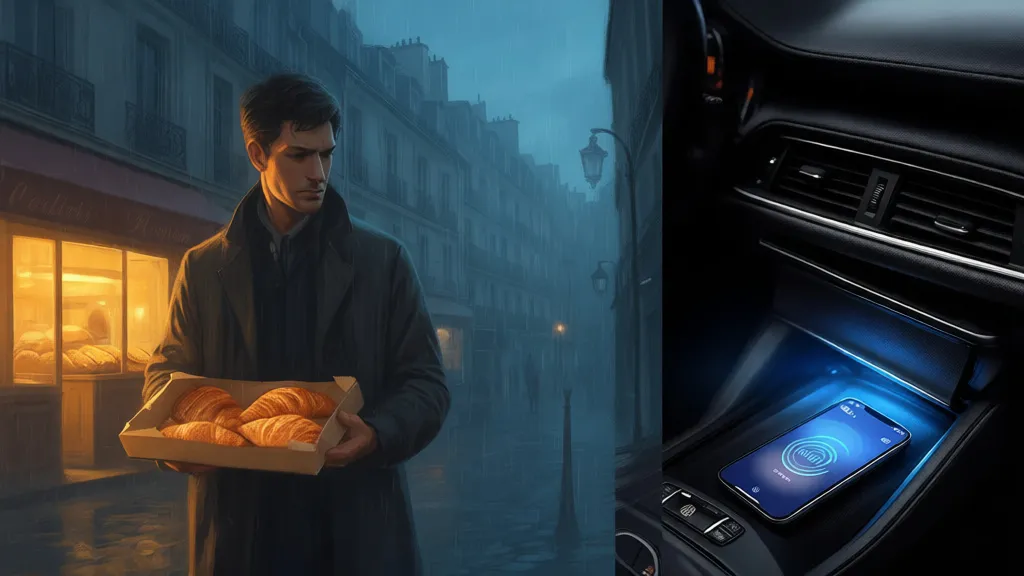
The croissant is still warm.
I know because the box burns my fingers when I pick it up. Not the usual bakery heat—this is oven-fresh, the kind that seeps through wax paper and leaves a ghost of butter on your skin. The delivery slip is taped to the lid: Rue du Marché aux Poulets, 3rd floor, no bell. No name. No tip.
I don’t ask. That’s the rule.
The Peugeot’s glove compartment is already open when I get back to the car. Not broken into—just hanging there like a slack jaw. Inside, a phone vibrates against the fake leather. The screen glows UNKNOWN, but the ringtone is Bella Ciao, which is either irony or a joke I don’t get. I let it ring. The box goes on the passenger seat. The passport slides out when I nudge it with my thumb.
Thierry Moreau.
The photo’s a bad one—flash-washed, eyes half-closed like he’s about to sneeze. But I know that face. Saw it two days ago on a slab in Saint-Pierre, the morgue’s fluorescent light turning his skin the color of old yogurt. The stairwell off Rue de Flandre had been narrow, the kind where you have to turn sideways to let someone pass. He’d been on his back, one arm twisted under him, the other flung out like he was reaching for the railing. No blood. Just a thin line of drool from the corner of his mouth, dried to a crust.
The phone stops ringing. I flip the passport shut. The corners are damp, the laminate already peeling at the edges. Like it’s been sweating.
The bakery’s a hole-in-the-wall on Rue des Bouchers, the kind that sells day-old bread at half price after 6pm. The baker’s a woman with forearms like ham hocks and a cigarette permanently glued to her bottom lip. She doesn’t look up when I walk in, just slides a tray of pain au chocolat into the display case with a clang.
"You the one who picked up the box?" Her voice is gravel and Gitanes.
"Yeah."
"You check inside?"
"No."
She exhales smoke through her nose. "Good. Means you’re not an idiot."
I wait. The oven hums behind her, the heat pressing against my face like a hand.
"You deliver to the same place again in an hour," she says. "Different box. Same instructions."
"What’s in it?"
"None of your fucking business." She stubs out the cigarette on the counter, leaving a black smear on the Formica. "But if you’re smart, you’ll forget the first box ever existed."
The Peugeot’s parked half a block down, wedged between a DHL van and a scooter with a busted taillight. The phone’s ringing again when I open the door. Bella Ciao, same as before. I answer this time.
"You’re late." The voice is male, accentless. Not French, not Dutch, not anything I can place. "The border doesn’t wait for couriers."
"Who is this?"
"The man who knows where you are." A pause. "And where the box is."
I look around. The street’s empty except for a drunk pissing against a shuttered kebab shop. No cameras. No faces in the windows.
"You’re watching me?"
"I’m watching the passport." Another pause. "Thierry Moreau. Died in a stairwell off Rue de Flandre. No next of kin. No autopsy. Convenient, isn’t it?"
My fingers tighten around the phone. "What do you want?"
"The same thing I wanted when I called the first time. The box. Delivered on time. To the right address."
"And if I don’t?"
"Then I tell the police where to find the Peugeot. And the body in the trunk."
The line goes dead.
The trunk’s empty when I pop it. Just a spare tire, a jack, and the sour smell of old fast food. No body. No blood. But the carpet’s been peeled back in one corner, the glue still tacky. Someone’s been in here recently.
I slam it shut. The phone rings again.
"You’re thinking about running," the voice says. "Don’t."
"How do you—"
"Because I know what you’re carrying. And I know what happens to people who try to keep it."
I don’t ask. I already know.
The second box is heavier. No croissant this time—just a loaf of sourdough, the crust scored with a pattern I don’t recognize. The delivery address is the same, but the instructions have changed: Leave it on the doorstep. Do not knock.
I park three streets over and walk the rest of the way. The building’s a walk-up, the kind with peeling paint and a buzzer that hasn’t worked since the ‘90s. The third-floor landing smells like boiled cabbage and bleach. No name on the door. No bell.
I set the box down. The sourdough shifts inside, the crust cracking like dry bones.
The phone rings before I can turn away.
"Good boy," the voice says. "Now go home."
"What’s in the bread?"
"Nothing you need to worry about."
"And the passport?"
A laugh, dry as paper. "The passport’s already where it needs to be. By midnight, Thierry Moreau’s ghost will be in Germany. By morning, he’ll be in Switzerland. And by the time anyone notices he’s missing, he’ll be someone else entirely."
"He’s dead."
"People die every day." The line crackles. "But passports? Good passports are harder to come by. And dead men don’t need them."
I don’t go home.
Instead, I drive to Rue de Flandre. The stairwell’s still there, the railing bent where Thierry Moreau must’ve grabbed it on the way down. The police tape’s gone, but the smell lingers—cheap cologne and something metallic, like a coin left in the rain.
I sit on the steps and wait.
The phone rings at 11:47.
"You’re not where you’re supposed to be," the voice says.
"No."
"This is a mistake."
"Maybe." I look up at the landing. "But I want to know why a dead man needs a warm passport."
Silence. Then: "You’re not getting paid enough for this."
"I’m not getting paid at all."
A sigh. "Fine. You want the truth? Thierry Moreau was a mule. Not drugs. Not cash. People. He moved them across borders, one at a time, in the backs of vans and the trunks of cars. But he got greedy. Started skimming. Taking photos. Blackmail."
"So you killed him."
"No. They killed him. The people he was working for. But the passport? That was mine. And I want it back."
"Why not just take it?"
"Because I don’t know where it is." A beat. "But you do."
I stand up. The stairwell spins for a second, the walls pressing in. "You’re lying."
"Am I?" The voice is calm. "Then tell me, courier—how did I know you were in that stairwell just now? How did I know you’d recognize Thierry’s face?"
The phone beeps. A text comes through. A photo. Me, sitting on the steps, the Peugeot’s license plate visible in the background.
"You’ve got until midnight," the voice says. "After that, the police get an anonymous tip. About a stolen car. And the body in the trunk."
I glance at the trunk. "There’s no body."
"You sure about that?" A pause. "Check again."
The bakery’s closed when I get back. The shutters are down, the lights off. But the side door’s unlocked, the handle warm to the touch.
Inside, the oven’s still on, the heat pressing against my skin like a warning. The baker’s on the floor, her apron soaked through with something dark. Her eyes are open, staring at the ceiling. The cigarette’s still in her mouth, burned down to the filter.
The phone rings.
"You’re early," the voice says. "I’m impressed."
"You killed her."
"She was a liability. Like you."
I crouch down. The baker’s hands are clenched into fists, her nails broken. She fought.
"Where’s the passport?"
"In the oven." A pause. "Where else?"
I open the oven door. The heat blasts my face, the smell of burning hair and melted plastic. Inside, a metal tray holds the charred remains of a passport, the edges curled like dead leaves. The photo’s gone, but the name’s still legible, the letters bubbled and black.
Thierry Moreau.
The phone rings again.
"Happy now?" the voice asks.
I don’t answer. I’m too busy looking at the baker’s left hand. Her fingers are curled around something small and plastic. A SIM card. The kind you find in a phone.
The kind that’s been removed.
I pull the glove compartment phone out. The back’s already off. No SIM inside. He’d taken it out. But he’d forgotten one thing—the GPS chip isn’t just in the SIM. It’s in the phone itself.
The Peugeot’s parked outside a warehouse near the canal, the kind with broken windows and a rusted crane. The phone’s been ringing nonstop since I left the bakery, but I haven’t answered. Let him wonder.
The GPS app on my burner pings. The red dot’s moving. Not far. Right here.
I dial the number back.
He picks up on the first ring.
"Took you long enough."
"You’re not as smart as you think," I say.
A laugh. "And you’re not as dumb as you look."
"You killed the baker. You burned the passport. But you forgot one thing."
"Oh?"
"The phone in the glove compartment." I look at the warehouse. The door’s ajar, a sliver of light spilling onto the pavement. "It’s got GPS. And you left it on."
Silence. Then: "You’re bluffing."
"Am I?" I step closer. "Because I’m standing outside your little hideout right now. And I’ve got the police on speed dial."
A beat. Then the line goes dead.
The warehouse is empty when I walk in. No crates. No people. Just a folding chair, a laptop, and a half-empty bottle of Jupiler. The laptop’s still on, the screen glowing with a map of Brussels. A red dot pulses near the canal, right where I’m standing.
The phone rings. Bella Ciao again.
I answer.
"You win," the voice says. "For now."
"Where are you?"
"Somewhere you’ll never find me." A pause. "But you should know—Thierry Moreau wasn’t the only one. There are others. Dozens. Hundreds. And they all need passports."
"So what?"
"So this isn’t over." The line crackles. "It’s just beginning."
The call ends. I look at the laptop. The map’s still up, the red dot blinking. Then it moves—slow at first, then faster, heading north toward the border.
I smash the laptop with the chair. The screen cracks, the map dissolving into static.
Outside, the Peugeot’s engine turns over on the first try. The glove compartment’s still open, the phone silent now. I toss it into the canal. The water swallows it without a sound.
The bakery box is on the passenger seat, the sourdough gone stale. I break off a piece and eat it as I drive. It tastes like ash.
By midnight, I’m on the E40, the border a distant glow on the horizon. The passport’s gone. The baker’s dead. And Thierry Moreau?
He’s still in that stairwell." }