The Wet Passport
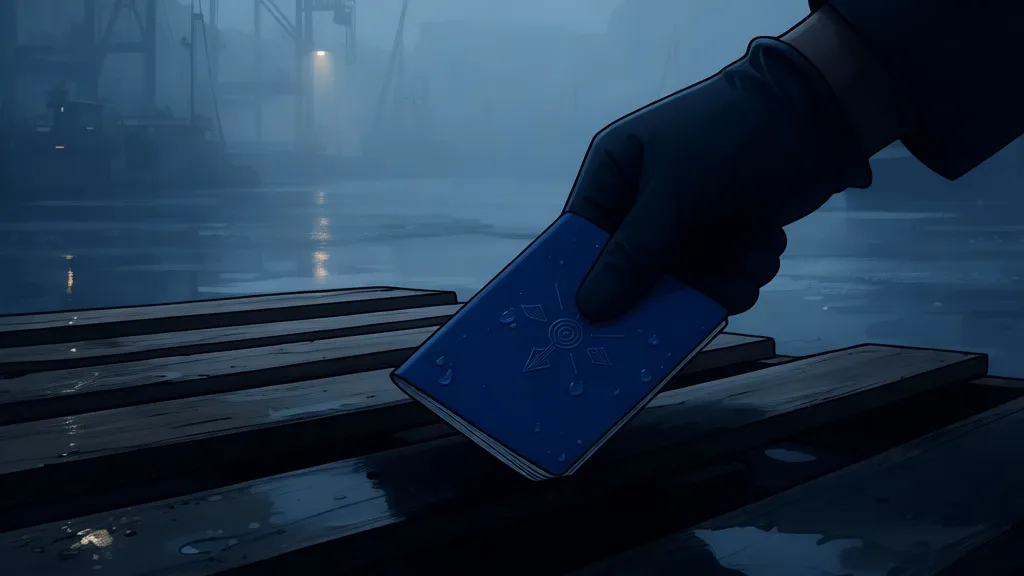
The pallet shifts. A wet thwack as something slides free.
Joachim freezes. His gloves are slick with fish guts, the smell of diesel and brine thick in the pre-dawn air. The docks at La Joliette are never quiet—cranes groan, forklifts beep, the occasional shout in Arabic or Wolof—but this sound is wrong. Too soft. Too personal.
He crouches. Between the slats of the pallet, something glints. Not a fish scale. Not a coin.
A passport.
Blue cover, gold embossing. The edges are damp, the lamination peeling like sunburnt skin. Joachim pries it loose. The photo inside is blurred—salt, maybe, or a thumb pressed too hard. The name beneath it reads Djamel Kader, but the face is a smudge, a ghost.
He should hand it in. The lost-property office at the port authority is two blocks away. They’ll log it, file it, forget it.
Joachim pockets it instead.
The ferry horn blares at 05:47. Joachim watches from the dock as the Corsica Linea pulls away, its white hull streaked with rust. He lights a Gauloise, the smoke bitter in his throat. The passport burns against his thigh.
He tells himself it’s nothing. A scrap of bad luck, like finding a wedding ring in a mussel. But the photo won’t leave him alone—the way the thumbprint smears the face, like someone tried to erase it.
At 06:12, his phone buzzes. A text from his sister in Aubagne: Maman’s pressure is up. Doctor says no salt.
Joachim deletes it. He doesn’t reply.
The woman is waiting outside the port authority at 09:15.
Joachim spots her from across the street. Beige raincoat, even though the sun is already sharp enough to bleach the graffiti off the walls. She’s holding a plastic bag of cherries, the stems poking out like tiny brown fingers. Her hair is pulled back in a tight bun, the kind that doesn’t move unless you want it to.
He slows his pace. The passport is in his jacket pocket, folded in half like a secret.
The woman smiles. Not at him. At the space just over his shoulder.
"You’re not Djamel," she says.
Joachim stops. The cherries glisten in the bag. One of them splits, juice running down the plastic.
"No," he says.
"But you were at the docks this morning."
A statement. Not a question.
Joachim looks at the cherries. At the juice. At the way the woman’s fingers don’t tremble.
"I work here," he says.
The woman sighs. She reaches into the bag and pulls out a cherry. Pops it into her mouth. The pit clicks against her teeth.
"The passport was under a pallet at La Joliette," she says. "Wet. Like someone dropped it in a hurry."
Joachim’s stomach tightens. He can smell the cherries now—sweet, overripe. The security camera above the port authority door buzzes, its red light blinking.
"I don’t know what you’re talking about," he says.
The woman nods. She spits the pit into her palm. It’s clean, polished by her tongue.
"Djamel’s been gone three weeks," she says. "No calls. No messages. Just a text to his boss saying he was sick."
Joachim doesn’t move. The ferry leaves in two hours.
"I don’t know him," he says again.
The woman steps closer. The cherries sway in the bag.
"His sister reported him missing," she says. "The police laughed. Said he probably ran off with a girl."
Joachim’s fingers brush the passport in his pocket.
"I’m not the police," the woman says. "I’m just the one who gets sent when the police won’t."
A beat. The sound of a scooter backfiring two streets over.
"You have something of his," she says.
Joachim exhales. The smoke from his cigarette curls between them.
"I don’t know what you’re talking about," he says.
The woman smiles. It doesn’t reach her eyes.
"The ferry leaves at 11:30," she says. "You should be on it."
Joachim’s flat is on the third floor. No elevator. The stairs smell like fried onions and bleach.
He unlocks the door. The woman follows.
Inside, the air is stale. A half-empty bottle of pastis on the counter. A stack of unpaid bills held down by a chipped mug. The passport is still in his pocket.
The woman sets the cherries on the table. She doesn’t sit.
"You’re not a cop," Joachim says.
"No," she says.
"You’re not his wife."
"No."
"Then what do you want?"
The woman picks up the pastis bottle. Turns it in her hands. The label is peeling.
"Djamel owed money," she says. "A lot of it. To people who don’t like waiting."
Joachim’s throat is dry. He reaches for the bottle. The woman hands it to him. Their fingers don’t touch.
"How much?" he asks.
"Enough that they sent me to find him," she says. "Enough that when I tell them he’s gone, they’ll start looking for who he left behind."
Joachim takes a swig. The anise burns.
"I don’t know him," he says.
The woman watches him. Her eyes are the color of wet pavement.
"The passport says otherwise," she says.
Joachim sets the bottle down. The passport is still in his pocket. He pulls it out. Hands it to her.
The woman flips it open. The photo is still blurred. The thumbprint still there.
She looks at him.
"You could’ve thrown it away," she says.
Joachim shrugs.
"I thought about it," he says.
The woman closes the passport. Slips it into her coat.
"You should go," she says.
Joachim doesn’t move.
"What happens to Djamel?" he asks.
The woman picks up a cherry. Rolls it between her fingers.
"Nothing good," she says.
The ferry terminal is crowded. Tourists with backpacks, old men with cigarettes, a group of teenagers laughing too loud.
Joachim buys a ticket at 11:12. One way to Algiers. The name on the ticket is Joachim Moreau.
He doesn’t look at the passport in his pocket. Instead, he watches the security camera above the ticket booth. Its red light blinks, steady and unblinking.
The woman isn’t at the terminal. Neither is anyone else.
At 11:20, he boards. The deck is hot, the metal burning under his palms. He finds a spot by the railing. The water below is dark, choppy.
The ferry pulls away at 11:30.
Joachim lights a cigarette. The smoke mixes with the salt air.
He doesn’t know Djamel Kader. Doesn’t know the woman in the beige raincoat. Doesn’t know why the passport was wet, or why the photo was blurred, or why the thumbprint looks like it was pressed there in panic.
He knows the ferry leaves at 11:30.
He knows he’s on it.
The woman’s voice in his head: You should be on it.
Joachim exhales. The smoke curls into the wind.
Somewhere in the city, a cherry pit hits the pavement." } }