The Wrong Pocket
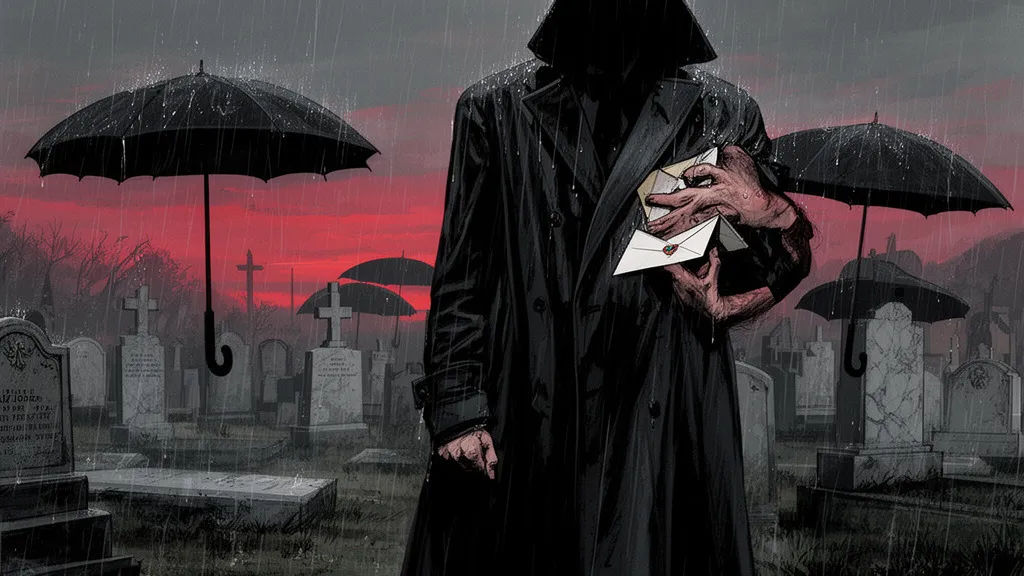
The rain tastes like salt and rust.
I press the envelope into the coat pocket, fingers slipping on wet wool. The fabric gives—too easy. Not the right resistance. I don’t look up. The priest is still droning about dust and mercy, his voice bouncing off the marble like a bad echo. The mourners stand in a loose half-circle, black umbrellas tilting toward the grave like sunflowers gone rotten.
Then the pocket moves.
Not the whole coat. Just the pocket. A twitch, a shift. The man inside it exhales through his nose, a sound like a kettle about to scream. I glance sideways. Dark suit, dark tie, dark eyes locked on the coffin. The dead man’s brother. I know the face from the file: Léon Vasseur, 42, dock foreman, two priors for aggravated assault, last known address—
The envelope is already gone.
The café on Rue Saint-Ferréol is all steam and shouting. I shake water from my sleeves, leave the umbrella dripping by the door. The envelope should have gone to the woman in the green scarf—Madame Duvall, 58, widow, no priors, but her nephew runs the fish market and the fish market runs the port—but instead it’s here, on this table, spread open like a wound.
A half-melted sugar cube. A key. Blood in the grooves, fresh enough to smear when I touch it.
The brother sits across from me, fingers drumming the table. Léon. His knuckles are split. Old scars, new scabs. He doesn’t look like a man who just buried his brother. He looks like a man who’s about to dig someone else up.
"You gave it to me." "You were the wrong pocket." "Doesn’t matter. Now it’s mine."
I don’t argue. Arguing is for people who expect to live past midnight.
The key is small. Too small for a locker, too big for a mailbox. The blood isn’t his—Léon’s hands are clean, just the usual grime under the nails. He wipes the key on his thigh, leaves a rust-colored streak on the wool.
"Who else saw?" "The priest. The widow. The guy selling umbrellas outside the cemetery." "Not funny."*
I don’t tell him about the kid. The one in the too-big suit, lurking by the mausoleum, watching the handoff. The one who slipped away before the rain got heavy.
The harbor at 11:47 PM is a graveyard of cranes and shadows. Léon moves like he owns the place, which he might. The key fits a padlock on a storage container near the old customs house. The door groans open. Inside: a single crate, stenciled with a logo I don’t recognize. Fragile. Perishable.
Léon pries the lid off. No fish. No drugs. Just a stack of black plastic cases, each the size of a shoebox. He flips one open. Wires. A timer. A block of something that looks like modeling clay but smells like a chemistry lab.
"You’re a courier," he says. "You know what this is."
I know what it isn’t. It isn’t a delivery. It isn’t a mistake. It’s a message, and the clock is ticking.
The kid from the cemetery is waiting outside the container. He’s not a kid. Mid-twenties, maybe. Face like a weasel, eyes like a rat. He’s holding a phone, thumb hovering over the screen.
"You’re late," he says. "They don’t like late."
Léon doesn’t hesitate. He grabs the kid by the throat, slams him against the container. The phone clatters to the ground. The screen lights up: 11:58.
"Who’s they?" Léon asks.
The kid grins. Blood on his teeth.
"The people who paid for the funeral."
The explosion is small. Contained. A pop, a flash, the container door buckling inward. The kid’s body jerks, then goes limp. Léon drops him, wipes his hands on his coat like he’s just touched something dirty.
"Clock’s still moving," he says. "Midnight’s not the deadline. It’s the starting gun."
I don’t ask what happens at midnight. I don’t want to know.
The widow’s house is dark. No lights, no sound. Just the smell of old money and new grief. Léon picks the lock. Inside, the green scarf is draped over a chair, still damp from the rain.
"You think she’s in on it?" I ask.
He doesn’t answer. He’s too busy opening drawers, flipping mattresses, tearing apart the place like a man looking for something he’s already lost.
Then the phone rings.
Not a cellphone. A landline. Old-school, rotary dial. The sound cuts through the silence like a knife. Léon stares at it. The ringing stops. A voice on the other end, tinny and distant:
"You have something that doesn’t belong to you."
Léon slams the receiver down. The phone rings again.
"Give it back," the voice says. "Or we take it."
The key is still in Léon’s pocket. The blood is still on the metal. The clock is still moving.
"What do you want?" I ask.
He looks at me like I’ve just asked him to explain the rain.
"I want my brother to not be dead."
The phone rings again.
We’re back at the harbor by 12:30. The container is a smoldering ruin. The kid’s body is gone. The widow’s house is empty. The only thing left is the key, and the key is just a key now—no blood, no secrets, just a piece of metal that doesn’t fit anything anymore.
Léon tosses it into the water. It sinks without a sound.
"They’ll come for me," he says. "Or they won’t."
I don’t ask who they are. I don’t ask what happens next. I just watch the ripples spread, then disappear.
The rain starts again. Tastes like salt and rust.
Epilogue, three days later:
The fish market is open. The widow is selling tuna. The priest is blessing sardines. The envelope is gone. The key is gone. The brother is gone.
I’m still here.
The rain never stops.