Your Name Here
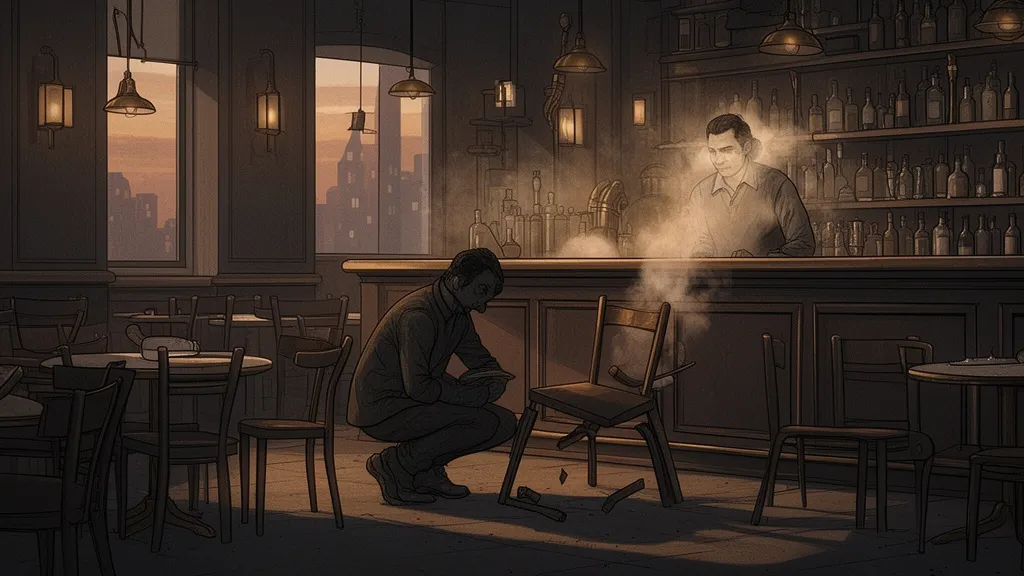
The chair leg is loose. I tap it with my boot—hollow. Not rot. Someone drilled it out.
I glance at the counter. The barman’s back is turned, steam from the espresso machine fogging his glasses. The café’s half-empty, the kind of quiet where a cough sounds like a gunshot. I kneel, pretend to tie my lace. The chair wobbles. I work my fingers into the gap, feel the rough edge of the wood, the sticky residue of glue. Inside, something wrapped in cloth. A handkerchief, maybe. Thick. Heavy.
I pull it out. The fabric’s damp, the kind of damp that isn’t just from the air. Blood-specked. Not fresh. Old enough to brown. The knot’s tight, but my nails are sharper. Inside, a stack of notes—fifties, hundreds, a few twenties thrown in like an afterthought. More money than I’ve seen in one place since last winter. Since him.
I shove it into my jacket pocket. The chair leg goes back in, loose as before. No one’s looking. The barman’s still wiping the same glass he’s been wiping for ten minutes.
Then I see the slip of paper tucked under the cash. A delivery note, the kind I used to run before I learned how to say no. My name’s on it. Lucien Vasseur. My address. The café’s name. Today’s date. No signature. No instructions. Just my name, like a dare.
I stand up too fast. The chair scrapes. The barman turns, squints at me. I force a smile, drop a coin on the counter. Keep the change. He shrugs, goes back to his glass.
Outside, the rain’s stopped, but the pavement’s still slick. The streetlamp flickers, the kind that’s been flickering since before I was born. And there he is, leaning against the lamppost like he’s been waiting for a bus. Remy. Split lip, one eye swollen shut. The calm smile of a man who’s already won.
Lucien, he says. You’re late.
I don’t answer. My fingers twitch toward the pocket, but I keep my hands where he can see them. The money burns. Not the cash—the note. The way it had my name on it like a label.
You took the job, he says. Good. I knew you would.
I didn’t take shit.
He laughs, a wet sound. Then why’s your hand in your pocket?
I pull it out empty. Habit.
Sure. He pushes off the lamppost, steps closer. The rain’s started again, fine and cold. You got the package?
What package?
The one in the chair.
There was no package.
Lucien. His voice is soft. I paid you to disappear. Not to lie to me.
I swallow. The money’s a lump against my ribs. You paid me to leave town. I left.
And now you’re back.
Not for you.
No? He tilts his head. Then who?
I don’t answer. The truth’s worse than the lie. I came back because Marseille’s the only city where I know which alleys have cameras and which don’t. Because my sister’s kid’s in the hospital, and the bills are piling up, and the only thing I’m good at is moving things that don’t belong to me. Because last winter, Remy paid me to vanish, and I did, but the money ran out, and now here I am, standing in the rain with a handkerchief full of blood money and a man who looks like he’s been hit by a truck.
You want it back? I ask.
Want what?
The money.
He smiles. It’s not mine.
Then whose is it?
Yours, Lucien. If you want it.
I laugh. It sounds like a cough. That’s not how this works.
No? He steps closer. The streetlamp flickers again. For a second, his face is in shadow. Then how does it work?
I don’t know. That’s the problem. I don’t know who left the money. I don’t know why it had my name on it. I don’t know if Remy’s here to collect or to warn me. I don’t know if the blood on the handkerchief is his or someone else’s. I don’t know if the police are already looking for me, or if they’re the ones who put the money in the chair in the first place.
You’re in trouble, I say.
Me? He touches his split lip. I’m fine.
Then why’s your face look like that?
Long story.
I’ve got time.
No, he says. You don’t.
A car rolls past, slow. The headlights catch the rain, turn it into needles. Remy doesn’t look at it. Neither do I. We both know what happens when you look at the wrong car at the wrong time.
Midnight, he says. You bring the money to the old fish market. Alone.
Or what?
Or I come to your sister’s place.
The air leaves my lungs. You wouldn’t.
Try me.
I believe him. That’s the worst part. I believe him.
The police station’s a ten-minute walk. Five if I run. The fish market’s fifteen. The harbor’s twenty, but the last ferry leaves at eleven-thirty. I check my watch. Nine-forty. Two hours and twenty minutes to decide.
I walk. Not toward the police. Not toward the fish market. Just walk, hands in my pockets, the money a dead weight against my thigh. The streets are quiet. Marseille at night is a city of closed shutters and flickering neon. The kind of place where you can disappear if you know how. I used to know how.
I duck into a bar, the kind with no name and no windows. The bartender’s a woman with a scar through her eyebrow. She doesn’t ask. Just slides a pastis across the counter. I drink it in one go. The anise burns.
You look like shit, she says.
Thanks.
You want another?
No. I push the glass back. You know Remy?
She doesn’t blink. Who?
The guy with the split lip.
Never heard of him.
Bullshit.
She smiles. You want another drink or not?
I leave a twenty on the counter. Keep it.
Outside, the rain’s stopped again. The streets are slick, the cobblestones shining under the streetlamps. I walk faster. The money’s still in my pocket. The note’s still in my head. Lucien Vasseur. Like a brand.
I pass a phone booth. The kind that still works if you know how to use it. I step inside, pick up the receiver. The dial tone’s a dull hum. I could call the police. Tell them I found money in a chair. Tell them I don’t know what it’s for. Tell them I’m scared.
I hang up. The police don’t help people like me. They help people like Remy.
The fish market’s a ruin. The roof’s half-collapsed, the stalls rotting. The smell of old fish and saltwater lingers, even though the place hasn’t been used in years. I step inside, my boots crunching on broken glass. The money’s in my jacket, the handkerchief wrapped tight around it. No blood on my hands. Not yet.
Remy? My voice echoes. You here?
No answer. Just the sound of water dripping from the rafters. The streetlamp outside flickers, throws shadows across the walls. I check my watch. Eleven-fifty. Ten minutes to midnight.
Then I see it. A shape in the corner. A man, sitting on a crate. His head’s down, his hands in his lap. I can’t see his face.
Remy?
He doesn’t move. I step closer. The smell hits me first. Copper and salt. Then I see the blood, dark and wet, soaking through his shirt. His hands are tied behind his back. His throat’s been cut.
I don’t scream. I don’t run. I just stand there, staring at the body of the man who was supposed to meet me. The man who knew my name. The man who paid me to disappear.
Then I hear the footsteps. Slow. Deliberate. Coming from the back of the market. I turn, my hand already reaching for the money. But it’s not Remy. It’s not the police.
It’s a woman. Tall. Dark coat. Her face is in shadow, but I can see the gun in her hand. Not pointed at me. Not yet.
Lucien Vasseur, she says. You have something that belongs to me.
I swallow. I don’t know what you’re talking about.
She steps closer. The streetlamp flickers again. For a second, I see her face. Sharp cheekbones. Cold eyes. A scar across her lip. The money, she says. The money in the chair.
It’s not yours.
No? She tilts her head. Then whose is it?
I don’t know.
But you took it.
I found it.
In a chair. With your name on it.
Yeah.
That’s a coincidence.
I don’t believe in coincidences.
She smiles. Neither do I.
I glance at Remy’s body. You kill him?
No. She follows my gaze. But I know who did.
Who?
The same people who want the money.
And you?
I want it too.
Why?
Because it’s mine.
You’re not making sense.
Neither are you. She steps closer. The gun’s still not pointed at me, but it’s closer. Give me the money, Lucien.
Or what?
Or I walk out of here, and you explain to the police why there’s a dead body and a handkerchief full of cash with your name on it.
I laugh. It sounds hollow. You think the police care about me?
No, she says. But they care about the money.
I look at Remy. At the blood. At the woman with the gun. At the money in my pocket. What’s so special about it?
She doesn’t answer. Just holds out her hand. Midnight, she says. Tick tock.
I check my watch. Eleven-fifty-eight. Two minutes.
I pull the handkerchief from my pocket. The blood’s dried now, brown and flaky. I hold it out. She takes it, unwraps it. The cash is still there. She counts it, quick and efficient. Then she looks at me.
You’re lucky, she says.
How’s that?
You could’ve been the one with your throat cut.
Yeah, I say. Lucky me.
She pockets the money, tucks the gun into her coat. Go home, Lucien. And next time you find something that doesn’t belong to you, leave it where it is.
There won’t be a next time.
There’s always a next time. She turns, walks toward the back of the market. I watch her go, the shadows swallowing her whole.
I look at Remy one last time. Then I walk out, into the rain. The streets are empty. The harbor’s a dark line in the distance. The last ferry’s gone.
I start walking. Not toward home. Not toward the police. Just away. The money’s gone. The note’s gone. The body’s still in the fish market, but it’s not my problem anymore.
I check my watch. Midnight. The night’s just getting started.