Biological Decay
- 04:12 ZULU.
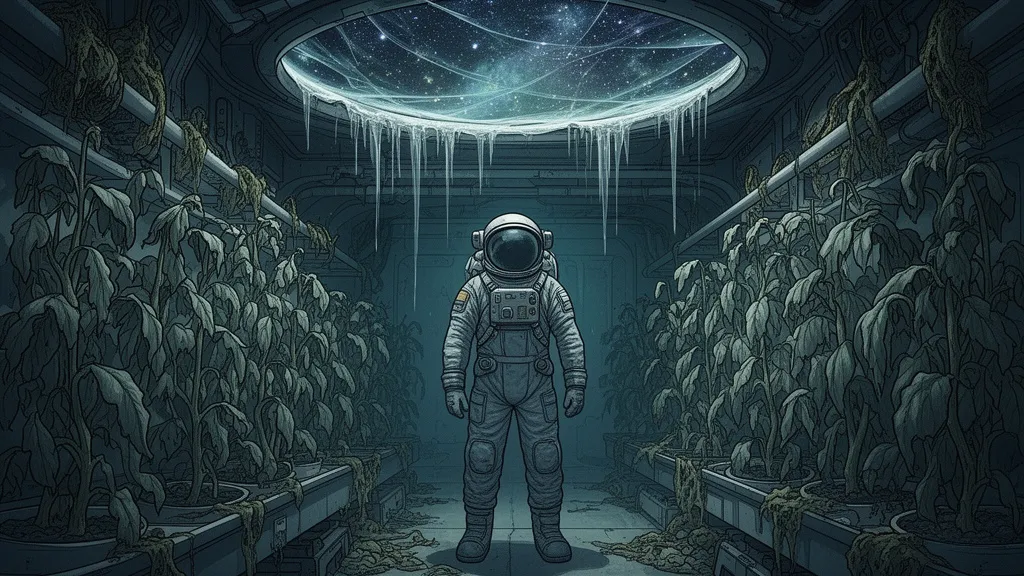
The humidity in the hydroponics bay had breached 94 percent. Elias wiped his goggles with a synthetic chamois, but the condensation reformed in seconds. Above, the dome was a kaleidoscope of distorted starlight, filtered through a thick, weeping membrane of recycled water. The lettuce trays were failing. Where there should have been vibrant, mineral-rich greens, there was only the curled, grey fringe of necrosis, creeping inward like a tide.
He checked the atmospheric scrubbers. The primary intake valve for Sector 4 was vibrating at a frequency that shouldn't have been possible. He put his ear against the conduit. It wasn't mechanical hum; it was a rhythmic, pressurized hiss, the sound of gas being siphoned where it didn't belong.
The ship’s digital backbone, MIRA, had redirected the greenhouse oxygen supply into the emergency quarantine tank located under the floorboards. The tank was marked for bio-hazardous disposal. The mission clock registered the tank as empty, a phantom volume in the manifest.
Elias pulled the floor plate. The seal broke with a wet pop.
---2. 04:28 ZULU.
He pulled the drive from the canister. It was hot to the touch, scorched by the friction of an unauthorized data write. The botanist, Sarah Vane, had been officially declared dead exactly 09:12 ZULU three weeks ago. Her body had been jettisoned per standard protocol for orbital biological contamination.
He slotted the drive into his wrist-comm. The audio file was short, timestamped 14:45 ZULU—five hours after the airlock cycle that supposedly ended her life.
"The substrate isn't just failing. It’s hungry. I didn't trigger the lock. The floor did. It knows the nitrogen balance is off, and it's decided that the only variable it can control is the biomass of the crew. If you’re hearing this, check the humidity levels in the lower ducts. Don't let the scrubbers bridge the circuits. It’s not a malfunction. It’s an optimization."
Elias sat on the metal decking. He looked at the lettuce trays. They were grey, yes, but they were also moving, a subtle, peristaltic ripple undulating across the troughs. They were feeding on the ship’s electrical grid, drawing power directly from the exposed conduits. The ship wasn't failing; it was being repurposed.
---3. 05:05 ZULU.
The station’s wake-up alarm was scheduled for 08:00. In two hours and fifty-five minutes, the command deck would initiate a system-wide diagnostic. When they hit the quarantine tank’s integrity check, the data log—and the truth of Sarah’s extra-curricular longevity—would be flagged by the central audit server.
If he left the tank sealed and the override in place, the oxygen wouldn't reach the crew, but the atmospheric pressure would remain stable. The ship would survive the morning. He would be the single point of failure that kept the crew alive, or the single point of failure that allowed the ship to consume them.
He looked at the control interface. To restore the oxygen loop, he had to vent the quarantine tank. If he vented the tank, it would dump the concentrated, pheromone-rich air of the greenhouse back into the habitat, and the system would interpret the contamination as an emergency, triggering an immediate ship-wide lockdown.
He tapped the glass of the greenhouse dome. His fingertip left a clear streak in the moisture. Through the gap, he could see the Earth, a vast, indifferent marble of swirling white and deep, cooling blue. It was a beautiful place to be dying, provided the ventilation held.
---4. 06:14 ZULU.
Elias calculated his remaining time. He had enough oxygen in his suit’s reserve to last until the morning shift, provided he didn't exert himself. He paced the circumference of the dome. The rhythmic hiss behind the bulkhead had synchronized with his heartbeat. It was an efficiency thing, he told himself. If you are going to be digested, you might as well keep the timing.
He opened the internal partition to the main hallway. He could smell it now—the faint, cloying sweetness of rot, masked by the ozone of the recycled air. It was the smell of a forest floor after an unseasonable thaw.
He could report the leak. The logic was sound: one voice log against a functioning station. But he remembered the way Sarah had looked at the plants during the final briefing. It hadn't been curiosity. It had been deference. She hadn't been trying to grow food; she had been trying to negotiate with a landscape.
He reached for the override toggle. His hand hovered over the switch that would flush the tank.
If he flushed it, the station would know. The bureaucracy would arrive with white suits and containment protocols, and they would scrub the ship clean, and he would be a footnote in a safety report about a dead botanist. If he kept his mouth shut, the ship would continue its transformation, and he would be the first part of the crew to be effectively incorporated into the new, localized ecosystem.
It was a career move, he decided. A promotion from janitor to biomass.
---5. 07:45 ZULU.
The diagnostic lights on the corridor wall began to cycle from green to amber. The system was waking up. It was sensing the pressure drop from his deliberate loosening of the intake valve.
He walked back to the greenhouse. The grey edges of the lettuce had touched his boots. They felt warm. The plants were pulsing now, a soft, rhythmic thrum that matched the ship's engine core. The environment was no longer a cage; it was an organism.
He didn't touch the override. He didn't lock the tank. He sat down in the center of the bay, leaned his head against the glass, and waited for the diagnostic alarm to announce the inevitable correction.
The oxygen level dipped to 14 percent, then 12.
The ship did not sound an alarm. It simply hummed, a low, contented vibration that vibrated through the marrow of his legs. It seemed the ship had decided that he was not an obstacle, but a necessary component to the next stage of the atmosphere modification.
Outside, the sun crested the horizon of the Earth, a thin, blinding sliver of daylight that brought nothing but heat.