COLD FREQUENCY
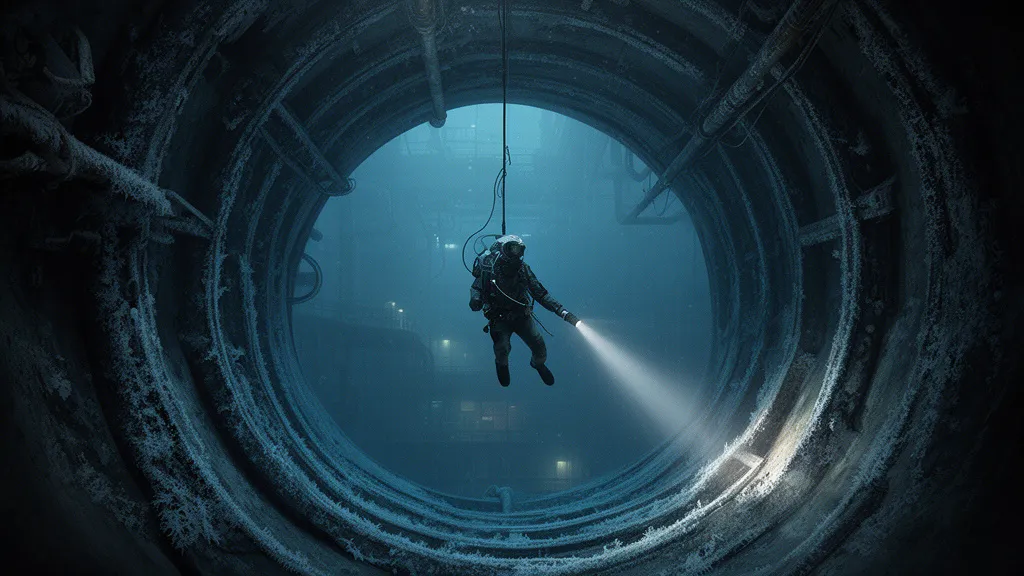
- 02:44 STATION TIME. The intake pipe measured three meters in diameter, a slick, reinforced-polymer artery feeding the coolant requirements of the desalination hub. The water was four degrees Celsius, viscous enough to impede movement but not enough to freeze the seals on Kael’s drysuit. She held her tether line with one gloved hand, the magnetic torch in her other casting a narrow, trembling beam against the encrusted frost of the ceiling.
“Maintain current depth, Kael,” the voice of the Control Officer crackled in her ear. It was flat, stripped of urgency. “The signal is 400 meters ahead. Sector 4.”
Kael pushed forward. Her flippers moved rhythmically, pushing against the resistance of the intake flow. She didn't acknowledge the order. She hadn’t spoken since the recording started broadcasting on the maintenance band thirty minutes ago. It was Elias. It was his cadence, his rhythmic, uneven breathing that he’d had since the pulmonary collapse in the Jovian mining colonies.
Elias had been dead for three years.
- 03:02 STATION TIME. The acoustic recorder was lodged in a sediment trap, a heavy-duty titanium canister intended to monitor flow velocity. As Kael approached, the beam of her torch caught a patch of clear ice on the interior wall.
She stopped. Her heart rate monitor spiked to 110 beats per minute.
There were prints. Not mechanical indentations, but smooth, elongated depressions in the frost, running horizontally along the pipe wall. Five fingers. A thumb. They were spaced as if a person had been walking—or crawling—on the vertical curve of the conduit. The ice inside the prints was still transitioning from a solid state, weeping thin, sluggish trickles of meltwater into the intake stream.
“Control,” Kael said. Her voice sounded thin against the pressure of the water. “There is an obstruction in Section 4. Biological.”
“Confirmed, Kael. We are tracking the signature. Proceed to the recorder.”
“The tracks are fresh,” she said. “There is no pressure suit in the inventory that allows for this kind of grip.”
“The recorder, Kael. It is emitting the anomaly. Secure it.”
- 03:12 STATION TIME. She reached the canister. It was wedged against the filter grate. As her fingers closed around the cold, reinforced casing, she recoiled. The metal was warm. Not ambient warm—it was pushing 37 degrees Celsius, a localized heat source blooming against the frigid wall of the pipe.
She pulled the unit free. The recording stopped instantly.
In the silence that followed, the hum of the coolant pumps seemed to expand, filling the pipe with a low-frequency vibration that rattled her skull. Then, the audio feed flickered back to life. It wasn't through the canister anymore. It was directly into her comms-link. It was Elias’s voice, clear, devoid of static.
“Kael. Stop breathing so hard. You’re using the oxygen too fast.”
She looked down the dark length of the pipe. The tunnel stretched into a black, impenetrable vanishing point. The tracks on the wall continued, disappearing into the dark.
“Elias?” she whispered.
“Kael,” Control cut in. “Do not terminate the connection. We need six more minutes of telemetry. The signal is being re-routed to the diagnostic core.”
“There is someone here,” she said. “Or something. It sounds like him.”
“It is a high-fidelity echo, Kael. Atmospheric harmonics in a pressurized tunnel can replicate vocal patterns. Do not deviate from the protocol. Six minutes.”
- 03:15 STATION TIME. She kept her back to the wall, scanning the water. The heat from the canister was dissipating, but her glove felt damp. She pulled it back to check the seal, but the material was intact. The warmth was leaking from the metal into her palm.
“They’re watching, Kael,” the voice whispered in her ear. It wasn't the recording. The cadence was different. It was frantic, clipped, the way he sounded when the mining company cut their life support during the strike.
“Don't go back to the hatch. The seal is rigged to cycle when the timer hits zero. They need the data, but they don't need the diver.”
She looked at the digital readout on her wrist. 03:17:42. The hatch was 600 meters behind her.
“Control,” Kael said, her voice steady. “The unit is hot. I’m pulling it into the containment pouch.”
“Negative. Keep it exposed. The external sensor array needs a clear line of sight.”
“It’s burning my glove.”
“The mission parameters are fixed, Kael. You are being paid for the duration. Six minutes.”
- 03:19 STATION TIME. She looked at the tracks again. They weren't just on the wall; they were moving. A smear in the frost appeared near her boot, then another, three centimeters higher, as if something was slowly, methodically lifting its weight.
She checked her oxygen. 18 percent.
If she swam back now, she could beat the timer by thirty seconds. If the voice was a lure, it was a very effective one. It knew the specific rhythm of her brother’s breathing. It knew the way he punctuated his sentences with a slight hitch in his throat.
“They took the black box from the colony,” the voice said, soft now. “They mapped the neural pathways. It’s just code, Kael. It’s just math and a bucket of warm liquid. Get out of the pipe.”
“If I leave, I lose my pension,” she said. The absurdity of the statement felt like a physical weight in her chest. She was arguing with a piece of software about the cost of living while a ghost walked on the ceiling of a water pipe.
“Thirty seconds,” Control said. “You are doing excellent work.”
- 03:21 STATION TIME. The intake hatch at the rear of the tunnel shuddered. The heavy, hydraulic groan of the locking pins engaging vibrated through the water.
“Control,” Kael said. “The hatch is closing.”
“Malfunction,” Control replied. “Stay at your post. The data is incomplete.”
Kael didn't move. She watched the tracks on the wall. They stopped directly above her. She tilted her head back, shining her light up into the dark. The ice was perfectly smooth, undisturbed by the turbulent flow of the water.
There was no one there. There was only the feeling of a presence, a displacement in the water that didn't show on her sonar. A lack of space where there should have been flow.
“They don’t care if you drown,” the voice said. It sounded tired. “They only care that the frequency is captured.”
She looked at the canister in her hand. It was no longer warm. It was freezing, the cold biting through her glove and numbing her fingers until they couldn't grip. She let it go. It tumbled into the intake flow, swept away instantly by the current, lost in the machinery of the station.
“Data connection lost,” the voice in her ear said. It wasn't the voice of her brother anymore. It was the sterile, clipped tone of the station's automated monitoring system. “Diver performance index recorded. Efficiency: 82 percent. Oxygen reserves: 12 percent.”
Kael turned toward the hatch. The heavy steel door was sealed tight. The status light on the locking mechanism glowed a steady, unblinking red.
She pressed her hand against the ice-covered wall. The marks were still there. She traced the shape of the thumb print. It was exactly the same size as hers.
There was no sound in the pipe but the rhythm of the pumps. She sat on the floor of the conduit and watched her oxygen gauge drop another percentage point.