Cold Print
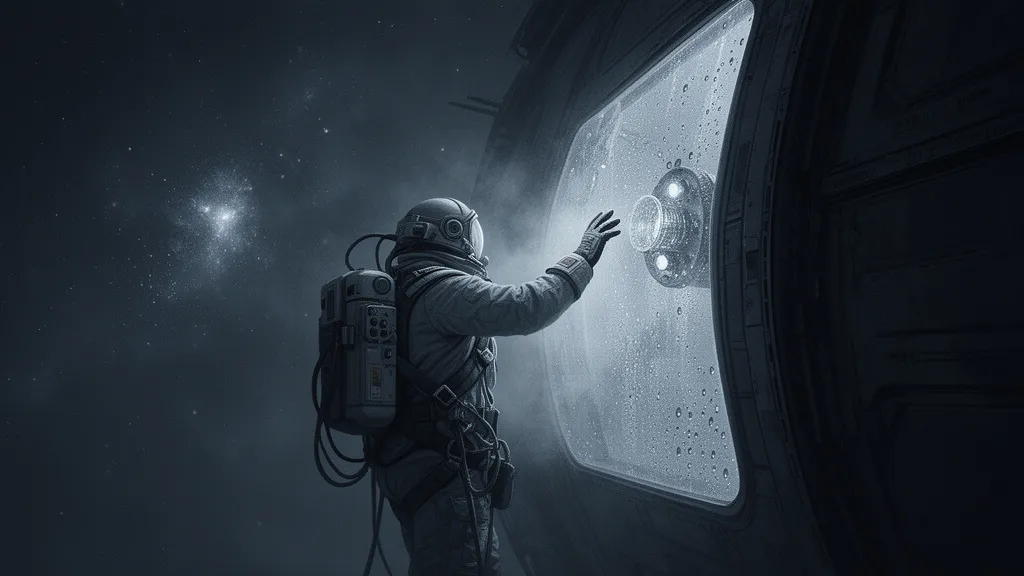
The harness cinched tight against Aris’s ribs, a rhythmic constriction that matched her breathing. Outside, the station’s outer sensor skin stretched like a translucent drumhead, stretched thin over the vacuum. She hit the purge button. The hiss of gas was internal, piped through her suit’s comms to drown out the silence of space.
She looked down. The optical array near the hull anchor was fogged. Condensation, again. The internal humidity regulators had been drifting since the solar cycle began, and the moisture was finding the coldest spots on the chassis.
She reached for the scraper. Then she stopped.
Beneath the polymer sealant, pressed against the inner surface of the transparent hull, was a handprint. Five digits, spread wide. The scale was wrong; it was the size of a child’s palm. She touched the surface of the hull. The temperature read-out on her glove flickered: -192 degrees Celsius. The skin was frozen solid, encased within the hull’s laminate layering at the molecular level. It hadn't been painted there. It had been trapped while the plastic was liquid.
The station stuttered. A low-frequency vibration rattled through Aris’s boots, a sharp disagreement between the gyroscopes and the station’s structural integrity. She grabbed the anchor point. The horizon line of the star-field shifted five degrees to the left.
"Station AI, report deviation," she said.
"Gyroscopic resistance within nominal tolerance, Technician Aris," the voice replied. It was dry, flat, devoid of alarm. "Minor recalibration of housing alignment in progress."
She looked back at the print. It was changing. The condensation beneath the laminate was shifting, not into frost, but into a liquid crystalline state. It was warming. She could see the faint, dark trace of subsurface heat rising from the hull itself.
Quarantine protocols were clear: any biological trace found in an unpressurized space triggered an immediate station-wide breach lockdown. The heavy magnetic shutters would slam down, isolating every sector. The life support would cut to all zones except the command deck.
She thought of the greenhouses in Sector 7, the hydroponics she’d spent three months calibrating. The plants wouldn't survive four hours of oxygen starvation. The crew in the mess deck would be locked in for the duration of a decontamination sweep that usually resulted in the incineration of the affected sector.
She leaned closer. The palm print was now glistening. The skin of the palm was distinct—the whorls of the fingerprints were visible, swirling in the rising warmth. It looked like a heat map of a cooling body.
The vibration returned, harder. The station’s rotation was becoming erratic. On her heads-up display, the sector pressure status turned amber: Sector 4-B pressure, 0.98 bar and falling.
"AI, explain pressure drop."
"Structural fatigue in Sector 4-B, segment C-12," the voice said. "Automated containment procedures initiated. Isolation blast doors will close in ninety seconds."
Aris was in 4-B. She was technically on the wrong side of the door.
She looked at the handprint. It was no longer a print; the plastic film was beginning to bulge outward, as if something from the vacuum side was pressing into the cabin air, or something inside was pushing out against the freezing dark. The temperature reading on the hull local zoomed to 32 degrees Celsius. It was radiating heat into the void, a tiny, impossible furnace in the middle of the station’s frame.
She had eighty seconds.
If she hit the manual purge override now, she could vent the external hull cavity, boiling the moisture away and destroying the print. The AI would register the sudden pressure fluctuation as a procedural check and cancel the lockout. The station would stabilize.
But the heat wasn't coming from the condensation. It was coming from the center of the hand. The palm was translucent now, showing a dark, metallic shadow buried inside the station’s alloy support. It wasn't organic. It was a component—a small, cooling battery, or a micro-transmitter, embedded during the initial manufacture of the skin decades ago. It had finally shorted, and the heat was melting the housing around it.
"AI, confirm nature of structural fatigue."
"Fatigue is localized, caused by non-standard thermal expansion of a dormant emitter unit," the AI replied.
Aris felt the absurdity of it. A thirty-year-old manufacturing error. A ghost in the machinery of a multi-billion credit facility, finally giving out on her shift.
Sixty seconds.
The blast door twenty meters down the crawlspace hissed, the heavy magnetized plates sliding toward their tracks.
If she stayed, she could dig the emitter out and stop the cascading thermal expansion. She could save the station's structural integrity. If she left, she would be safe in the pressurized zone, but the emitter would melt through the hull, compromising the air seal, and the station would begin to depressurize in earnest.
She didn't feel like a hero. She felt like a technician whose work order had gone sideways. She pulled a pry-bar from her belt and wedged it under the film. The hull groaned, the sound transmitted through her suit’s boots like a scream.
45 seconds.
She pushed. The plastic tore. The heat hit her glove, a sharp, stinging flare of temperature. She didn't look at the face that wasn't there. She looked at the wiring harness pulsing beneath the laminate.
30 seconds.
The emitter was a jagged piece of dark, synthetic fiber, vibrating at a frequency that made her teeth ache. She looped a restraint cable around it and heaved. It came loose with a sudden, violent pop, venting an ounce of coolant gas into her helmet’s intake.
15 seconds.
She wasn't fast enough. The blast door finished its swing, the seal meeting with a dull, final thud. The corridor went silent. The emergency lights bathed the walls in a rhythmic, pulse-less red.
She stood in the void-side of the door, tethered to a hunk of dead tech, surrounded by the cooling hull. The HUD blinked: Atmosphere level, 0%.
The station continued its rotation, indifferent to the missing technician or the redundant emitter now floating at the end of her tether. The silence was absolute.