Data Burial
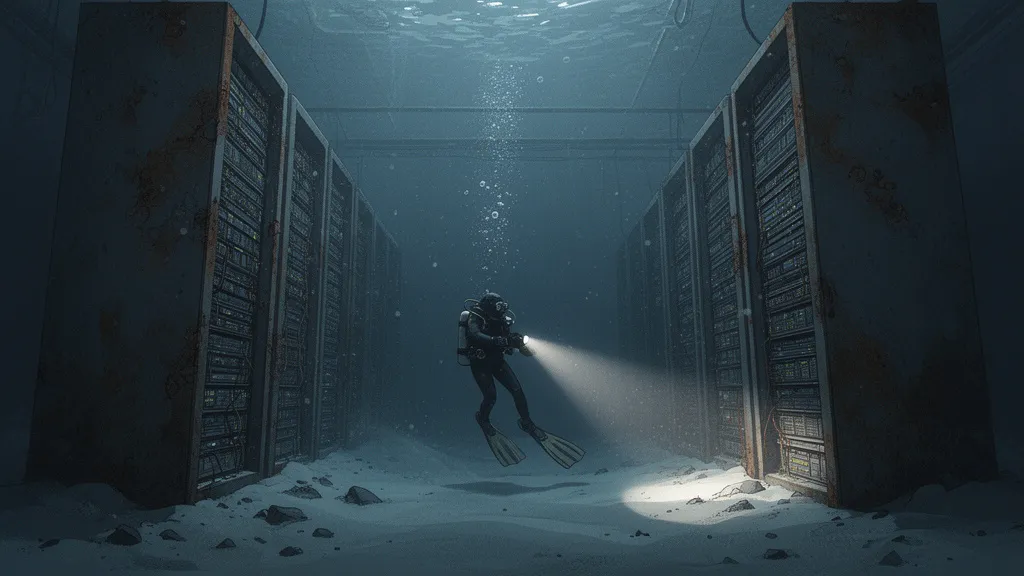
The pressure gauge on Elara’s forearm read 3.1 bar. The ambient temperature in the archive’s sub-basement was a constant 4 degrees Celsius. Here, the salt-thickened seawater held a steady, viscous suspension of sediment and data-shard fragments, opaque as liquid slate.
She kicked once, her heavy fins stirring a cloud of rust-colored silt. The beam of her shoulder-mounted strobe cut a narrow, truncated cone through the dark. Light hit the aluminum racks. They stood like serrated teeth, four meters tall, furred in a thick, crystalline crust of brine. The servers were dead, but the internal architecture of the room—the rows of magnetic tape spools and the rusted steel partitions—remained an obstacle course of jagged, sharp-edged decay.
She checked her internal chronometer. 08:14 remained until the tide-gate cycles. The mechanical locking mechanism for the vault was a legacy installation from the pre-collapse era, designed to prevent seawater from entering the main grid. By locking her in, it would successfully protect the continent from the archive’s leaking toxicity. The irony of the design was not lost on her; she simply found it mathematically inconvenient.
She navigated the aisle between Rack 4 and Rack 5. The water here was static, holding the cold-heavy chill of an unventilated grave. She passed a control terminal, its screen cracked into a spiderweb of obsidian fissures. Behind the terminal, on the cabinet door of a secondary backup unit, a handprint was pressed into the oxidation. It was small, frantic, and pointed downward, as if the person who had placed it there had been sliding toward the floor even as they were sealed behind the steel.
Elara reached out, her gloved fingers hovering an inch from the mark. The salt had hardened the print into a geological feature. She did not touch it. To touch it would disrupt the sediment layer and compromise the evidence of the struggle.
Her harness snagged on a protruding wire bundle. She twisted with a practiced oscillation, loosening the kevlar tether. The water murmured against her suit, a low, tectonic groan of structural stress from the floors above. The archive was groaning under the weight of the Atlantic. It would be entirely submerged within the week, and the city registry office would mark the data migration as 'lost due to environmental attrition.'
She reached the central core housing at 05:22 remain. The unit was a dense cube of titanium alloy, pulsing with a faint, intermittent amber luminescence. It was the only hardware in the room that retained a power supply. She clamped her magnetic hoist onto the casing, her pulse spiking to 110 beats per minute.
She touched the interface port. The core hissed, a series of pressurized air-valves venting into the water before the glass screen stuttered to life. It didn't download diagnostic data. It didn't provide a file directory. Instead, the screen scrolled a single text string across its pixelated surface, the characters glowing a violent, surgical blue.
IDENTIFICATION: UNIT 77-B/ELARA V. STATUS: ACTIVE. INITIATING RECOVERY PROTOCOL: SELF-EVIDENCE.
The message was a loop. Below it, a video file initiated, though the data stream was corrupted by electrolyte leakage. It was a feed from the room’s internal CCTV, dated three years prior, showing a maintenance diver in a suit identical to Elara's own. The diver was pleading with a terminal, their hands moving in rapid signs. The room began to flood. The door to the exterior hallway did not lock; it was jammed from the outside.
Elara watched her own service designation repeat in the header. The bureaucracy of the archive hadn't lost the data. They had harvested it. Every diver sent here to retrieve core samples was simply returning to collect the documentation of their predecessor’s termination.
03:40 remained.
She looked at the jammed door, then at the core. If she brought it to the surface, the automated verification system would flag the data-keys, quarantine her, and purge her log to keep the cycle intact. She reached out and pulled the hard-reset trigger on the casing, silencing the amber pulse. With the transmission signal dead, the surface sensors would see an empty, failed extraction. The quarantine protocol required a signal to activate. She would be an anomaly, not a threat. It was the only way to carry the weight of the dead back to the light.
01:10 remained.
She unlatched the magnetic hoist. She pulled the core from its housing, feeling the cold weight of it settle against her chest, heavy as a stone. She began to swim toward the extraction pipe. The water was colder now, the surge of the tide pushing cold oxygen-rich water into the depths, forcing the stagnant, salt-heavy water out through the drains.
She passed the handprint again. She didn't look at it this time. She looked at the green-blue light of the hatch aperture, a narrow circle of relative brightness in the abyss.
She gripped the core with both hands. It was a failure of imagination to think the water was the enemy. The tide didn't care about the records, or the Bureau, or the divers. The water was simply occupying the space where the archive had once been, performing a standard, inexorable volume displacement.
She reached the hatch. She pushed the heavy steel disk, her muscles vibrating under the strain of the pressure differential. The metal shrieked. A thin, pressurized jet of seawater sprayed past her shoulder, stinging her neck. She pulled herself through the breach, scraping her suit against the serrated edges of the bulkhead, and kicked toward the rising pressure at the surface.