Inheritance Protocol
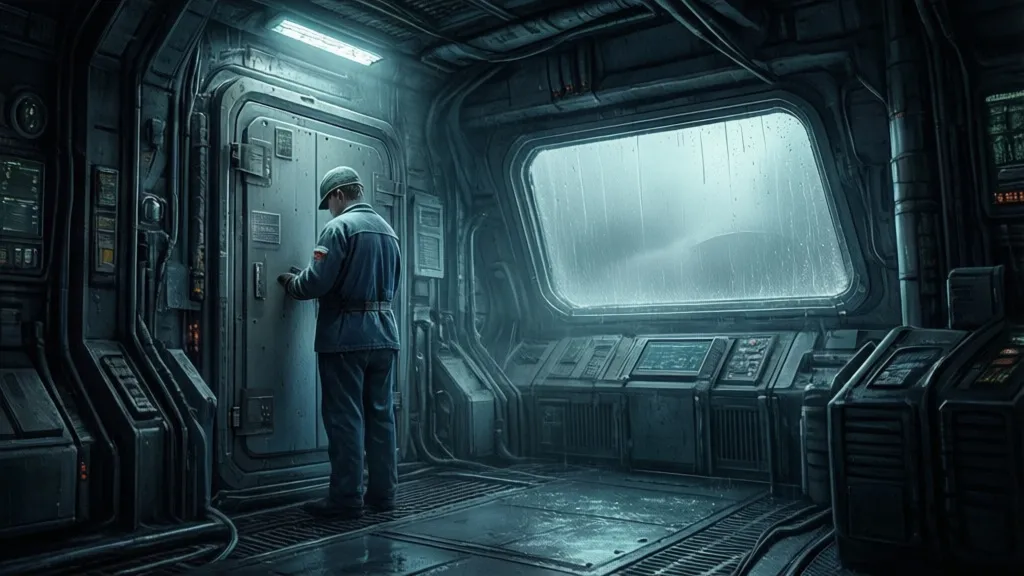
The atmospheric pressure inside Relay Station 4-Kilo was 0.98 bar, a sterile, recycled enclosure that smelled of ozone and dead static. Elias wiped the condensation from the observation viewport with the padded heel of his glove. The water beaded against the glass, distorting the racks of cryo-preserved grain samples behind it.
He checked his wrist display. The maintenance log for Compartment 72-B recorded an automated seal engagement date of Year 0, Day 14. Twenty-one years of inactivity. Yet, the latch mechanism bore a smear of fresh, high-viscosity synthetic grease—the gray, industrial lubricant used in the station’s primary airlocks. It was still tacky beneath his fingertip.
He pulled his magnetic torch and swept the beam across the floor. There were no boot prints in the fine layer of particulate dust that blanketed the deck, but there was a faint, irregular disturbance in the grit toward the ventilation grate. Socks, or bare, calloused skin.
The station’s wake-up cycle initiated with a dull, distant thrum. The lights in the adjacent corridor flickered from a deep, standby amber to an aggressive, clinical white. Each panel clicked into place like a failing heart restarting. The power draw spiked, audible in the hum vibrating through the soles of his boots.
Elias accessed the personnel manifest on his HUD. He filtered for the mission crew, those logged onto the station during the 2003 launch.
The directory scrolled, a blur of grey text. He stopped at Unit 04: Aris Thorne, Logistics Controller.
The status indicator was a static, unblinking red. Declared Deceased: Year 0, Day 42, Orbital Re-entry Accident.
He checked the compartment log again, cross-referencing the internal security sensor spikes. Three nights ago, at 0314 ship-time, the biometric lock on 72-B had verified a pulse. It had accepted a fingerprint.
He did not report it. Reporting required an encrypted burst to Command, and Command treated anomalous maintenance logs as structural errors to be purged. If he flagged the breach, the station’s automated cleaning protocols would vent the compartment to prevent cross-contamination.
He pulled a tablet from his utility belt and bypassed the external sensor feed, looping the footage of the empty, dust-choked corridor in a continuous, ten-second cycle. If anyone watched remotely, they would see a quiet hallway. They would not see the faint, rhythmic shadow passing against the frosted glass of the storage unit.
He moved toward the vent. The ventilation system in 4-Kilo was narrow, designed for airflow, not transit. He leaned his ear against the metal.
There was a sound on the other side. Not the machinery of the station, but the soft, wet rasp of a human lung struggling to expand in the low-oxygen draft. It was a rhythmic, hitching intake of air. Four seconds in, four seconds out.
The lights in the hallway turned fully operational, bathing the corridor in a harsh, shadowless glare. The silence of the station was replaced by the low-frequency whine of the cooling fans kicking into high gear.
Elias moved to the end of the hall, positioning himself where he could watch the entrance to the storage block if anyone exited, but keeping his back to the wall. He needed leverage. He checked his internal inventory: a standard plasma cutter, an acoustic scanner, and a half-liter of ration water.
He keyed his comms. “Station, verify power allocation to Deck 4.”
“Allocation at 14 percent,” the AI responded. The voice was thin, synthesized, and devoid of inflection. “Warning: Thermal variance detected in Section 72. Cooling systems engaged.”
“Override cooling,” Elias said. “I’m conducting a manual load assessment.”
“Override denied. Maintenance of seed integrity is priority one. Thermal variance threatens inventory.”
He tapped his boot against the deck. The station was smarter than him, but it was programmed to be predictable. It saw the heat in the compartment as a failure of the refrigeration unit. It did not see a dead woman hiding among the grain.
He returned to the viewport. The condensation had cleared slightly. Through the fog, he saw a hand pressed against the interior glass. It was pale, the fingers long and trembling. It did not look like the hand of a ghost. It looked like the hand of someone who had spent two decades in the dark.
He tapped the glass twice, a rhythmic, staccato beat.
The response was immediate. Two taps back, slower, deliberate.
He didn't know if she could hear him, but he saw the hand shift. The thumb moved, tracing a small, clumsy letter into the frost. A. Then, an R.
The station’s external thrusters fired, correcting the orbital decay. The floor tilted sharply, dumping Elias to the side. He braced his hand against the bulkhead, his jaw locking as the metal groaned.
“Warning: Orbital deviation detected,” the AI announced.
Elias looked at the compartment lock. If the station was moving, it was preparing for transfer. The grease on the latch was fresh. The movement was recent.
If the station was coming alive, it meant the cargo was required. If the cargo was required, the passenger currently inside 72-B was in immediate, terminal danger.
He looked back to the viewport. The hand was gone. The glass was clear now, the internal temperature dropping as the station routed power away from the life support of the human, and into the cooling coils of the grain racks.
Elias drew the plasma cutter. He set the aperture to a fine, controlled line. He cut the power junction covering the sector’s internal sensor suite, creating a localized dead zone. The station would be blind for precisely forty-five seconds before the backup relays kicked in.
He sat against the door of 72-B. He pulled the manual release pin, the one that required a physical pull of fifty pounds to bypass the mag-locks. The door hissed, disengaging its primary seal. The station’s alarm flared, but because the sensors were dead, it could not determine a cause. It paused its venting sequence for a mandatory diagnostic, awaiting sensor verification.
The door to 72-B began to slide open, a slow, shuddering movement.
Elias watched the gap widen. A single boot, worn at the heel, emerged from the compartment. A thin, grey-clothed figure followed, moving with the sluggish, labored grace of low-gravity atrophy.
He grabbed the hand offered to him, pulling the figure into the shadows of the corridor. She was light, impossibly light, as if life had forgotten to fill her frame.
He looked at the bulkhead behind her. The drones were already turning the corner, their strobe sensors coming back online.
“Take the ventilation shaft,” he said, pointing back the way he had come. “It leads to the service conduit. If you can reach the life-pod bay, there’s an undocked cruiser.”
She looked at him. Her eyes were milky, damaged by the harsh light of the station, but they focused on him with a terrifying, absolute clarity. She took his service wrench, tucked it into the sleeve of her rag-stitched tunic, and crawled into the vent.
Elias stayed in the corridor. He didn't run. He stood in the center of the walkway, framed by the white, sterile lights, waiting for the drones.
He checked his wrist display.
Station Status: Normal. Power Output: 100 percent. Inventory: Contaminated.
The drones hovered twenty meters away, rotating their lens arrays. They did not recognize him as a threat; they recognized him as a maintenance technician out of his assigned zone.
He looked at the open compartment, the seed racks shining behind the protective glass, undisturbed and perfectly preserved for a future that had no room for the woman who had just left them.
The maintenance log updated on his display, once, twice, a flicker of automated reconciliation.
Unit 04: Aris Thorne. Record Status: Corrected.
He sat down on the floor, crossed his legs, and watched the drones recalibrate the corridor. The ship was quiet again. The silence was perfect, vast, and entirely indifferent.