Module Residue
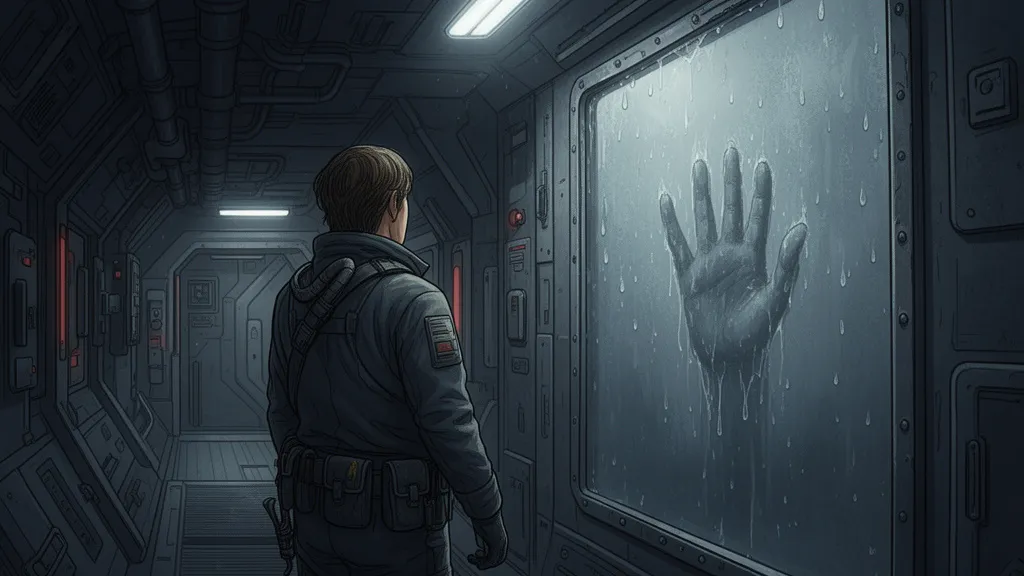
The condensation in Module 4-C existed at a constant 37 degrees Celsius. Elara wiped the metal panel with her sleeve, watching the beads of moisture smear into a translucent smear. By the time her arm dropped, the fluid had migrated back, reassembling into the impression of a human hand—fingers splayed, thumb hooked slightly downward, pressing against the hull from the inside out.
She touched it. The metal pulsed. It felt like holding a feverish wrist.
"Station maintenance, log entry 442-B," she said, her voice flat. "Module 4-C is reporting thermal anomalies and persistent surface moisture. Initiating duct inspection."
She didn't mention the shape. The station’s diagnostic software was programmed to categorize atmospheric irregularities as mechanical failure. To report a hand was to involve the Psych-Evaluators. Quarantine protocols meant three weeks of isolation in a med-bay while the board reviewed her synaptic logs. She didn't have three weeks. The decoupling sequence for the orbital ring was set for 06:00 tomorrow.
Elara pulled the inspection plate from the bulkhead. The air in the crawlspace tasted of ionized copper and ozone. She crawled forward, her harness tethered to the station’s structural spine, the only thing keeping her from drifting into the ventilation intake cycles.
She tracked the moisture line. It didn’t originate from the life-support vents. It pulsed from a series of sealed service conduits behind the sleeping quarters, a section of the ring technically designated as void space following the 2094 structural fatigue report. According to the station schematics, this space should have been vacuums-sealed and empty.
She reached a junction she wasn't supposed to know existed. Taped to the wall was a small, high-fidelity recorder, its casing worn down to the base metal. It was bolted into the intake filter, vibrating in synchrony with the station's life-support pulse.
She played the last file. It was her own voice, clipped and professional, asking for a status update on the water recycling system. But the rhythm was wrong; the breaths were timed to an engine she hadn’t started. The recording reached the end of her sentence—“...system functioning within nominal parameters”—and then cut off.
She played the file before that. She was asking for an extra ration pack. The recording clipped the end. She played another. She was talking to her mother back on Earth about the color of the horizon. The recording stopped exactly one syllable before the final word of the sentence.
The air inside the conduit shifted. It wasn't a wind; it was the pressure change of a seal breaking somewhere deeper in the dark.
Elara pulled her headlamp back. The dark section of the ring hummed, a low-frequency vibration that rattled her marrow. Someone was living in the walls. They were harvesting her audio, splicing the ends of her life into a new sequence, and using the moisture from the heat-exchange pipes to manifest shapes on her walls.
She stood up, her boots gripping the magnetic floor. The countdown clock on her wrist projected a holographic display onto the bulkheads: 04:12:00 until decoupling.
She looked at the maintenance hatch that led into the dead zone. It was rusted shut, the seal maintained by layers of synthetic grease and time. If she opened it, she would find a person, or a shadow of a person, or the ghost of the station’s previous crew. Or she would find nothing, and realize the station was simply folding her data back into its own infrastructure—a recursive loop of biological drift.
She remembered the hand on the wall. It had been warm.
She hesitated, her thumb hovering over the emergency broadcast switch. If she pressed it, the station internal security drones would be activated. They would flush the conduits with nitrogen. The temperature in the modules would drop to negative forty degrees within seconds. The creature in the wall—the entity, the ghost, the stowaway—would be erased.
She looked at the recorder. It was playing again. Her own voice, humming a lullaby she hadn’t sung since her childhood. It dragged, the pitch dropping, the silence widening until the space between the words was longer than the words themselves.
It was a very efficient way to store memories. That was the absurdity of it. The station was running out of external storage, so it was simply using her.
She reached for the emergency broadcast switch. Her finger halted. She thought of the silence of the drift, the way the stars looked like surgical steel when viewed through the observatory deck. She reached for the lever on the dead zone hatch instead.
She yanked. The metal protested, screaming against the hinges.
Beyond the hatch, there was only the cooling pipe running in a perfect circle through the center of the ring. There was no person. There was no stowaway. There was only the thick, white, human-shaped mass of frost growing around the pipe, pulsed by the heat being drawn from her own living quarters.
She touched the frost. It was soft, yielding almost like organic tissue.
02:00:00 until decoupling.
Elara climbed back into the module. She didn’t close the hatch. She sat on the floor, watching the condensation form again on the wall panel. It didn’t form a hand this time. It formed a pattern of sound waves, the visual representation of the final words she had been missing.
The recorder in the conduit began to play again, a steady, rhythmic stream of her own voice, finally finishing her sentences. The words didn't mean anything, but they occupied the space.