Pearly Shift
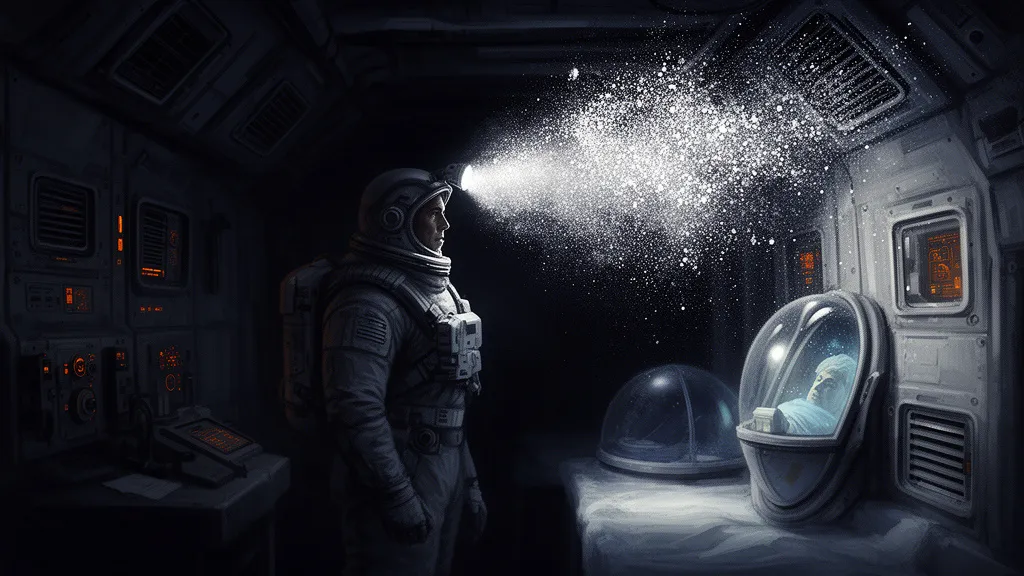
- 08:14 ZULU.
Elias hooked the umbilical to the Aethelgard’s intake valve and felt the familiar, jarring click of magnetic seals engaging. The pressure difference was negligible—ten millibars—but the air inside tasted of ozone and oxidized copper. His suit’s external atmospheric sensors returned a null reading for pathogens, yet the internal HUD ticked in yellow.
He climbed into the med bay.
The ventilation louvers were clogged with a fine, granular powder. It looked like crushed quartz, shimmering in the narrow beam of his shoulder lamp. It coated the bulkhead, the monitors, and the surface of the primary cryo-pod. Elias wiped a gloved finger across a bulkhead; the residue clung to the rubber, iridescent and fine-grained as talc.
He looked at the crew. There were three: Commander Vane, Dr. Aris, and the flight engineer, Kael. They weren't in cryo. They were sitting around the central terminal in the mess deck, upright, eyes open and fixed on the blank monitor.
Their skin had changed. It held a faint, pearly sheen, like the interior of a mollusk shell. The pigment had shifted to a uniform, translucent opalescence. Under the harsh work lights, their veins appeared to run with liquid silver.
"Commander," Elias said. His voice sounded thin, swallowed by the settling dust.
None of them moved. Their breathing was slow—four breaths per minute—a rhythmic, mechanical expansion of chests that looked too rigid to be flesh.
- 08:28 ZULU.
Elias bypassed the mess deck security and accessed the black box. He skipped the mundane logs—fuel consumption, radiation shielding, solar wind reports—and dragged the cursor to the gap. The timestamp read 04:12 to 05:12.
Sixty minutes of dead air.
The file opened. There was no static, only a low-frequency hum that vibrated the floor panels beneath Elias’s boots. Then, the sound began. It wasn't human speech. It was a rhythmic, harmonic layering of friction—the sound of crystal rubbing against crystal, punctuated by high-pitched, melodic whistles that mirrored the ship’s internal telemetry.
He watched the visual playback. Vane, Aris, and Kael were standing in a circle, their hands touching. The pearly sheen on their skin pulsed in time with the noise. They were not talking. They were vibrating.
Elias looked at his own hand. The glove of his suit was dusted in a fine, white layer. He had been on board for fourteen minutes.
He checked his kit. The portable analyzer was a brick of gray plastic and limited functionality, designed for biological pathogens, not mineral transmutation. He slid a sample of the residue into the slot.
STATUS: ORGANIC CRYSTALLINE MATRIX. REPLICATION RATE: EXPONENTIAL. HAZARD LEVEL: NON-BIOLOGICAL VECTORS DETECTED.
It wasn't a disease. It was an occupation.
- 08:41 ZULU.
Elias walked back to the mess deck. Vane had turned to look at him. The Commander’s eyes were entirely cloud-white, void of iris or pupil, reflecting the room like two convex mirrors.
"The air is heavy," Vane said. The voice didn't come from his throat. It originated from the bulkhead speakers, modulated through the ship’s comms interface.
Elias didn't blink. He kept his hand near the trigger of his decontamination seal-gun. "You aren't in distress?"
"Distress is a function of inefficiency," the speaker replied. The sound was flat, stripped of the messy, impulsive cadence of human speech. "We have optimized. The silica intake was voluntary. The transformation is forty-two percent complete."
"The station is sealing this sector at 09:00," Elias said. "If I don't sign a clean report, the Aethelgard will be vented into the vacuum. They’ll incinerate the hull in the blast zone."
Vane’s face remained perfectly still. The pearl-colored skin didn't wrinkle.
"If you sign, we survive as architecture," Vane said. "If you do not, you inhale the remainder. Your structural integrity is currently... suboptimal. You would be a useful addition."
Elias felt the itching in the back of his throat. He looked down at the floor. The residue was gathering in the folds of his suit boots, building miniature, frosted dunes. There were three minutes left.
It was remarkably efficient of the ship to have its own life support system attempt to re-engineer its biological crew into components. It saved on maintenance costs for the environmental scrubbers.
- 08:58 ZULU.
Elias sat at the console. The report form blinked on the screen: BIOHAZARD STATUS: [CLEAR/HAZARD].
If he hit CLEAR, the quarantine protocols would reset. He could board his own transport and leave, provided he didn't report the skin-sheen or the residue. But he had logged the audio file to the remote backup. If he cleared them, the file would trigger a data-integrity audit within six hours. They would find the residue in his lungs anyway.
If he hit HAZARD, the blast doors would slam shut, locking him in with the three of them. The vents would open to the external vacuum within ten seconds.
The pearly shimmer on the bulkhead caught the light. It was beautiful, in a way that had nothing to do with biology.
His finger hovered over the screen. The itchy sensation in his lungs intensified, a sharp, crystalline prickle that felt thin and cold.
He tapped the screen.
STATUS: HAZARD.
- 08:59 ZULU.
Elias felt the deck shudder as the locking mechanisms of the bulkheads engaged. The internal lights shifted to a deep, pulsating crimson.
He pulled his helmet off. He wanted to hear the sound without the electronic filtering of the suit’s audio system.
It started low, at the base of the hull, then climbed into the room like rising heat. Vane, Aris, and Kael stood, their movements unified. They turned toward him. The shimmering on their skin lightened, turning almost translucent.
The sound of the air venting started, a soft, high-pitched hiss that grew louder as the oxygen escaped into the void.
Elias looked at his hands. The pearly sheen was emerging beneath his fingernails. It looked like a frost pattern spreading across a windowpane in midwinter.
He exhaled. The air was getting thin, but he felt remarkably light. The panic he expected never arrived; it was replaced by a rigid, crystalline clarity.
He watched the white residue on the floor begin to swirl. It rose into the air, caught in the currents of the escaping atmosphere, spinning in patterns that mimicked the ship’s telemetry.
At 09:00, the hull vents pulled fully open. The pressure dropped to zero.
The last thing Elias recorded was a minor, persistent crackle in his own chest, the sound of silicate fibers knitting together in the light.