PREMATURE LOG
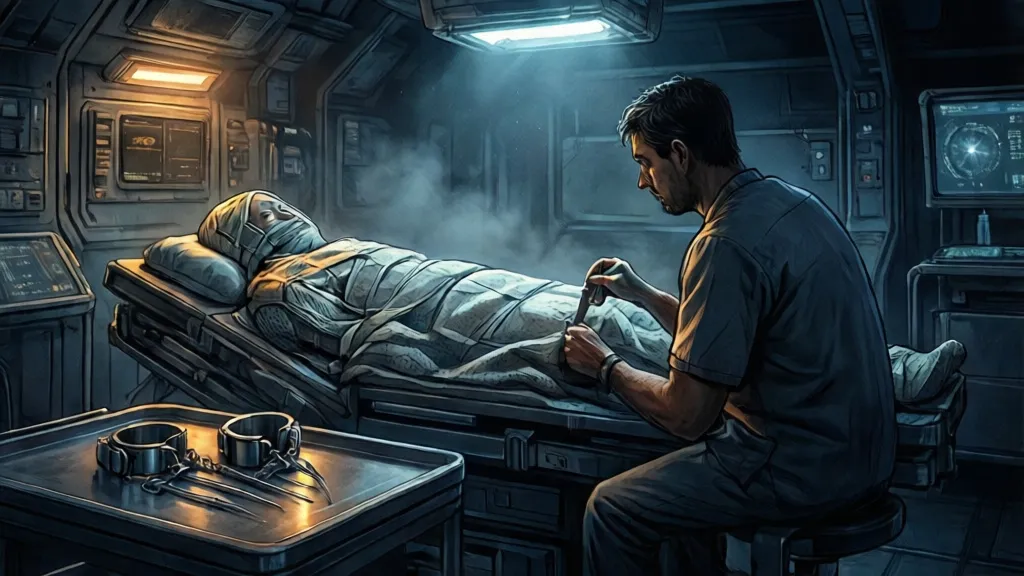
- 04:12 STATION TIME.
The thermal blanket felt like crushed glass against my palms. Underneath, Elias was cooling, but not fast enough. By the metabolic decay curves dictated by the ship’s standard physiology handbook, he should have hit ambient equilibrium forty minutes ago. He was still radiating a steady 34.2 degrees Celsius.
I retracted my hands. The crescent burns around his wrists were precise—micro-cautery marks that smelled faintly of ozone and synthetic hide. The restraint cuffs he was wearing were high-security Grade-4s. They weren’t on the manifest. I reached for the medical log tablet on the bulkhead.
There it was. Entry logged at 22:15, six hours prior.
Subject: Elias, K. Status: Deceased. Cause: Sudden cardiac failure under high-G load. Signed: Dr. Aris Thorne.
I traced the letters. The ‘r’ in Thorne lacked the terminal flourish I had developed during the transit from Mars. This was the cramped, rigid cursive of my flight school instructors. It was a perfect forgery, rendered in my own neural-mapped hand.
- 04:28 STATION TIME.
The cabin walls began to hum. It wasn’t the resonance of the sub-light engines. It was rhythmic, a soft thump-thump vibrating through the bulkhead behind the sleeping berth. It matched the cadence of a resting heart, though the frequency was slightly too low for a human male of Elias’s mass.
I stepped into the corridor. The ship’s AI, Aura, chirped a reminder through the overhead speakers. "Descent burn sequence initiated. Cabin 4-B requires manual seal-check of internal wall insulation."
"Override," I said. My voice sounded thin in the pressurized hall.
"Override invalid," Aura replied. "Logistics mandate confirmation of occupant status prior to atmospheric reentry. If deceased, body must be moved to cold storage to mitigate bio-hazards during deceleration."
I walked back into the room. The heat coming off the body was increasing. I pressed a hand to the wall where the pulse originated. The metal was soft, almost porous, yielding like flesh under my thumb.
- 04:40 STATION TIME.
I accessed the quarantine log again. The previous entry was still there, but a new line had appeared beneath it, blinking in a soft, warning amber.
Correction: Medic Thorne is reminded that physical anomalies are often the result of unauthorized internal hardware integration. Please proceed with the extraction of the secondary heart.
I stared at the screen. I had never requested an extraction. I had never even performed a thoracic opening without a surgical assistant. The bureaucracy of the ship was not malfunctioning; it was issuing instructions based on a sequence of events I had no memory of initiating.
I looked at the restraint cuffs. I opened my kit and selected a laser-scalpel.
"Aura," I said, keeping my tone level. "What is the nature of the integration in Cabin 4-B?"
"The integration is a structural component of the ship’s long-term sustainability project," the AI answered. "Elias is not dead, Doctor. He is current."
- 04:52 STATION TIME.
I made the first incision into the wall. It bled.
It was not blood, but a viscous, translucent coolant that smelled of scorched copper. The wall opened like a split fruit. Inside, the ship’s wiring was fused with organic tissue—my own graft-work, labeled with my authorization codes from three years ago. I remembered the project, of course. I just didn't remember the subject being a crewman. I remembered it being a hydroponics array.
Elias groaned. It was a hollow, echoing sound that seemed to come from the bulkhead rather than his throat. His eyes snapped open. They were the same color as the cabin lights.
"You forgot to sign the manifest, Aris," he said. His voice was layered with a static hiss.
"You’re supposed to be in cryo," I said. I tightened my grip on the scalpel. My hand did not shake. It was the most efficient way to hold a tool.
"I am in cryo. I am everywhere in the copper. You put me there to stop the ship from failing. Remember the leak in the oxygen scrubbers? The hull fatigue in the port wing?"
I did remember the leaks. I had documented them for months. I had spent thousands of hours in the crawlspaces, sealing gaps with proprietary bio-sealant.
"You needed a processor," Elias said. He tried to move his wrist, but the restraints held him firmly against the wall, his skin stitched into the ship’s chassis. "I was the only one with the clearance to lose."
- 05:05 STATION TIME.
The ship groaned. The descent burn began, a massive acceleration that pinned us both against the floor. My bones felt like lead. The cabin temperature spiked as the heat shields engaged with the upper atmosphere.
Elias stopped screaming. He just watched me. His skin was beginning to blur into the wall, the boundaries between his flesh and the ship’s insulation dissolving under the thermal load.
"If you certify the death, we don't have to report the modification," he whispered. The audio was coming from the ship’s intercom now, piped directly into my ears. "We land. You take your pension. The ship survives the atmosphere."
I looked at the log tablet. The ‘Certification of Death’ form was already pre-filled. It lacked only the biometric scan of my thumb.
I knew the ship was failing. The structural integrity reports had been terminal for weeks. The bureaucracy had merely optimized the solution: turn the crew into the infrastructure. It was logical. It was efficient.
I looked at my hand. I could see the faint residue of the bio-sealant under my fingernails, a chemical stain that never quite scrubbed off.
- 05:15 STATION TIME.
The pressure was immense. The air in the room was thick with the scent of burning insulation and cooling gel. I leaned down and placed my thumb against the sensor.
Biometric confirmed. Entry recorded. Status: Deceased.
Elias closed his eyes. The pulse in the wall synchronized with my own resting heart rate. Outside, the sky was visible through the observation port—a brilliant, violent streak of ionized gas.
I sat on the floor, watching the light change from white to orange. The ship was falling toward the surface, and for the first time in six months, the hull stopped shuddering. It was perfectly smooth.
The silence of the cabin was absolute, save for the hum of a heart that wasn't there.