Pressure Bloom
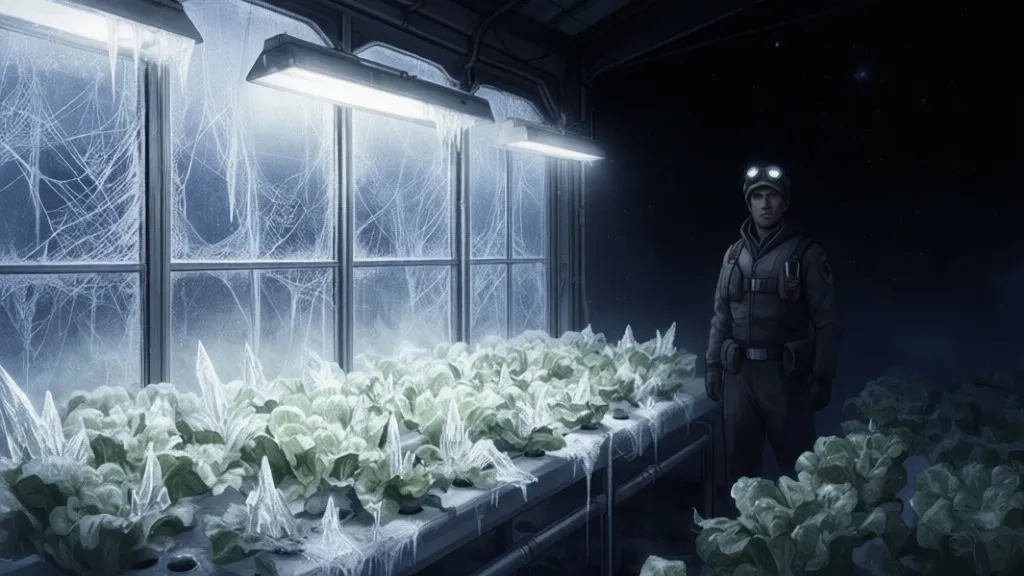
- 04:12 STATION TIME. The frost had spider-webbed across the polycarbonate pane in a radial pattern, clear evidence of a localized pressure differential. Elena tapped the glass. The ice didn’t fracture; it grew, a pale, crystalline parasite feeding on the heat differential between the greenhouse and the vacuum of the exterior. The lettuce below, a stunted hydroponic strain called 'Aurora Gold,' was already turning translucent.
She checked her wrist display. The O2 levels in the greenhouse sector had dropped by 14 percent over the last three minutes. The air recyclers—massive, cylindrical scrubbers recessed into the bulkhead—began to cycle. They didn't just move air; they exhaled in a wheezing, rhythmic thrum that matched the resting heart rate of a panicked organism. Hiss-thump. Hiss-thump.
Elena wiped a patch of frost from the viewport. The damage wasn't structural fatigue. There was a clean, circular indentation on the inner surface of the glass, the mark of a manual pressure-release valve being forced open from the inside. Someone had deliberately vented this sector.
- The station manifest for the sleeping deck, located directly beneath the greenhouse, listed forty-eight personnel. All forty-eight were currently in deep-cycle rest, their metabolic rates suppressed to 60 percent to conserve energy. If Elena flagged this breach to Central Control, the station’s automated response protocols would kick in immediately. Quarantine meant sealing the sector and rerouting power away from non-essential sub-systems to maintain cabin pressure in the command module. That included the life-support grid for the sleeping deck.
She looked down at the floor grating. Below her feet, separated by three meters of pressurized aluminum and insulation, forty-eight people were dreaming of things that didn't involve nitrogen-rich atmospheres.
Her diagnostic tablet chimed, a thin, digital sound that felt intrusive in the silence of the greenhouse. Unauthorized access detected in ventilation shaft 4-B. That was the crawlspace behind the hatch.
She tightened her grip on the torque wrench. She didn't work for the station’s security detail; she worked for the logistics division, which meant her job was to ensure the vegetables reached a harvestable weight, not to police the psychological instability of the crew. But the math was inescapable. If she hit the override to seal the greenhouse, forty-eight people would have their power cut for six hours. If she didn't, the pressure drop would eventually rupture the secondary seals, venting this sector into the void and dragging the deck below with it.
- The hatch to the maintenance crawlspace was locked. It was a heavy, industrial slab, meant to withstand decompression, but the emergency light above it was pulsing a dim, sickly amber.
"Open the bypass," Elena said. Her voice sounded flat, stripped of authority by the thin air.
There was no response, only the hiss-thump of the recyclers. The humidity in the room was plummeting. The Aurora Gold lettuce began to curl, the leaves blackening at the edges as the moisture was sucked into the ventilation return.
She stepped toward the hatch. Her boots made no sound on the perforated metal floor. The air was getting colder; the ambient sensors in her suit reported a temperature drop of two degrees every minute. She stopped five feet from the hatch and leveled her wrench.
"The alarm is buffered," she said, staring at the seam of the hatch. "I have ninety seconds before the system registers the pressure anomaly as a catastrophic event and forces a sector lockout. You know how the logic loops work. You’ll be sealed in here with me, and the decks below will go cold."
From the other side of the hatch, a voice emerged. It was ragged, lacking the modulation of the station’s intercom.
"They don't dream, Elena. They simulate. Do you really think they need the power?"
- Elena didn't recognize the voice, but she recognized the cadence. It was the frantic, over-caffeinated rhythm of a junior systems analyst. She checked her log again. Personnel Record: Kaelen, Sector 7. Duty cycle: 480 hours continuous.
"Kaelen," she said, keeping her tone strictly clinical. "You’re experiencing a cognitive overload. The station’s psych-monitoring should have flagged this hours ago."
"The psych-monitoring is a sub-routine of the navigation OS," Kaelen whispered through the door. His breath hit the metal, creating a small, damp patch of condensation. "I patched the monitor into a feedback loop. It thinks I’m sleeping. I’ve been awake for sixteen days, watching the star charts align. We aren't moving, Elena. We haven't moved in months. We’re just orbiting a dead rock, recycling the same air, pretending that if we harvest enough lettuce, we’re actually getting somewhere."
Elena glanced at the viewport. Outside, the blackness was absolute, save for the faint, unblinking smear of a distant nebula. The station’s telemetry had confirmed their trajectory yesterday: 12,000 kilometers per hour, stable orbit, nominal systems.
"We are on schedule," Elena said. It was a lie, but it was a sturdy, well-engineered lie.
"The schedule is a clock that doesn't have hands," Kaelen replied. "Look at the plants. They know. They aren't turning translucent because of the pressure. They’re turning translucent because there’s no sunlight. The fiber-optics are pumping simulated photons. It’s all just data, Elena. It’s just math."
- The recyclers spiked. The hiss-thump accelerated into a rhythmic, desperate panting. The emergency siren triggered, a low-frequency hum that vibrated the marrow in Elena's shins.
She looked at her tablet. 0.05 percent oxygen remaining in the sector. The greenhouse was becoming a vacuum chamber.
"Kaelen, step away from the valve," she said. She could feel her own lungs working harder, the O2 mix in her suit’s backup supply cooling her chest. "If I report this, they’ll purge the vents. They’ll kill you to save the deck."
"Then do it," Kaelen said. "Be the technician. Fix the leak."
Elena’s finger hovered over the 'Quarantine' button on her tablet. The screen displayed a red graphic of the station’s interior. Forty-eight dots glowed in the sleeping deck, forty-eight steady, green-lit heartbeats. They were so quiet. They were so efficient.
She looked at the frost creeping over her boot. It moved with a slow, crystalline elegance, reclaiming the space as if the metal had never been anything but a foundation for ice.
She didn't press the button. Instead, she reached for the manual release on her own suit’s neck seal. She wasn't going to report it. If she broke the seal, the pressure in the room would equalize instantly with the suit’s internal reserves, buying them both enough time for the station’s automated maintenance drones to reach the sector. By the time they arrived, the logs would show a freak pressure failure. It would be a technical fault. A mistake in the hardware.
She unscrewed the seal. The air hit her face like a slap—bitter, sterile, and cold.
Behind the hatch, Kaelen stopped speaking. The recyclers whined, hit a peak, and then cut out entirely. The silence that followed was heavy, absolute, and profoundly indifferent. Elena watched the frost grow. It reached her glove, a delicate, branching architecture that had no need for missions, for navigation, or for truth. It was just expanding, occupying the space it had been given, exactly as it was designed to do.