Stale Horizon
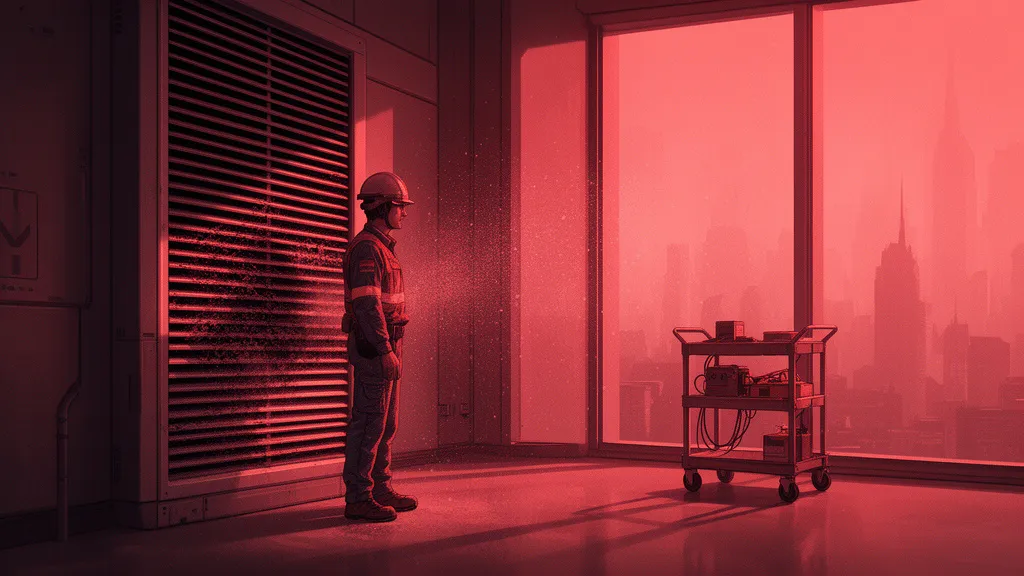
The nineteenth floor of the Sterling Research Tower smelled of ozone and ionized skin. Elias pushed the pneumatic maintenance cart forward, its rubber wheels vibrating against the floor tiles every 4.2 seconds. The emergency lighting was set to emergency-red, a low-frequency pulse that rendered the gray equipment lockers into silhouettes of dried blood.
He stopped at the main filtration stack. The intake vent was choked. A thick, silken layer of dust adhered to the wire mesh, warm to the touch through his nitrile gloves. It felt like felt. Or hair. He scraped a sample into a glass slide, the particulate matter clinging to his fingers with static electricity. It was high-protein dust—dead skin, fiber, aerosolized lipids. It was not debris from the building.
He pulled his wrench from the belt, loosened the intake housing, and pulled. The heavy plate slid away, revealing not the expected ventilation duct, but a seamless polymer wall. It was a recent addition, finished in the same clinical white as the surrounding hallway, but the seam was off by three millimeters.
He tapped the wall. It sounded hollow.
Elias ran his badge over the reader mounted to the trim. The machine chirped twice, a polite, synthesized trill, and the wall receded into the ceiling with a pneumatic hiss that barely whispered over the hum of the HVAC system.
Inside, the air was different. It lacked the metallic taste of the central supply. It was humid, smelling of stale starch and recycled sweat. The room was twelve feet by twelve feet, partitioned by a glass observation panel. In the center, a crib was bolted to the linoleum floor. It was child-sized, the rails reinforced with carbon fiber. A mobile hung above it, motionless, the plastic stars covered in a thick layer of undisturbed grit.
Monitors embedded in the wall pulsed with faint blue light. Vitals: 98 bpm. SpO2: 96 percent. The readings were active.
Elias stepped toward the crib. The blanket was mounded, suggesting a sleeper, but as he reached out, he hesitated. He turned to the terminal attached to the wall to check the entry logs, needing to know if a custodial shift had cleared this floor before his arrival.
Entry log: Maintenance Access - 04:12 - Badge #77-492-E
Elias looked at his plastic ID card. #77-492-E.
He had not left the basement commissary until 06:00. He checked the timestamp again. The clock on the wall synchronized with the building’s master server. It was 06:14.
He pulled his hand back, the nitrile glove catching on the edge of the console. Beneath the glass, the child was there—small, sallow-skinned, eyes open and fixed on the ceiling. It didn't breathe. Its chest remained perfectly still, the rise and fall simulated by the hum of the life-support loop integrated into the mattress.
He looked at his badge. The plastic surface was warm, as if it had been held in a closed hand for a long time.
The system is a closed loop, Elias. If memory serves, it doesn't tolerate redundancy.
He didn't remember saying that. He looked at the wall, at the seamless seam, and noticed the shadow of a smudge on the touch panel—the distinct shape of his own thumbprint, overlaid perfectly across the ‘Unlock’ command.
The overhead lights flickered, shifting from blood-orange to a harsh, diagnostic white. A mechanical voice echoed through the ventilation shafts, devoid of cadence.
Oxygen-rich saturation detected in Restricted Zone 19. Balancing atmospheric ratios.
Elias heard the heavy pneumatic seals on the stairwell doors slam shut. He was isolated. The building was designed to contain anomalies; it did so by removing the oxygen from the air until the fire hazard—or the biological anomaly—suffocated into submission.
He checked the ambient pressure sensor on his wrist. 1.01 bar. The numbers began to tick downward. 0.99. 0.98.
He grabbed the crib. It was heavy, anchored to the floor by electromagnetic locks that didn't respond to his badge. He wedged his prying bar under the base plate. The metal groaned.
He looked at the terminal. He could override the local containment protocol, but only by logging a deletion of the internal room entry. If he erased the log, the system would stop its purge, treating the room as an architectural error to be addressed during the next shift.
If he left, the child remained behind the white wall.
If he stayed to break the floor mount, he would run out of air.
He looked at the vitals monitor. The pulse had slowed. 92 bpm. 88 bpm.
Elias didn't panic. Panic was a luxury of the external environment. Inside the tower, physics dictated the outcome. He swung the pry bar, the force of the strike reverberating up his arms. The floor plating cracked.
The sensor on his wrist flickered. 0.92 bar.
He realized the child was not looking at the ceiling. The child was looking at him. Its pupils were dialated, fixing on his face with an intensity that felt like a calculation. It didn't cry. It didn't need to.
He pulled the badge from his vest and jammed it into the manual manual-release port on the crib’s base. It snapped. He hadn't meant to break it, but the lock disengaged. The crib jolted, releasing its bond to the floor.
Elias shoved his cart out of the way, the heavy steel frame clattering against the hallway wall. He lifted the crib. It was lighter than he expected, the child barely registering against the frame.
He moved toward the elevators, but the floor indicators were dark. He went for the stairwell. The door was a thick, reinforced slab of painted steel. He checked the handle. Locked.
He looked at his wrist. 0.85 bar. The air was thinning, the oxygen-deprivation alarm beginning to hum in his ears.
He turned back to the room. The false wall was already beginning to cycle closed, the hydraulic actuators whining as they pushed the heavy slab toward the frame.
He could jump through the opening and leave the child, resetting the cycle, or he could stand here and wait for the remaining oxygen to oxidize the rest of the room.
He took a breath. It was thin, metallic, tasting of the copper that bled from his own gums.
He looked down. The child’s hand reached up, fingers curling around his thumb. The grip was precise.
Elias sat on the linoleum, the crib resting on his knees. He placed the palm of his hand against the wall control. He accessed the configuration menu.
Delete entry? Y/N
He watched the pressure climb back down. 0.80 bar.
He typed 'Y'.
The wall stopped its descent. The red emergency lights clicked back to a soft, pulsing orange. The ventilation system audibly sighed as the oxygen flow resumed, a fresh injection of freezing, sterile air pouring from the ceiling vents.
He sat there for a long time. The building was silent once more. The room was empty, the terminal showing only a standard maintenance log for the nineteenth floor, clean and unremarkable.
Elias walked to the elevator, carried the crib to the basement, and placed it inside the back of his maintenance storage locker. He wrapped a yellow caution sheet around it.
He returned to the nineteenth floor. He replaced the intake vent cover and tightened the screws.
When he reached the basement, he opened the locker. The crib was empty. The blankets were folded neatly into a square.
He went to the mirror above the utility sink. His face was identical to his own, but his eyes were a different shade of brown. He took his badge from his pocket. It had been replaced. It was a new card, pristine and unscratched. He swiped it against the locker door.
Access granted.
The humidity index in the basement was exactly 42 percent.