Eleven Minutes Missing
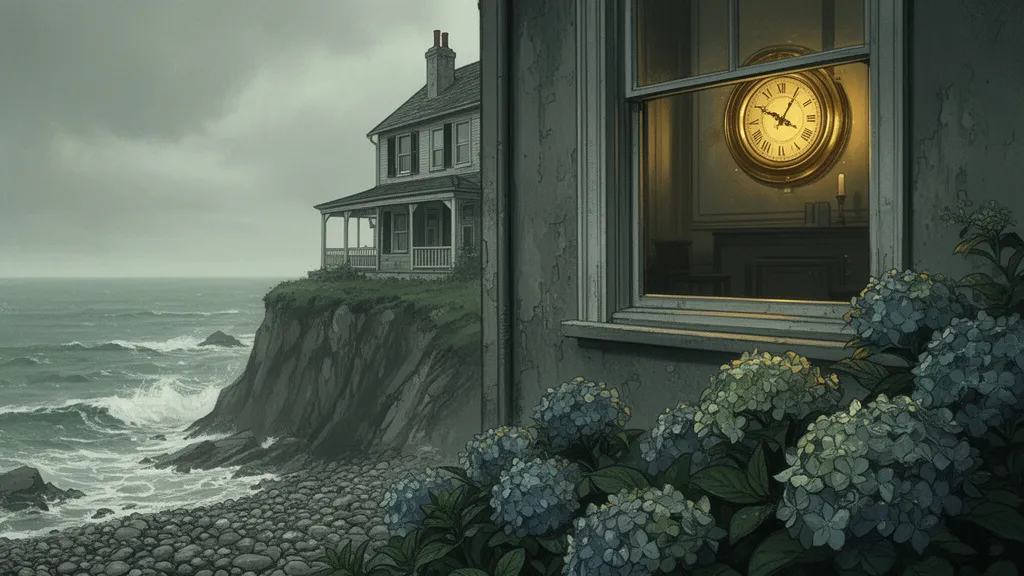
You noticed the brass clock before you noticed the sea. That, later, seemed consistent with your life.
The guesthouse stood on a low bluff above a pebbled cove, with a white railing gone grey in the salt and hydrangeas that had given up any ambition to be blue. When you came in out of the wind, carrying a bag lighter than your years and heavier than your shoulder preferred, the lobby smelled of old wood, dried kelp from somewhere unseen, and a polish that had once wanted to be lemon.
The brass clock hung behind the register. It was large, domestic, faintly grand. Its dial had Roman numerals, its glass was clean, and its hands said six minutes past five.
Your wristwatch said seventeen minutes past five.
You put your bag down. The woman at the register, who wore a cardigan the colour of weak plum skin and had the composed face of someone who had spent years apologising for weather, smiled at you.
“Mr. Akiyama? Welcome to Shiosai House.”
You looked not at her but at the dish beside the register.
It was a pale ceramic dish with a crackle glaze and a painted sprig of grass at one side. Six room keys lay in it. Each key had a wooden tag with a room name burned into the grain: Pine, Iris, Gull, Tide, Fern, and Cliff.
They had not been dropped there carelessly. They had been arranged. Pine and Fern lay parallel. Gull had been set crosswise between them. Cliff had been turned face down. Tide sat alone near the lip. Iris had been tucked partly beneath the others, visible and hidden at once. There was nothing practical in the arrangement. It was too deliberate to be random and too untidy to be neat.
The woman was still smiling. “We’ve had a cancellation, so you may choose between Cliff and Pine. Cliff looks out to sea. Pine does not, but the window shuts properly.”
“The clock is slow,” you said.
She looked up as though seeing it for the first time in years. “Is it? How inconvenient.”
“By exactly eleven minutes.”
“Then it is very exact in its inconvenience.”
Her smile improved by a degree. She thought, perhaps, that retired men liked clocks the way retired colonels liked maps: as a hobby capable of harmless intensity. This was not wholly unfair.
You said, “May I?” and gestured toward the clock.
“If you can forgive the state of the ladder,” she said.
There was no ladder. There was, however, a chair. You declined it and instead took the watch from your waistcoat pocket, opened the back with your thumbnail, listened, and looked again at the brass clock. Not stopped. Running. Merely wrong.
“Cliff, please,” you said.
The woman reached into the dish. She paused, faintly. Her fingers passed over Pine, Fern, Gull. She picked up Cliff from its face-down position and handed it to you.
“Dinner is at seven if you’ve booked it.”
“I haven’t.”
“Breakfast from eight. If you hear banging in the night, it will be the shutters, unless it isn’t.”
She said this in the tone of a person repeating a line that had once amused somebody worth amusing.
You took your key and your bag. “Has the house been full?”
“No. Empty, nearly. You and one other guest.”
“The keys suggest more traffic.”
At this, she looked directly at you. Her eyes were dark and candid in the way candour sometimes is when it expects to be doubted.
“I had a child visitor this afternoon,” she said. “My sister’s son. He likes touching what is not his.”
“Ah.”
It was possible. Children and disorder had long been acquainted.
Your room was at the end of the upper corridor. Cliff looked out over the cove and the weather-beaten rail and, beyond them, the sea in a long sheet of tin. The window did not shut properly. This, too, was possible.
On the writing desk lay a glass tumbler upside down on a coaster, a guest booklet, and a packet of sencha. You rang, later, for hot water. It arrived scalding enough to suggest a private grudge. You let it cool too long while unpacking and drank it tepid. This also was consistent.
By half past seven the wind had risen. At eight, while you sat in the downstairs sitting room with a book you did not read, the other guest came in. She was perhaps forty, perhaps younger under better light, with hair pinned untidily and a linen suit that had accepted the sea air as a personal insult. She carried a violin case and a face of restless intelligence.
“You’re the clock man,” she said.
You closed the book. “I am a retired watchmaker.”
“Even better. I’m Fujishiro Emi. I play badly when nervous and very well when angry.” She sat opposite without invitation, which saved you the trouble of offering one. “Did you notice the lobby clock?”
“Yes.”
“It was right at dinner.”
“You had dinner?”
“I had soup of uncertain fish and admirable potatoes. At seven twelve, by my watch, I was waiting for bread and looked directly at the clock because the owner was telling me a story that wanted a reaction. It showed seven twelve.”
“You are certain.”
“I earn my living entering at the correct bar after too many rests. I am tedious about time.”
This was said without apology.
“And now?”
“Now it is eleven minutes slow. I checked because the owner looked at it and looked away as though she disliked what she saw.”
You considered this. “You heard no one adjust it?”
“It hangs high enough that I’d have noticed furniture moving.”
The wind tapped a branch against the pane. She glanced at the tea tray on the side table.
“Do you trust her?”
“I have not yet had occasion.”
“You may. Or may not. It would be useful to decide before morning.”
This was dramatic, but only a little. Musicians often lived as though somebody had asked for a larger gesture than the room required.
At ten, you went upstairs. The corridor smelled faintly of soap and seawater. Near your door, on the worn runner, lay a folded note.
It had been pushed under and not fully made it.
The paper was common hotel stationery. The edge was spotted with dried salt, as if from a damp hand or a wet sill. In a narrow upright script, it said:
2:13. The missing time was in the wall. Do not let her tell you the house was asleep.
There was no name.
You looked down the corridor. The doors were all shut. At the far end, the window showed only your own faint reflection and a square of moving dark where the sea must be.
You knocked first on Fujishiro Emi’s door.
She opened at once, barefoot, violin under her chin, bow in hand. “Well?”
You held up the note.
She read it. Her expression did not become theatrical. That argued for sincerity.
“I didn’t write it,” she said. “Though I admire the style. And yes, I heard something at 2:13 last night.”
“Last night?”
“I arrived yesterday. I thought the owner had told you.”
“She said there were two guests. That is all.”
“Then technically she remains innocent.” Emi lowered the violin. “At 2:13 precisely, because I checked my watch after it woke me, there was a sound inside the wall behind the headboard. Not scratching. Not pipes. More like…” She searched. “A compact rattling. Mechanical, but muffled. It lasted perhaps twenty seconds. Then a knock, one hard knock, and silence.”
“Did you tell the owner?”
“At breakfast. She said old houses speak in their sleep and ours had a stammer.”
“And the house?”
“She said it had been empty before my arrival. No staff overnight but herself. No deliveries. No one else.”
You held the note a moment longer. Salt on paper, a time, a contradiction. “May I see your room?”
She stood aside.
The room called Iris looked inland, over a kitchen garden and the lane beyond. The headboard stood on the wall shared with the empty room next door, Tide, if the plan in the guest booklet could be trusted. You tapped the plaster with one knuckle. Hollow enough in places. Old enough everywhere.
“Did you hear it here?” you asked.
“Yes. Exactly here.”
You listened to the wall, which offered only the sea’s general opinion of the coast.
“Who has Tide?” you asked.
“No one, unless ghosts book under false names.”
“Did you try the handle?”
Emi looked at you with gentle contempt. “Of course.”
“It was locked?”
“It was not merely locked. It was possessive.”
You went back into the corridor. Tide’s door stood three down. You tried the knob. Locked.
The owner was in the kitchen, decanting tomorrow’s milk into a blue jug for no reason except habit. Up close, she was perhaps sixty, with capable wrists and a tiredness arranged very neatly around the mouth.
“There seems,” you said, “to be some uncertainty about your occupancy.”
She did not spill the milk. “Does there?”
“A note was put under my door.”
“By whom?”
“If I knew, there would be less uncertainty.”
She dried her hands on a towel. “I dislike games, Mr. Akiyama.”
“So do I. Which room adjoins Iris?”
“Tide.”
“Is it empty?”
“Yes.”
“May I see it?”
A small delay. Not enough to be called hesitation if one were kind.
“At this hour?” she said.
“At this one.”
She fetched the key from a hook beneath the counter, not from the dish. That was interesting in itself. She led you and, having joined by invitation she did not receive, Emi upstairs.
Tide smelled of linen press and disuse. The bed was made too tightly. The curtains had been drawn. When the owner turned on the lamp, its light showed a room tidy to the point of discouragement.
“The wall,” Emi said.
You went to the bed and put your palm on the plaster opposite her headboard. Cool. Nothing. On the floor, half hidden by the valance, was a faint crescent of white grit.
You crouched. Not plaster. Salt.
Emi saw you see it. The owner did not move.
“Your empty room has been visited by the sea,” you said.
“The windows do not fit well,” she said.
You looked at them. The casement was latched. The sill bore a pale, scrubbed tide-mark in one corner.
“Did your sister’s son come up here as well?”
Something flickered in her face then — not guilt, not exactly. Irritation at an old obligation. “No.”
“Then the keys were not his work.”
She folded the towel once more though it no longer required folding. “No.”
Emi leaned against the wardrobe, interested as only an uninvolved person can be. “That simplifies matters.”
It did not, but she was trying to be helpful in the manner of those who enjoy complication.
You said, “The brass clock was correct at seven twelve and wrong by eleven minutes later. The room next to Iris, supposedly empty, contains salt under the bed and on the note delivered upstairs. Someone was in this room last night or this evening. At 2:13, Miss Fujishiro heard a mechanical sound in the shared wall. And your keys were rearranged not by a child but by a hand with a purpose. I think, Mrs.—?”
“Shinohara.”
“Mrs. Shinohara. I think you may as well tell us the smaller lie before we are forced into the larger one.”
That amused Emi. It did not amuse the owner.
Mrs. Shinohara sat, suddenly and carefully, on the chair by the writing desk.
“My husband,” she said, “died three years ago. He left debts, recipes, and an unhelpful number of admirers. Since then this house has remained open by stubbornness and arithmetic. I have a son. He is thirty-two. He is kind, handsome, and wholly unreliable. He also has a wife, from whom he is at present not legally separated and from whom he has, however, separated himself several times in spirit. Yesterday he arrived after midnight by the cliff path with a woman who was not his wife.”
Emi closed her eyes briefly in gratitude to the world for being itself.
Mrs. Shinohara continued, “They begged one night. They said no one need know. I put them in Tide. At dawn, before Miss Fujishiro came down, the woman left. My son remained until late morning, then left by the same path. He promised discretion. My experience of his promises is mature.”
“And the note?” you asked.
“I did not write it.”
“The keys?”
“My son has a habit of touching things when anxious. He rearranged them while pleading.”
This, absurdly, sounded true. You could see the hand that could not keep still making patterns in a dish while inventing excuses.
“And the sound in the wall at 2:13?”
At this Mrs. Shinohara frowned, genuinely. “I know nothing of that.”
You looked again at the bed, the shared wall, the tight coverlet. In old houses, walls hid pipes, cracks, mice, letters, bottles, resentments, and occasionally the reason for everything. Mechanical, muffled, twenty seconds, then one hard knock.
You asked, “Where does the brass clock’s case open?”
“From the side,” Mrs. Shinohara said. “There is a little panel.”
“Who winds it?”
“My husband used to. Now no one, very carefully. It is electric.”
You nodded. Decorative case, modern movement perhaps added years ago. You went downstairs at once, the two women behind you with that reluctant companionship mysteries often produce.
In the lobby, the clock still lagged behind. Eleven minutes had remained stubbornly absent.
You stood on the chair this time. From up close, the brass case showed the fine green shadows of old polishing in its seams. On the right side was a narrow door with a turn catch.
“Do you object?” you asked.
Mrs. Shinohara said, “I have passed objecting.”
Inside the case was not only a movement. Wedged behind it, where no clock required one, was a packet wrapped in oiled paper. The paper had been folded many times and recently; one edge was crusted white.
Salt, again.
Mrs. Shinohara made a noise so small it was almost manners.
You handed the packet down. She unwrapped it. Inside was a bundle of letters tied with shoe ribbon, and beneath them a woman’s wristwatch with a cracked leather strap.
Emi said, “Well.”
The letters were old enough to have yellowed at the folds. The top one was addressed to Sachiko in an impatient, elegant hand. Mrs. Shinohara looked once at the script and sat down without choosing to.
“My husband,” she said.
No one spoke.
After a moment she opened one letter. She read three lines, then stopped. Her face did not collapse. It altered more quietly than that. Something private and long suspected had moved from weather into stone.
“He had an affair,” she said. “Many years ago. With a woman named Sachiko.”
Emi, less unkind than curious, asked, “Your son found these?”
“Yes.” Mrs. Shinohara’s fingers tightened on the paper. “The woman with him yesterday was my husband’s daughter.”
That landed softly and stayed where it landed.
You said, “His half-sister.”
“Yes.”
Emi sat down too. “That,” she said, with care, “is awkward in several directions.”
Mrs. Shinohara gave her a brief look of bleak appreciation. “Quite.”
Now the arrangement of the keys, the clandestine room, the sea path, the salt on the packet all began to settle into ordinary human shape. A son had found old letters hidden in the house, perhaps while repairing something, perhaps while rummaging where grief and entitlement had thinned the boundaries. He had brought the woman to the guesthouse to confront facts or ask questions or both. He had hidden the packet in the clock for the night, lacking a better place. At 2:13 he had tried to retrieve or conceal it through some opening in the shared wall, failed, knocked once in frustration. Later, before leaving, he had moved it properly into the clock case. Or perhaps the opposite: moved it from the clock to the wall and back again. The precise sequence required only the physical route.
You looked at the shared wall on the lobby side. There was, beside the umbrella stand, a narrow built-in cupboard door painted the same cream as the wainscot. It might once have housed hot-water pipes. Mrs. Shinohara opened it with a key from her ring.
Inside, behind shelves of spare blankets, ran a shallow service shaft upward. At shoulder height in the plaster of Tide’s side was a square patch cut cleaner than the surrounding wall. A board, removable. From Iris, behind the headboard, there had likely once been a matching access panel papered over long ago.
“A rattling,” Emi said, leaning in. “A packet scraping in a cavity.”
“And the knock,” you said, “when he replaced the board.”
Mrs. Shinohara closed her eyes once. “He must have found the letters earlier. He used to play in these cupboards as a child. He would remember the shaft.”
Emi said, “Then the note was from the woman.”
“The daughter,” you said. “Or half-daughter. She knew enough to point to the wall, and enough to distrust silence. She slipped it under my door this evening after returning, perhaps, or before she left if she saw me arrive and guessed what you were.”
“She returned?” Mrs. Shinohara said.
You indicated the salt. “The packet was wet recently. Sea path, night air, or both. Someone carried it after midnight.”
Emi looked at the letters in the owner’s lap. “And the eleven minutes?”
That was the smallest matter and had taken the longest shape.
You returned to the brass clock and studied the minute hand. At the arbor, where the hand was fixed, there were faint fresh scratches.
“Not the mechanism,” you said. “The hand was moved by force. Backward eleven minutes. Likely with a knife tip or key edge.”
“Why eleven?” Emi asked.
“Because at 2:13 she heard the search in the wall. If your son needed an alibi before dawn, Mrs. Shinohara, he could make the house appear to have been asleep at a different time. Anyone recalling the lobby clock might misremember when he came down or went out.”
Mrs. Shinohara thought. “At two twenty-four I heard the front door. I looked at the clock from the stairs. I remember because I was awake with shame and annoyance. It said two thirteen.”
“Then he altered it before leaving Tide,” you said. “You trusted the house’s public face over your own wakefulness. It is a common courtesy we pay objects.”
Emi smiled despite herself. “That is nearly philosophical.”
“It is only watchmaking,” you said.
Near midnight, the son arrived.
Not because summoned by police or conscience, but because weather had turned and secrecy often loses courage in rain. He came in wet from the cliff path, beautiful in the incompetent way his mother had advertised, with a face too open for long deceit and too selfish for short wisdom.
When he saw the packet on the table, he stopped.
The explanation, once begun, was almost insultingly ordinary. He had discovered the letters a month ago behind the service shaft panel while searching for old account books. From them he had traced Sachiko, too late to meet her alive. He met instead her daughter, Kanako, a schoolteacher from another town. They had become close before they understood exactly how close blood had once made them. Then the understanding came. They had come to Shiosai House to confirm it from the original letters and decide what to do with the knowledge. Whether they had been lovers before that knowledge was not asked directly. It did not matter in the useful sense and mattered in every other.
He had hidden the packet in the wall when his mother stirred upstairs. Later, panicking, he had set back the lobby clock on his way out, thinking only to blur the hour at which he left Kanako in Tide and took the cliff path to think, sulk, or be sick with himself by the sea. Kanako had found the packet again, realised how little silence could be trusted in families, and written the note.
He said all this with the helpless exactness of a man whose lies had failed him early and who had not rehearsed the truth.
Mrs. Shinohara listened. She did not forgive him at once. This was one of the few signs of intelligence available to parents.
Emi excused herself only when it became clear no one would throw crockery. She paused by your chair.
“You were right not to trust the clock,” she said.
“I distrust any device handled by the distressed.”
“And people?”
“Less. They are rarely precise enough to deceive for long.”
She considered that, then touched the rim of your teacup with one finger. “Cold.”
“Of course.”
She went upstairs smiling.
In the morning the sea had turned a flat persuasive silver. Mrs. Shinohara had put the room keys back in the dish without arrangement.