Platform Early
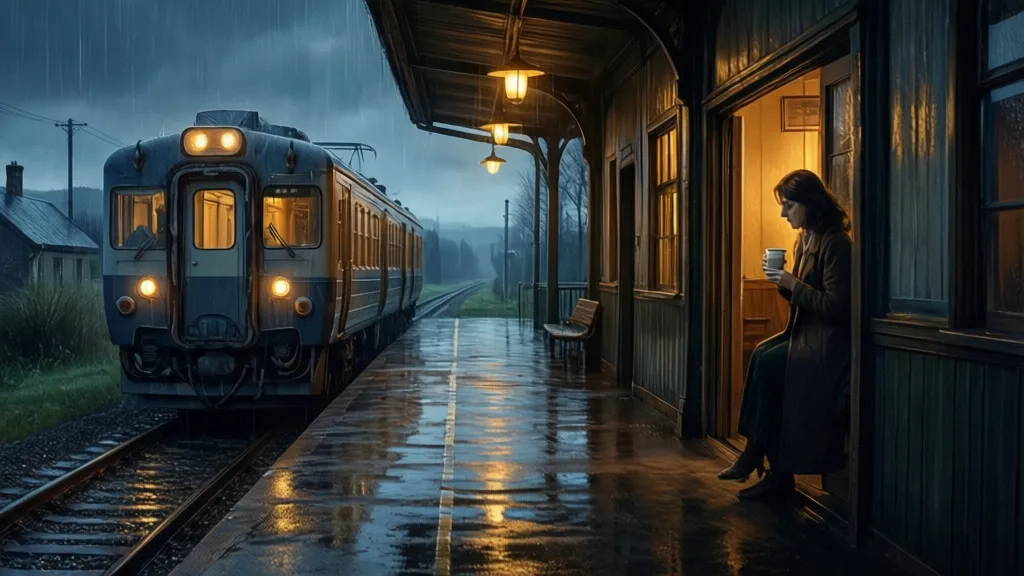
The midnight local came in on Platform Two instead of Three, which was the first thing that went wrong, and not, Mizuki Arai thought later, the most important.
It glided under the station lamps with a wet metallic patience, rain ticking along the roof. Kurokawa Station was small enough that mistakes arrived in full view of everyone. The night porter stepped out from beneath the awning, looked at the train, looked at the sign, and made the face of a man who had been insulted by timetables personally.
Mizuki was standing in the waiting room doorway with a paper cup of tea too hot to hold properly. She set it on the sill before it could damage either hand or dignity. She had come to Kurokawa to meet a colleague who had failed to arrive on the last evening train, and had instead found herself absorbed into the station’s midnight arrangements, which were not usually so dramatic.
Conductor Seshimo jumped down from the second carriage with the anxious energy of a man who expected rails to take offence. He was tall, neat, and already wet at the shoulders.
"Platform Three was blocked by a freight wagon," he said to nobody in particular. "Signal from the junction changed us over. We are eight minutes late. Eight."
The stationmaster, Mr. Hori, emerged from his office fastening one cuff. "Then be grateful you are not nine."
This was his manner with all disasters, whether weather, staffing, or human weakness.
Passengers descended in a trickle. A student carrying a violin case, though not, Mizuki thought, a violinist’s posture. An elderly couple who argued gently over an umbrella they were both using. A woman in a green felt hat with a collar of fox fur gone sleek from rain. A man carrying florist’s boxes with This Side Up ignored by all sides.
Then Seshimo, who had begun checking the corridor windows by habit, stopped and looked back into the carriage.
He looked again at the woman in the green hat.
"Excuse me," he said.
She turned. She was perhaps thirty-five, fine-boned, handsome rather than pretty, with a composed mouth that had practiced not reacting too soon. The coat she wore was dark blue, belted, with rain darkening the hem.
"Were you not in the rear carriage just now?" Seshimo asked.
"I have just got off this train," she said.
"Yes. In a brown coat."
A few people, hearing the note in his voice, paused without looking as though they had paused. This, too, was a station habit.
The woman’s expression did not change. "No."
Seshimo glanced along the windows. "Stationmaster. There is still a passenger seated in the rear compartment side. A woman in a brown coat. I took her ticket at Higashino myself."
The woman in blue said, with the mildness of someone refusing soup, "Then you are mistaken about one of us."
Mizuki picked up her tea, discovered it was still too hot, and held it anyway. Rain had left a line of dark wet along the woman’s hem, two inches high, irregular, as if she had crossed shallow standing water. The brown-coated woman, visible now through the rear carriage glass, had the same hat, the same angle of head, and, as she rose, the same line of wet at the hem.
It was not resemblance. It was repetition.
Mr. Hori said, "Well. We can settle that in thirty seconds." He turned to the porter. "Tanabe, nobody boards, nobody leaves."
"Except those already left?"
"Do not improve my instructions."
The brown-coated woman descended from the rear carriage. She also wore a green hat. Her face, under the brim, was the face of the blue-coated woman exactly: same narrow eyes, same straight nose, same calm mouth. The station lamps, which were kind to nobody, made no distinction.
The porter inhaled through his teeth with a sound of professional satisfaction. Something truly inconvenient had happened.
"I see," said the brown-coated woman.
The blue-coated one said, "As do I."
Neither sounded surprised enough.
They were brought into the waiting room because there was nowhere else to put an impossibility.
Kurokawa’s waiting room had wooden benches polished by decades of discomfort, a stove giving off more smell than heat, and a newspaper rack beside the timetable board. Over the stove hung the station clock, which had kept a severe and public time for forty years.
At 12:17, while Mr. Hori was asking for names, the clock stopped.
It did so with a little click that sounded, absurdly, deliberate.
Everyone looked up.
"Of course," said Mr. Hori. "If I set fire to this station, would the furniture also become whimsical?"
No one answered. His rhetorical questions had often suffered that fate.
The two women gave their names within half a second of each other.
"Chisato Kamei," said the one in blue.
"Chisato Kamei," said the one in brown.
Seshimo closed his eyes briefly.
Mizuki sat at the end of a bench and accepted from Tanabe a second paper cup of tea, this one already cooling into disappointment. Her first had vanished in the confusion. This seemed consistent with the universe.
Mr. Hori pinched the bridge of his nose. "Occupation?"
"Companion and assistant to Mr. Tsuneyuki Kamei," said the blue-coated woman. "Jeweler."
"The same," said the brown-coated woman.
At that, the ticket clerk, a narrow young man named Ogawa who had been trying to become invisible behind the luggage scale, made a small involuntary sound.
Mizuki noticed it because he then pretended to cough and failed to perform a convincing cough.
"You know the name?" she asked.
All eyes moved to her, and she was once again reminded that asking a sensible question in public often made one responsible for the answer.
Ogawa looked at Mr. Hori, who shrugged with ill grace.
"There was a message," Ogawa said. "This evening. For a Mr. Kamei. The jeweler. I was told if he came through, I should give it to him."
"By whom?" asked Mizuki.
"A messenger from town. I did not know the boy. He said it was urgent."
"Where is it?"
Ogawa pointed, to everyone’s surprise, not to the desk but to the newspaper rack.
There, tucked flat behind the local paper and half-concealed by a railway circular, was an envelope sealed with dark red wax. On the front, in a careful hand: For Mr. Tsuneyuki Kamei. To be delivered into his own hand only.
Mr. Hori stared. "Why is it there?"
Ogawa stared harder. "I do not know. I put it on the counter."
"Did you?" said Mr. Hori.
"Yes."
"And then?"
"Then I did not leave the waiting room." Ogawa swallowed. "I mean that literally. Since eleven-forty I have not left this room once. Ask anyone."
Tanabe said, "He has not. He has been standing in plain sight being unhelpful for nearly an hour."
"Thank you," said Ogawa faintly.
The sealed letter sat in the rack like a small animal pretending to be paper.
The two Chisato Kameis watched it, and for the first time the resemblance between them bent slightly under strain. The blue-coated woman’s attention sharpened. The brown-coated woman’s became guarded.
"Where is Mr. Kamei now?" Mizuki asked.
The blue-coated woman said, "Missing. Since this afternoon. We were traveling to meet him here."
"We?" said Mr. Hori.
The brown-coated woman said, "I was traveling to meet him. She was traveling to impersonate me."
"No," said the blue one, with faint impatience. "She was traveling to intercept him."
Seshimo said, to the room at large, "They boarded at different stops. The brown coat at Higashino. The blue at Numata Crossing. I saw each one separately. I would stake my wages on it."
"That is not a large stake," said Mr. Hori.
"Large to me."
Mizuki rose and went to the newspaper rack. The envelope was dry except for one corner, where a raindrop had touched and spread the ink slightly. The rack stood by the outer wall beneath a window cracked open for stale air. Rain could have reached the front edge in a gust, but not the place where the envelope had been hidden behind the papers.
She did not touch the wax seal.
Instead she looked at the newspapers. The top one was folded badly, not by the station’s usual vendor, who folded with exact and irritating symmetry. The second sheet had been inserted upside down. Someone had handled the rack recently and in haste.
Behind her, Mr. Hori was conducting the inquiry with increasing dissatisfaction.
"Tickets," he said.
The women produced them. Both were for Kurokawa, one issued at Higashino, one at Numata Crossing, both in cash, both in the same day’s sequence, though not consecutive.
"Luggage?"
The blue-coated woman had a leather case and a hatbox. The brown-coated woman had an identical leather case and no hatbox.
"Convenient," said Mr. Hori.
"Unavoidable," said the brown-coated woman.
"Meaning?"
She looked at the other woman. "Meaning one copies what one sees."
There was, Mizuki thought, an intimacy in the bitterness. Not family. Not friendship. Something more selective.
She said, "How long have you known Mr. Kamei?"
The blue-coated woman answered first. "Three years."
The brown-coated woman said, after the smallest pause, "Five."
That pause was interesting, not because it proved a lie, but because it admitted the need to calculate one.
Mizuki set her cold tea down and wished, not for the first time, that beverages would either comfort or disappear, instead of lingering between intentions.
The sealed compartment at the rear of the train complicated everything.
It was not a secret compartment in the melodramatic sense. It was a locked reserve carriage section, used tonight to transport a satchel of unset stones and accounting books from a provincial estate sale in Higashino to the city office by dawn. The railway had sealed the door with paper strips and wax because provincial caution favored ceremony when true security was unavailable.
Only one passenger was booked to ride in the adjoining private compartment: a representative of the consignee, who had not yet appeared. If he failed to board by departure, the satchel would still travel. If the wrong person boarded in his place, and that person already knew where and how the stones were moving, opportunity would be carried neatly into the dark.
Mr. Hori explained this with the air of a man resenting every noun in the paragraph.
"And one of these women," he said, "claims connection to a missing jeweler. The sealed letter is for that same jeweler. The clock has stopped because God is theatrical. Dawn comes whether we solve it or not. Excellent."
"May I see the rear carriage?" Mizuki asked.
Seshimo blinked. "Why?"
"Because if one woman boarded at Higashino and the other at Numata Crossing, then something happened in between or before. Trains are very good at preserving the order of inconvenient facts."
This sounded more confident than she felt, but confidence was often a practical courtesy.
Mr. Hori considered, then grunted permission.
The two women remained in the waiting room under Tanabe’s supervision, where each could observe the other with increasing dislike. Ogawa hovered near the stove as if fear might improve his circulation.
Rain followed Mizuki, Seshimo, and Mr. Hori onto the platform in a silver drift. The rear carriage smelled of wet wool, coal smoke, and fatigue. Seshimo showed where he had seen the brown-coated woman seated alone on the left side. On the rack above was no luggage. The floor beneath the seat was damp from shoes but held a single detail that did not belong: a little crescent of blackened red wax, trodden flat at one edge.
Mizuki crouched.
"Did you seal anything in this carriage?"
"Only the reserve door at the end," Seshimo said.
They examined it. The paper seals across the reserve compartment were intact. The wax on them was black, not red. The flattened crescent on the floor had come from elsewhere.
On the seat itself, near the window, there was a tiny dark-red smear no larger than a lentil, as if an envelope had rested there while still tacky from handling.
"A letter seal," said Mizuki. "And recently."
Mr. Hori said, "So the envelope was on the train first."
"Or in the hands of someone on it."
At the Numata Crossing side of the carriage, near the external door, rain had dried in interrupted splashes along the threshold. Two sets of recent footprints had crossed there before the train reached Kurokawa: one narrow, one broader. The narrow prints carried the same shallow wet line along the edges that Mizuki had noticed on both hems, as though the wearer had stepped through the same puddle. The broader belonged, probably, to Seshimo.
She looked out through the corridor window. Numata Crossing was little more than a shelter and a plank platform. In heavy rain, passengers often had to step off the cinder path into standing water to reach the carriage door. That would explain one damp hem. But both women had it.
Unless both had boarded at Numata, or both had crossed the same puddle somewhere else.
On the seat opposite the place where the brown-coated woman had sat, Mizuki found a newspaper section folded into quarters. The local advertising page. One corner was damp; another smelled faintly, distinctly, of violet powder.
In the waiting room, the blue-coated woman wore no powder. The brown-coated one did.
Seshimo said, "Well?"
"She sat there too," said Mizuki, touching the opposite seat. "At least for a while. Brown coat in the rear carriage, violet powder. And the red-wax letter was handled in this compartment before the train arrived. Then she moved, or someone in her clothes did."
Mr. Hori folded his arms. "That gets us from impossible to tiresome. Continue."
They returned to the waiting room, where the impossible had become sharper rather than softer.
The envelope still waited in the rack.
Mizuki stood before the two women. "Which of you uses violet powder?"
The brown-coated woman said nothing.
The blue-coated one gave her a brief look. "She does. Mr. Kamei says he can smell her before he hears her. He means it kindly."
The brown-coated woman’s mouth altered by one degree. There were many histories in one degree.
"Then you know him well," Mizuki said.
"I know his manners," said the blue-coated woman.
"And his affections?"
A silence. Not embarrassed. Precise.
The brown-coated woman said, "More than she does."
"That," said Mizuki, "may be true and still not help us. Tell me instead why both of you are dressed as Chisato Kamei."
The blue-coated woman looked at the stove. "Because I am Chisato Kamei. I have managed Mr. Kamei’s appointments and designs for three years. He intended to dismiss another woman this week, and she knew it."
"Dismiss?" said Mizuki.
The brown-coated woman laughed once, dryly. "How businesslike she makes it. I worked with him before her. With him, beside him, for five years. He promised marriage often enough to make the omission elegant. When his business improved, elegance no longer suited him."
No one moved. Even Mr. Hori had sufficient humanity to leave that sentence alone.
The blue-coated woman said, "He told you what was easiest at the time. He tells everyone that."
"Including you?"
"Naturally."
There it was: the relationship that refused a simpler name than complication.
Mizuki said, "And today?"
The brown-coated woman answered. "He sent me a note asking me to meet him at Numata Crossing, privately, before he came on to Kurokawa. He said he wanted to settle matters."
"He sent me the same note," said the blue-coated woman. "At a different hour."
"Do you have the notes?"
Neither did. Both had destroyed them. This was very like people with pride and very unlike people with foresight.
Mizuki turned to Ogawa. "When the messenger brought the sealed letter for Mr. Kamei, was it already sealed?"
"Yes. Red wax."
"Did you notice any scent?"
He looked baffled, then slowly nodded. "Yes. Something floral. Powder, perhaps. I thought it belonged to the messenger, but he was only a boy."
Mizuki looked at the brown-coated woman. Powder on the carriage newspaper. Red wax in the carriage. Letter hidden after arrival. Ogawa insisting he had not left the room.
She crossed to the newspaper rack again and examined its back. The rack had two open sides, one facing the room, the other the wall, with enough gap to slide papers through from either end if one stood close. Ogawa had indeed not needed to leave the waiting room to move the letter. He would only need to drift a step while everyone watched the stopped clock.
"Mr. Ogawa," she said. "Who asked you to conceal the envelope?"
He went white with an efficiency bordering on art.
"No one—"
"The clock stopped at 12:17 because someone standing beneath it reached up and opened the case. The latch is loose. The hand has been pinched still. You are the only one here tall enough to do it without a chair, and the clock is directly above this rack. You stopped it to create a distraction while you shifted the letter from the counter into the papers, after the two women began giving the same name." She spoke gently. "Why?"
Ogawa’s lips moved. No sound came out. Then he looked, not at either woman, but at Mr. Hori.
This was almost touching.
Mr. Hori said with weary disgust, "If you have accepted money in my station, at least do it with a little style."
"I did not accept money," Ogawa said desperately. "I accepted a request. From Mr. Kamei himself. He came at eleven-fifty, before the train. He was soaked. He said if two women asked after him, I was to keep the letter out of sight until he returned, and tell no one. He said one of them meant to ruin him. I left it on the counter because I thought he would be back before the train. When they both said they were Chisato Kamei, I panicked. So I stopped the clock and hid it."
"Which one?" asked Seshimo. "Which woman meant to ruin him?"
"He did not say. I think he did not know."
"Where is he now?" said Mizuki.
"He went out again. To the old parcels shed. He said he needed ten minutes alone. He took the station umbrella and did not bring it back."
Mr. Hori made a short sound which, with charity, might be called prayer.
They found Tsuneyuki Kamei in the parcels shed behind the freight siding, alive, miserable, and very damp.
He had not been murdered, merely cornered by his own arrangements. He had slipped on the wet threshold, twisted his ankle, and then, discovering that shouting into rain was less effective than novels suggested, had remained on an upturned crate among trunks retired from travel and three sacks of feed. The station umbrella lay beside him, broken at the rib.
He was a handsome man in the worn and anxious way of men who had been admired too specifically. At the sight of Mr. Hori and two lanterns, he attempted dignity and obtained only relief.
They brought him back to the waiting room, where the two women regarded him with the united contempt that only divided affection can produce.
The sealed letter was placed on the table. Mr. Hori looked at Mizuki. She nodded once.
"Open it," said the stationmaster.
Kamei broke the wax with fingers that were less steady than vanity preferred. Inside was a single sheet.
He read it, and color left him.
"Well?" said Mr. Hori.
Kamei swallowed. "It is from my creditor in Higashino. He states that unless I repay what I owe by tomorrow, he will begin proceedings and notify my clients that several pieces in my recent catalogue are not my own designs."
The room settled around that.
The blue-coated woman closed her eyes briefly. The brown-coated one did not move at all.
Mizuki said, "You summoned both women separately to Numata Crossing because you meant to persuade one to provide money and the other to surrender silence. You wore yourself thin enough that each knew only half of what you were doing."
Kamei said nothing.
"And when you realized both might arrive, you panicked. You told Ogawa to hide the letter because whichever woman saw it would know how desperate you were. Then you ran to think privately and fell over your own melodrama."
Mr. Hori said, "A precise summary of what my profession endures."
Seshimo frowned at the women. "But there are still two."
"Yes," said Mizuki. "