The Ash Thumbprint
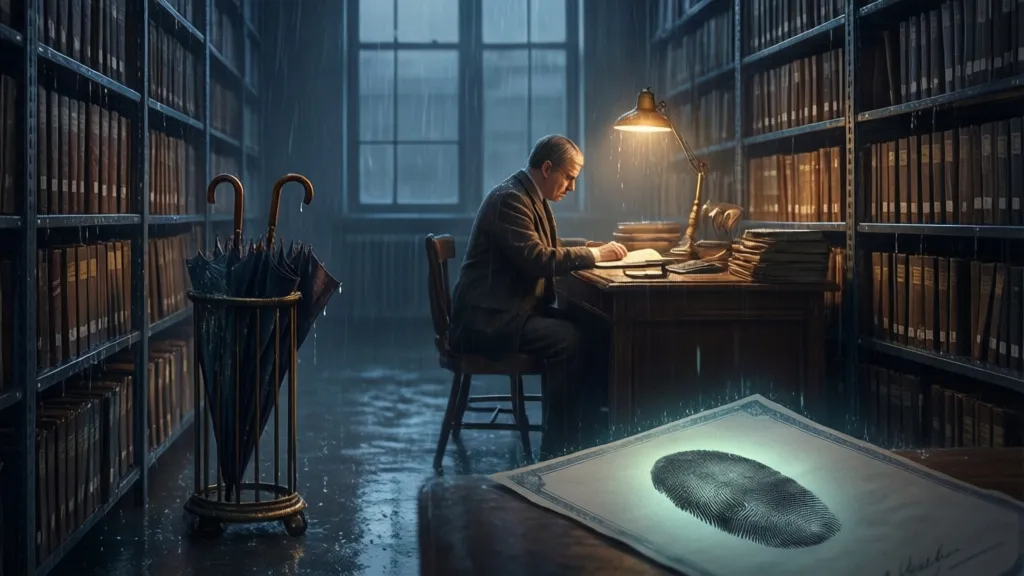
By half past four, the rain had found the gap above the municipal archive window and was dripping, with steady civic patience, into a chipped umbrella stand no one had thrown away because it still held water perfectly well.
Hoshino Aya moved the stand two inches to the left, set a saucer under the worst of it, and went back to the death certificates.
There were twelve to file before closing. The town had been old for a long time and damp forever, and both conditions kept the records office employed. Aya sat at her desk in the rear room of the Minato Ward Office, beneath steel shelves labelled Births, Deaths, Transfers, Tax Irregularities, and opened the next folder.
Sugimoto Fumie, age eighty-one. Pneumonia. Certified three days ago.
Nothing odd there. She stamped the corner, checked the registry number, and reached for the second.
Matsuda Kenji, age sixty-four. Cardiac arrest at home. Certified four days ago.
Her hand stopped before the stamp came down.
At the lower right corner, just above the filing notation, there was a smudge. Not ink. Not rainwater. A thumbprint, faint but distinct enough in its ridges, laid diagonally in a powdery gray that looked almost like soot.
Aya held the page closer to the lamp. The print was partial, as though someone had touched the paper after rubbing ash from a cigarette or a brazier. The clerks upstairs still smoked under the loading bay awning, though they denied it if asked in writing.
She set the certificate aside and opened the third file.
Nakamura Chie, age seventy-two. Fall on temple steps. Certified two days ago.
The same gray thumbprint marked the same lower corner.
Aya looked back at the second certificate, then opened the fourth. No smudge. The fifth. No smudge. The sixth.
There it was again.
Three certificates, all filed in the same week, all carrying the same faint ash-gray thumbprint in the same place.
She did not think, at once, of murder. Municipal records clerks were not paid to think of murder. They were paid to notice when a date was wrong, when a seal had been misapplied, when a widow became a widower halfway through page two. Aya was very good at this. It amused her, privately, how often grief misspelled itself.
She laid the three certificates side by side. The paper stock matched. The signatures differed. The corners were crisp except where the print had blurred slightly into the fibres.
Someone had handled these three together, after certification and before filing.
That was enough to be troublesome.
She checked the accession log. All three had come down from Health Affairs in one canvas bundle on Tuesday afternoon. Received by K. Sato. Shelved temporarily in basement overflow because the death registry cabinet in Room B was being rehung after the wall damp had made the screws surrender.
Basement overflow meant the storage room under the library.
Aya looked at the clock. Four thirty-seven. The public counters would close in twenty-three minutes. Sato had gone home to his wife and pickled mackerel at four precisely, as he did every day with moral force. The rain had thickened. The librarian would still be downstairs until five, if she was shelving local newspapers.
Aya stood up, took the three certificates, and told the front desk she was going to check a box label before tomorrow. No one objected. Nothing in the ward office seemed less dangerous than a clerk with papers.
The library shared a retaining wall with the old municipal building. Between them ran a corridor lined with notices no one read. Aya crossed it, nodded to a schoolboy pretending to study map symbols, and went down the narrow service staircase to the lower level.
The smell changed first. Upstairs there was wet wool and paper. Below, salt had entered the building years ago and decided to stay.
The storage room door stood at the end of the passage, under a bare bulb. It was locked.
Aya tried the handle once, then looked at the hasp. Old brass, scratched around the keyhole. Someone had used it recently; the metal was brighter there.
The librarian, Tsunoda Reiko, emerged from the newspaper annex carrying a stack of bound volumes against one shoulder as though she had been born with shelves attached to her.
"You look like a person about to do something unofficial," she said.
"I need the key to basement overflow. Three certificates may have been misfiled."
Reiko shifted the newspapers. She was fifty and broad in all the practical directions. "May have been, or definitely were?"
"I don't know yet."
"That is the honest answer. How tiring for you."
She fished a ring of keys from her cardigan pocket, selected one, and handed it over. "Bring me back the brass one. Not the painted one. The painted one opens the stationery cage and should not be trusted."
The room beyond was larger than Aya remembered and colder. Metal shelving ran in two rows. Seawater had reached this floor once in a storm surge decades ago; the lower legs of the shelves still wore tidemarks like a memory the town could not wash off.
Box labels marched along in careful handwriting: Fishing Licenses 1989–1994. Road Survey Photographs. Census Fragments. Vital Records Overflow.
Aya found the last and opened the first box.
The smell of damp cardboard rose. Inside were folders tied with tape ribbon, a warped ledger, and, behind them, three filing boxes stained dark at the bottom where water had once climbed and stopped. Their lids had been removed and stacked nearby.
The folders inside were not arranged by year.
She felt, not fear exactly, but the clean tightening she got when she saw a line of text where no line should be. A disorder had been made, and therefore by someone.
Aya set the certificates on top of the shelf and began comparing names against the ledger. Each box corresponded to temporary transfers from the old records annex after flood repairs. Each entry listed a name, date of death, box number, and permanent cabinet location once restored.
Box 14 matched. Box 15 matched until midway down page seven, where the sequence jumped.
There, between a fisherman who had drowned in 2008 and a retired music teacher who had died in 2009, a page had been torn cleanly from the ledger.
Not ragged. Removed with care.
Aya touched the stub at the spine. Recent enough that the paper edge remained pale.
She checked the box against the surviving entries. Three folders were missing.
The names had been written on the inside lid as a cross-reference in older, fussier handwriting:
Ishikawa Jun
Morita Sanae
Fujisaki Tetsuo
Aya read them twice.
Then she sat down, because standing had become briefly uncertain.
She knew those names together.
Not from the registry. From a dinner party.
Six months earlier, in October, before the winter rains set in, the head librarian had hosted a farewell dinner for a local historian who was leaving for Kobe. Twelve people had been there: librarians, a school vice-principal, a retired ferry accountant, Aya herself because Reiko had decided municipal clerks were nearly literary, and Aya's brother, Riku, because someone had needed a spare driver after the historian drank too much plum wine.
Ishikawa Jun had brought sea urchin. Morita Sanae had corrected everyone about local pottery. Fujisaki Tetsuo had talked, at length, about a wharf warehouse scheduled for demolition, and the documents found inside after a leak exposed a false wall.
"Old port records," he had said, pleased with himself. "Half ruined, but there may be something embarrassing in them. There usually is."
Aya had remembered that because everyone had laughed except Riku, who had asked where the boxes were being stored.
Under the library, Fujisaki had said. Temporarily. Until the committee decided whether history could be afforded.
Aya stood again, more slowly. Three missing folders. Three old names linked by one dinner party. Three new death certificates touched by the same ash-gray thumb.
She put the ledger back exactly where she had found it, locked the room, and returned the key to Reiko.
"Well?" Reiko asked.
Aya considered lying, then didn't. "Some old records appear to have been removed."
"Appear to have been, or definitely were?"
"Definitely."
"How refreshing. Should I begin being alarmed?"
"Not yet. But perhaps don't mention this to anyone tonight."
Reiko gave her a long look over the rims of no glasses; she wore none, but had the manner of a woman permanently considering them. "That is a sentence which nearly always arrives too late."
At home Aya made tea, forgot it, found it cold, and drank it anyway while going through the dinner party in her head.
Her apartment looked over the harbor road. Rain silvered the railings and erased the horizon. On the table lay an old notebook in which she occasionally copied down numbers that mattered to no one else. She turned to October.
Reiko's farewell dinner had been on the twelfth. Aya had written it because she had nearly declined, then gone because Riku had said, with unusual carelessness, You should come. They know things.
At the time she had thought he meant stories. Riku liked old harbor stories, especially those that turned into debts. He worked casually where work could be found: unloading crates, painting hulls, carrying nets for men who paid late and swore they would not. Estranged was a useful word for him because it suggested a single clean tear. In fact their relationship had frayed in many places over years and still held in a few stubborn threads.
She had not seen him for nearly two months.
When Aya looked at the names again, another fact rose.
Ishikawa, Morita, Fujisaki. They had all died within the last four months.
Not these recent certificates; those belonged to other people entirely. But the names in the missing folders were no longer alive to object if something in their records were altered, or removed, or used.
She went back to the office after dinner because there was no rule against it if one had a key and the sort of face that implied paperwork. In the active death register she checked the three older names.
Ishikawa Jun: died in November, house fire. Cremated.
Morita Sanae: died in January, stroke.
Fujisaki Tetsuo: died in March, swept from the breakwater during high wind.
Each certificate had been processed normally. Each attending witness or reporting relative was different.
And at the bottom corner of each archived copy, almost invisible unless the page caught the light, lay the same faint ash-gray thumbprint.
Aya sat back.
So the print did not mark the deceased. It marked the paper. The person who handled the files had handled those three older death certificates and these three new ones.
Why the new ones? There was no obvious link. Unless the new certificates had been used as cover, inserted into a routine bundle so someone could reach the archives without notice. Or unless the dates on them mattered.
Dates.
The person who could confirm them was Riku.
He knew tides, harbor shifts, who had been on the breakwater in March and who had lied about it after. He knew because everyone near the water knew, and because men told him things when they wanted a pair of hands and did not care whether the hands had ears attached.
Aya went home again and found a note under her door, damp at the edges.
Harbor, east mooring steps. Dawn.
Before the tide turns.
Come alone.
—R
She slept badly and dreamed of paper dissolving from the corners inward.
At dawn the town was blue-gray and half erased. Gulls worked noisily over the fish sheds. Aya came down to the east mooring steps in a raincoat that had given up resisting weather years ago.
Riku was already there, sitting on an overturned crate with his hands in his pockets. He looked thinner than she remembered, or perhaps only wetter. Beside him stood a thermos and two cups.
"Tea," he said.
Aya looked at him.
"I know," he said. "A mistake."
He poured. It was far too hot. She held the cup anyway.
"You left me a note instead of knocking," she said.
"If you'd been asleep, you'd have pretended not to be."
"That is not untrue."
He glanced toward the water. The tide was still coming in, shouldering weed and scraps of rope against the pilings. "You found something under the library."
It was not a question.
"How do you know?"
"Because I went there three nights ago and the lock already had fresh scratches on it. Not yours. Cruder. Someone nervous, or in a hurry. Yours are neater."
Aya let that pass for the moment. "Why were you there?"
"Because Fujisaki lied before he died. And because Jun and Sanae both did too, though in different ways." He rubbed his thumb against his forefinger unconsciously, as if feeling for grit. There was a gray stain lodged in the cuticle. Cigarette ash, Aya thought. Or carbon paper. "Do you remember the dinner?"
"Yes."
"Fujisaki talked about boxes from the wharf warehouse. He was showing off. There had been a ledger in them. Not municipal—private. Harbor mutual fund, unofficial loans, side payments. Old enough that half the names were dead, recent enough that some of the children aren't. Including ours."
Aya said nothing.
Their father had borrowed against a boat he never owned outright and drowned with three creditors still using polite language about it.
Riku went on. "There was an entry proving one loan had been repaid. If it had surfaced twenty years ago, Father might not have lost the house. If it surfaces now, someone else's family loses a claim they've been living on. Fujisaki found it. Jun and Sanae knew. The three of them had dinner and decided, between the fish and the pears, that old truth was inconvenient."
Aya remembered now how Fujisaki had kept touching the inside pocket of his jacket. How Sanae had said, lightly, Some documents improve by drowning. How Jun had laughed too hard.
"They removed the page," Aya said.
Riku nodded. "Then one of them kept it. Maybe to bargain. Maybe from guilt. I don't know. But after that, they died one by one, each in a way that looked like weather or age or bad luck. I thought it might only be the town doing what towns do. Then I heard that someone had been asking, quietly, whether old death files in basement overflow were ever checked against transfer ledgers."
"Who?"
"Shibata Masayo. Health Affairs. Smokes in the loading bay and believes no one can smell it because she uses violet perfume."
Aya thought of the thumbprint again. Ash gray, lower right corner, placed where a page would be lifted for reading.
"Masayo received the recent bundle on Tuesday," Aya said. "She could have handled the certificates before they came down to us."
"And she was engaged to Fujisaki once," Riku said. "Years ago. People forget because afterward she lived with Morita Sanae for a decade without ever explaining the arrangement to anyone's satisfaction. Then Sanae died and Masayo moved back into her own flat and became, apparently, a woman with excellent filing habits."
Aya looked at him. "You make gossip sound clerical."
"I learned from you."
There it was, affection arriving disguised as insolence. She let it sit between them.
"Why dawn?" she asked.
Riku pointed toward the pilings below the steps. Wedged behind a rusted ladder rung, just above the high-water stain, was an oilskin packet tied with line.
"Because if the tide turned first, that would go out. I found it where Fujisaki used to sit when he came down to think theatrically."
Aya crouched, reached, and drew the packet free. Inside, under two layers of waxed paper, was a single torn ledger page, spotted with salt but legible.
Harbor Mutual Subscription Account, 1998. Several names. Several sums. One line marked in red pencil:
Kazehara Shunichi — repaid in full, 17 June.
Her father.
Below it, in a different hand, later:
entry omitted from municipal claim abstract.
Aya read it twice. Then she looked up.
"Why hide it?"
"Because Jun took it from the boxes first. Sanae found out. Fujisaki found out she found out. Masayo found out all of it, eventually. I think