The Backward Face
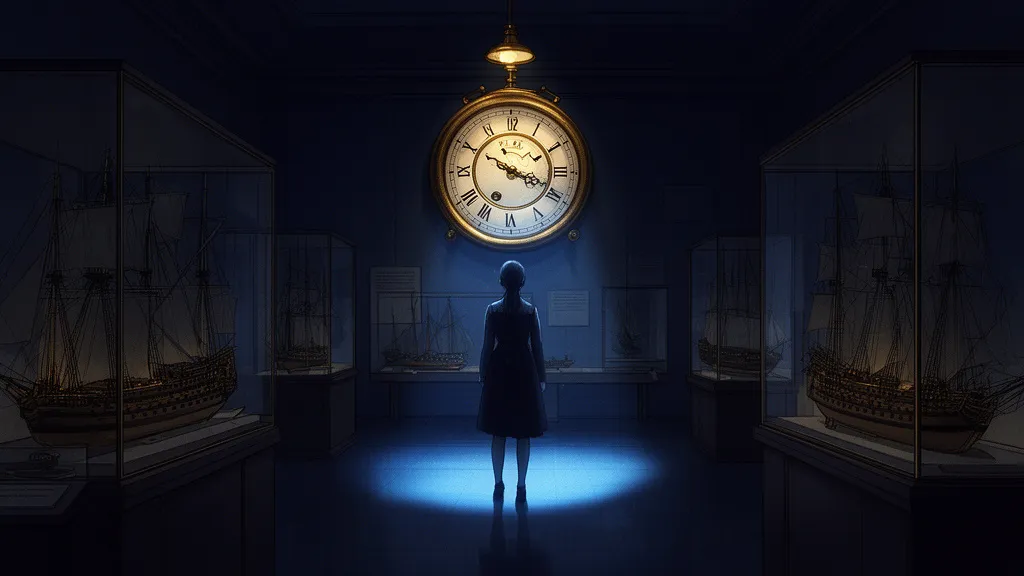
When the clock face began to run backward, Senda Rie was halfway through telling herself that the night would be quiet.
The maritime gallery lay in a blue hush, glass cases reflecting the low security lamps in patient doubles. Ship models floated in the dark on their black mounts. Compasses slept with their needles fixed. The large framed clock face on the north wall—salvaged, according to its brass plaque, from the Meisei Maru in 1892—gave a small metallic click.
Rie stopped.
Then it clicked again.
The brass minute hand moved from twelve to eleven.
It did not sweep. It stepped, with determination, one minute backward.
Rie stood very still in the middle of the polished floor, her torch lowered. She had worked six years on nights in the Kurohama Municipal Museum and had learned that nearly everything strange had an ordinary cause, usually involving humidity, poor repairs, or men from the board who believed old things would preserve themselves out of gratitude. Still, the movement made the hairs rise on her forearms. It sounded wrong. A clock should advance with the room. This one appeared to be retreating from it.
She glanced automatically at her wristwatch. 1:14 a.m.
The gallery remained empty. Beyond the glass doors, the corridor to the administrative wing was dark. Behind her, the sea beyond the museum grounds pressed its smell faintly through old window frames; not a fresh smell tonight, but a dry salt lodged in wood and rope and varnish, as if the whole building had once been dipped and left to harden.
The hand stepped backward once more.
Rie approached the wall. The frame was square, waist-wide, mounted over a display of chronometers. It was not a working exhibit. The museum label called it a painted dial from a ship’s wall clock, the movement long lost. Yet from inside the frame came that trapped, insectlike ticking.
She did not touch it at once. She bent first and looked at the floor.
There was nothing beneath except the neat shine of polish and, near the skirting board, a chalky smear no longer than her little finger. She crouched. Not chalk. Crystalline, faintly damp. She touched it, then smelled her fingertip.
Salt.
Rie straightened, frowned, and at last laid her fingers on the lower edge of the frame. It was warm.
Warm, in an unheated gallery at one in the morning.
She drew back her hand. Then she did what she always did when uncertain: she wrote it down. Time, place, what she had seen, what she had not yet understood. Her handwriting in the pocket notebook remained annoyingly schoolgirl neat.
At 1:16 she called the duty office from the wall telephone. No answer. She called the curator’s extension out of principle, though he would be asleep in the apartment over the west wing. No answer there either. She considered the chief custodian and imagined his expression if she woke him to report an elderly clock face behaving theatrically.
The frame clicked again behind her.
Rie sighed, and went to fetch the maintenance log.
By 6:40 the rare pocket watch was missing from the curator’s desk, the deputy curator was in tears for reasons not wholly connected to the watch, and a woman in a camel coat was insisting she had seen the same man in two places at once.
The museum would open at nine.
Rie sat in the staff room with a cup of tea that had been poured for her in crisis and had already gone cold. Across from her, Assistant Curator Matsuura folded and unfolded his handkerchief.
“The police are on their way,” he said. “They will naturally assume theft by staff access. We must be prepared to explain why that assumption is incorrect.”
Rie drank the tea because it was there and because refusing would take energy. It was as unpleasant as expected.
“What time did you discover it missing?” she asked.
“Six ten. I came to retrieve the Kanda pocket watch before the insurers arrived next week. The desk drawer was locked when I left yesterday at five thirty. This morning the lock was intact, but the watch box was empty.”
“Who has keys?”
“Myself, Curator Okabe, and administration. In practice,” he added, with feeling, “everyone who should not.”
Behind him, in the corridor, voices crossed and rebounded. The camel coat belonged to Mrs. Nire, a patron of the museum and widow of a shipbuilder, who had attended a private lecture the previous evening and had stayed late discussing sextants with anyone too polite to flee. Her voice now carried cleanly.
I am not confused. I know what I saw. He was in the east corridor at the very moment he was coming down the west stairs. If your museum employs twins, say so plainly.
Matsuura shut his eyes.
“Who is she talking about?” Rie asked.
“The conservator’s assistant. Takada. Or so she says.”
“Did she say what time?”
“Shortly before nine.”
That was before closing. Rie set down her cup. “I want the maintenance log, last night’s visitor list, and the curator’s office as it is now.”
Matsuura looked at her, properly looked, perhaps for the first time since deciding she was useful only for locked doors and leaking pipes. Rie was forty-two, compact, and had a face that made the unwary tell the truth to fill silences. The museum had learned over the years that if something was misplaced, or if two accounts disagreed by three minutes and a side entrance, asking Rie was cheaper than hiring embarrassment from outside.
He handed her the maintenance log at once.
The curator’s office had the strained tidiness of a room recently searched by people trying not to seem to have searched it. Morning light lay across maritime charts, filing trays, a paperweight shaped like a whale. The desk drawer in question stood open. Inside sat the blue velvet box for the Kanda watch, lid up, recess empty.
Curator Okabe, pale and rigid in his excellent cardigan, said, “I have touched nothing except the box. Naturally.”
“Naturally,” said Rie.
She crouched by the drawer. There were faint scratches around the lock, too fine to have been made this morning in panic. The drawer had indeed been locked and opened neatly. That was irritating. Neat methods multiplied suspects.
She examined the desk surface. Pens, correspondence, a brass key tray with three keys and a little dust around a missing fourth, a half-finished memorandum, and beside the blotter a narrow crescent of white grit.
Salt again.
Not much. Enough to catch light.
She looked up. “Did anyone bring seawater into your office?”
Okabe blinked. “I should hope not.”
“The window?”
“Closed.”
It was. The office overlooked the inland street anyway.
Rie opened the maintenance log. At 12:40 a.m. there was an entry in square, compressed handwriting:
Maritime Gallery, north wall electrical check. Dial-frame heating reported by Guard Senda. Investigated. Fault found in temporary line. Isolated.
Signed: H. Fujimoto.
Rie read it twice.
“I did not call Fujimoto,” she said.
Matsuura said, “He was not on duty. He came in?”
“No.”
She turned pages. At 1:50 a.m. another line:
Admin corridor lamp reset.
Signed: H. Fujimoto.
And at 2:05:
West stair fire door checked after report of sticking.
Signed: H. Fujimoto.
Rie closed the book.
Chief custodian Fujimoto, broad as a wardrobe and incapable of silent movement, had spent last night in his sister’s house inland recovering from a dental extraction. She knew because he had spent much of yesterday displaying the gauze with gloomy pride.
“So the log was falsified,” said Okabe.
“Yes.”
“Then surely the thief intended us to think maintenance staff had moved about the building.”
“Or intended us to stop asking how they moved.”
She left the office and walked, without hurry, back to the maritime gallery.
The framed clock face was still on the wall. In daylight it looked less uncanny and more embarrassed. The plaque beneath remained truthful: salvaged dial, movement lost. Yet when Rie touched the frame again she felt the warmth still trapped in the wood.
“Ladder,” she said.
Takada brought one, looking offended in a young, elegant way that suggested he practised. He was slender, twenty-seven, and wore his museum badge as if it had committed a social error.
“I did not steal anything,” he said before she asked.
“I know.”
He seemed almost disappointed.
From the ladder, Rie peered behind the frame. A thin black wire ran down the wall, tucked against the moulding, then slipped behind the case below. Not old. The museum’s wiring had the decency to look elderly.
“Who mounted this?” she asked.
Takada said, “No one recently. It’s been there years.”
Rie followed the wire to the display case beneath. Behind the case, hidden from ordinary view, sat a small battery unit and a cheap clock mechanism fixed to the backboard with fresh putty. The spindle passed through a hole in the old dial.
The mechanism was installed backward.
So the hands retreated.
“Very theatrical,” Takada said.
“Yes.” Rie climbed down. “Also useful. Anyone hearing a clock where none should be might come to investigate.”
“Drawing you away from somewhere else.”
“Or giving someone reason to be seen in the gallery at night.”
She looked again at the salt smear on the floor. It was directly beneath the frame, but a little to the right, as if brushed from a sleeve or cuff while someone stood close to the wall. Not carried on a shoe. The crystals were too localised.
“Who was here last evening after closing?” she asked.
Takada began counting on his fingers. “Mrs. Nire lingered. Curator Okabe. Matsuura. Me. Professor Sena from the university. Lecturer Moroboshi, briefly. And Ms. Hase, from education, locking up the children’s workshop.”
“Professor Sena?”
“The horology lecturer. He had arranged to examine the Kanda watch this week.”
Rie looked at him. “He was in the curator’s office?”
“Not alone, I think.”
“Think carefully.”
Takada thought with visible reluctance. “At about eight forty-five I took tea—”
He paused, and Rie knew at once the tea had gone wrong for someone.
“To whom?”
“To Professor Sena and Curator Okabe, in the office. Professor Sena complained it was too hot. Curator Okabe said that was the point.”
Rie nodded. A plausible scene. “Then?”
“Then Mrs. Nire asked me where the west stairs were. I showed her. When I came back through the east corridor, I saw Professor Sena near the maritime gallery door.”
“At what time?”
“Just before nine. We were trying to clear the building.”
“And Mrs. Nire says she saw you in two places at once.”
Takada gave a small helpless spread of the hands. “Mrs. Nire sees socially.”
Rie almost smiled.
Professor Sena arrived at 7:55, carrying his own gloves and a folded umbrella though the sky had been clear. He taught eighteenth-century navigation instruments and had the absent, polished air of a man who had spent half his life explaining to undergraduates why an object of brass and patience mattered. He also had, Rie noticed, a line of white at one cuff.
Salt.
It had dried into the weave.
They spoke in the old reading room because it was quiet and because people lied better among books; the effort made the lies easier to hear.
“I examined the Kanda watch in Okabe’s office,” Sena said. “A beautiful piece. Late Edo export work, probable Dutch influence on the escapement. I advised against sending it out before stabilisation.”
“You were alone with it?”
“Not to my knowledge.”
“Your knowledge is what I’m asking for.”
He looked at her over folded hands. “For perhaps two minutes, yes. Okabe took a telephone call in the corridor.”
“Did you open the desk drawer?”
“I did not need to. The watch was on the blotter.”
That was interesting. “In its box?”
“No. Open. We discussed the engraving inside the outer case.”
Rie said nothing.
He continued, “When I left the office, Mrs. Nire stopped me in the west corridor to tell me my lecture three winters ago had been inadequate on tidal timing. This delayed me. I then crossed to the east side because I had left my umbrella in the maritime gallery.”
“There was no rain.”
“No. I still left it.”
“And someone saw you in both places.”
“Yes.”
He said it calmly. Too calmly? Perhaps. Or perhaps he had spent enough years among committees to know that absurdity was not improved by indignation.
“Why is there salt on your cuff?” she asked.
For the first time he looked surprised. Then resigned.
“I leaned against a frame in the maritime gallery. There was residue on it.”
“The backward clock face.”
“So that is what you found.”
“Found?”
His eyes moved once, briefly, to the windows. “I installed the mechanism.”
Takada, standing by the shelves with all the posture of a scandalised heron, inhaled.
Rie waited.
Sena said, “Not to steal the watch.”
“That would have been a vulgar use of ingenuity.”
A dry crease appeared at the corner of his mouth. “Quite. I installed it yesterday afternoon. Mrs. Nire funded the repair of the maritime gallery and wished for some manner of surprise during her lecture reception. She has sentimental notions about time and the sea. I thought a clock running backward might amuse her.”
“Without informing staff.”
“I meant to tell Okabe after the guests left. Then we quarrelled.”
“About the watch?”
He was silent half a beat too long. “About its attribution.”
“Meaning ownership.”
“Meaning whether the museum had the right to claim it as Kanda family donation when the documentary chain is weak.”
That, Rie thought, sounded true in the way truth often sounded when it inconvenienced everyone.
“Why falsify the maintenance log?” she asked.
“I did not.”
“I believe you,” she said, which startled him more than accusation might have.
Because the false log had a different purpose. Not the gallery. The corridors.
She asked one more question. “When you crossed from west to east, how did you go?”
“Through the central hall.”
“Not by the service passage behind the gallery?”
He frowned. “I don’t know any service passage.”
Takada did. So did Matsuura. So did anyone who worked there more than a month.
The museum had been added to in phases, and behind the maritime gallery there ran a narrow staff passage connecting the west stair to the administrative wing. It had no public signs. It also had, Rie now remembered, a lamp that had indeed flickered for weeks.
Admin corridor lamp reset.
West stair fire door checked.
A route, disguised as maintenance.
She walked it herself.
From the west stair, through the sticky fire door, along the service passage behind storage and the maritime gallery, to the administrative corridor and the curator’s office. Eighty-seven steps if one was not hurrying. Seventy if one was.
A person could be seen in the west corridor by Mrs. Nire, vanish through staff access, and appear on the east side within a minute or two. To someone dramatic, it might well seem simultaneous.
At the junction by the gallery’s rear wall, Rie stopped.
There, on the skirting near knee height, was another faint grainy smear of salt.
Not from a cuff this time. Lower. As if brushed by a bag.
She returned to the office and asked that everyone who had remained after closing bring their outerwear.
This request caused offence in three distinct styles.
Ms. Hase, from education, arrived first with a canvas satchel decorated by hand-painted fish. Clean.
Takada brought a black coat and looked as if he hoped for arrest on aesthetic grounds. Clean.
Okabe’s cardigan did not count and showed no salt anyway.
Matsuura presented his raincoat with administrative martyrdom. One lower corner of the lining glittered faintly.
He saw her looking and said too quickly, “I came from the harbour yesterday.”
“You came from the station,” said Takada, with involuntary malice.
Matsuura reddened.
Rie turned the coat corner between finger and thumb. Salt had dried in a brushed streak, exactly the height of the mark in the service passage.
“Who are you protecting?” she asked.
His mouth worked. Not with outrage. With calculation. A person deciding which truth would do the least damage.
“At nine ten,” he said at last, “after the last guests left, I saw Okabe and Professor Sena arguing in the office. About the watch, among other things. I went away. At about nine twenty I passed through the service passage and found the office door ajar. The watch box was open, empty.”
“You did not report it.”
“No.”
“Why?”
He looked down at the salt on his own coat as if it had betrayed him personally. “Because I had already taken the watch.”
Silence settled. Even Takada had the grace not to move.
Matsuura said, “Not for myself.”
“Then for whom?”
“For Okabe.”
Okabe made a strangled sound.
Rie did not look at him yet. “Explain it step by step.”
Matsuura did, because there was nothing left to gain by style.
The Kanda watch, he said, was almost certainly not the museum’s to display. A descendant had written months earlier, quietly, asking to examine the donation papers. Okabe had delayed. Sena’s visit had made delay impossible; he knew enough to challenge the attribution publicly. If the watch were shown to insurers and catalogued for loan, the dispute would become formal, and ugly. Okabe had panicked.
“He said only for a day,” Matsuura said. “Only until he could locate the old correspondence or speak to the family. He asked me to remove it last night and keep it offsite. No theft report if he could avoid one. A temporary absence. That was his phrase.”
Okabe whispered, “I did not think—”
“No,” said Rie. “That is often where these difficulties begin.”
Matsuura had used his key after the guests dispersed, taken the watch from the desk, locked the drawer again, and intended to leave by the service passage so he would not meet anyone. Passing the maritime gallery he heard the impossible ticking, stopped to look, and brushed the frame with his coat while peering behind it. He had no idea Sena’s prank was there. The salt on the frame transferred to him; more rubbed off in the passage.
Then, finding the trick useful, he falsified the maintenance log after midnight when he realised the missing watch would have to become a theft by morning. The entries established movement through the building by an invented maintenance presence, and also explained away anyone seen near the gallery or service route.
“And the box was empty at six ten,” Rie said. “Where is the watch now?”
Matsuura closed his eyes. “In locker fourteen at Kurohama Station. Left-luggage.”
Okabe sat down very suddenly, like a folding screen giving way.
The motive, as promised by human beings whenever possible, was not grandeur but embarrassment. Professional embarrassment, institutional embarrassment, the wish to postpone disgrace by twelve hours and thereby enlarge it into police business.
Mrs. Nire’s doubling of Professor Sena had been genuine enough: she had seen him once in the west corridor, then later seen Matsuura emerge on the east side, same height, similar dark coat, both men carrying their shoulders as if apologising to architecture. In poor light, with conviction as solvent, one man became two copies of another.
Simple, after all. Only not the simple explanation the police would have preferred.
At eight twenty, before the officers arrived, Rie stood again in the maritime gallery while Takada removed the false mechanism from behind the old dial.
Without its borrowed ticking, the frame became what it had always been: painted numerals, hairline cracks, brass gone brown at the edges. A face from which time had long ago been taken. Around them the museum prepared to open with its usual composed dishonesty. Labels straightened. Cases locked. Histories resumed their official tone.
Professor Sena, passing on his way to wait for questions, paused beside her.
“I am sorry,” he said, and from his expression it was not clear whether he meant the prank, the quarrel, or the world in general.
“People should be less inventive at night,” Rie said.
“That would empty half of history.”
“Yes.”
He hesitated. “Will Okabe be ruined?”
Rie looked at the dial. “Not ruined. Corrected.”
He accepted this with a small nod and went.
Someone set a fresh cup of tea on the case beside her. She waited until the steam had grown dangerous, then drank it anyway. It was far too hot.
Through the high windows the morning sea sent up a pale light that did not reach the corners. Soon there would be visitors pressing close