The Bell Suitcase
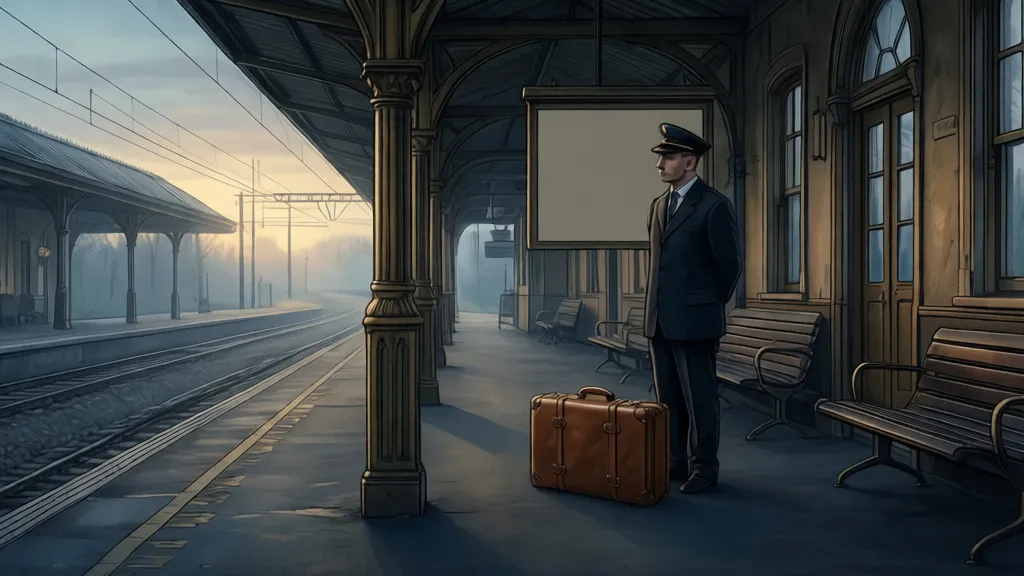
At 7:12, just after the down train had gone and before the first schoolchildren arrived breathless from the slope, Stationmaster Nakata found the suitcase under the timetable board.
It was the sort of case that belonged to commuters who wished to look more organised than they were. Brown leather, brass corners, one handle polished dark by use. Someone had set it squarely against the wall, as if it had been measured into place. Nakata noticed the heat before anything else. When he bent to lift it, the brass latch touched the side of his thumb and felt faintly warm.
He stood still in the empty waiting room, case in both hands, and looked at the stove.
The stove was cold.
Outside, March snow still lay in grey ridges where the plough had shoved it aside, but the road had become a black ribbon of meltwater. The mountains above the town held their white without apology. Beyond the station yard, the single street of Hoshimine climbed toward the chapel, the post office, the grocery, and, farther up, the line of lodges that opened only in summer. Above those, where the road gave up and became path, there were the old shelters and one abandoned survey hut. People still called that country above the tree line above the snow line, though the phrase was inaccurate except in winter. People liked phrases that made their town sound more dramatic.
Nakata set the suitcase on the ticket counter. A smear of red clay marked one handle.
That was wrong as well. Hoshimine was a town of dark soil, stone, and the pale grit that lorries dropped from their tyres. Red clay belonged down-valley, where the old brickworks had once stood, or higher up on the western shoulder, near the disused kiln track. There had been rain in the night. Clay would still be soft where it showed.
He waited, because one ought to give a forgotten item a chance to be reclaimed. At 7:19 he heard running, but it was only a boy late for school who purchased a half-fare ticket with the mournful expression of someone unjustly persecuted by arithmetic. At 7:26 Mrs. Endo came in for the town paper and remarked that the thaw smelled like wet socks. By 7:31 nobody had claimed the case.
Nakata fetched the station ledger, wrote one suitcase, brown leather, found under timetable board, and hesitated before the column for contents.
He disliked opening other people's property. He disliked, even more, unexplained heat.
The first latch lifted without complaint. The second stuck for a moment, then gave way.
Inside, arranged on folded grey felt, lay five keys.
They were church keys. Nakata knew at once because he had once done volunteer repairs at the chapel and had been shown, with some ceremony and no trust whatsoever, the cabinet where spare keys were kept. These were old iron keys with bow handles and narrow stems, each wrapped separately in white paper and tied with cotton string. A tag had been fastened to each with florist's wire.
The tags bore addresses, not names.
3 Mizunoki Lane.
The Organ Loft, Hoshimine Chapel.
14 East Slope.
The Bell Stair.
Storehouse, Suzuki Inn.
Nakata looked at the last one for a moment longer than the others. The Suzuki Inn stood halfway up the mountain road, a respectable ryokan with good pickles and a leaking bathhouse window that had leaked for nine years. Their storehouse key had no business in a suitcase under his timetable board.
Nor, come to that, did the others.
There was no note.
He touched the felt. Still warm.
The waiting room door banged open and admitted a woman in a navy coat carrying a canvas satchel and, disastrously, a paper cup of tea. Kuroda Aya taught history at the junior college down-valley and spent three days a week in Hoshimine cataloguing the chapel archive, because nobody else was willing to endure Reverend Mamiya for that length of time. She was not local, which had made her trustworthy to the locals only after she had spent two winters failing to leave.
She saw Nakata, the open case, and the expression with which he regarded both.
"That looks educational," she said.
"I was hoping for laundry," he said.
Aya set down her satchel. The tea, having chosen its moment, slopped over the cup lid and burned her wrist. She did not react except to place it farther from herself with the sort of carefulness people reserve for snakes in baskets.
Nakata turned the suitcase toward her.
She leaned in. Her face did not change much; it rarely did. Her attention simply sharpened. "Those are from the chapel. At least two are. Reverend Mamiya labels everything as if God were absent-minded." She picked up the tag reading The Bell Stair by its edge. "And this is his handwriting. Or an imitation good enough to annoy him."
"Would he put them in a commuter suitcase?"
"Only if he wished the commuter punished." She looked at the red clay. "Not chapel grounds."
Nakata said, "The brass was warm."
Aya glanced at the stove, then at the patch of sun beneath the timetable board. "Not from there. Did you see who left it?"
"No."
"Then we should ask before the asking gets difficult."
That was how she always put such things. Not urgent, not dramatic. Merely that delay caused inconvenience, and inconvenience ought to be avoided if possible.
By 8:05 they had learned that Mrs. Endo had seen a woman in a pale raincoat at the station a little after seven, though Mrs. Endo would not commit to whether the raincoat was pale beige or pale green because, she said, colours before breakfast were unreliable. The schoolboy had seen nothing except the station clock and his own mortality. A lorry driver remembered a suitcase near the board but believed it had probably always been there, which described his relationship to the world in general.
Aya carried the case. Nakata took the keys in their wrappings and put them in his ticket pouch, which had once held fares and now held, with admirable resignation, stranger things.
They climbed to the chapel.
Hoshimine Chapel had once been a mission church and then, after many decades and one small schism over flowers, had settled into being simply the chapel. It stood on a terrace above the street, white paint flaking from its walls, a bell tower rising from one corner like an afterthought. Reverend Mamiya was in the side garden cutting dead stems with an expression of personal injury.
When he saw the key tags his scissors dropped open. "Who touched those?"
Aya said, "An excellent question. Perhaps we might share it."
He snatched at the tag marked Organ Loft. "These should be in the vestry cabinet." He turned and strode into the chapel with the short, offended steps of a man hurrying toward an outrage he intends to confirm. Nakata and Aya followed.
The vestry cabinet stood unlocked. Inside, six labelled hooks lined the back board.
Five were empty.
The sixth held a key tagged Wine Cellar, though the chapel possessed no wine cellar and never had.
Mamiya stared at it. "This is mockery."
Aya, beside Nakata, said softly, "Or substitution."
"The bell," Nakata said. "Can we see the tower?"
They could. The door at the base of the bell stair was locked. Mamiya fumbled in his pockets, produced another key, and opened it with muttering that approached prayer only in persistence. The stair spiralled upward, wooden, steep, enclosed by whitewashed boards. Cold air came down from above with the smell of rope and old dust.
The bell frame at the top stood empty.
A frayed end of rope hung from the beam. The square opening where sound should have lived was blank.
Mamiya made a very small sound. It was not theatrical. It was the sound of finding that something familiar had truly gone.
Hoshimine possessed one bell. It had marked weddings, storms, funerals, New Year midnight, and the volunteer fire drill whether anyone wished it to or not. It had once rung when a child was found after a blizzard. People remembered that one especially.
By noon the whole town knew it was missing.
The police box in Hoshimine was staffed, on alternate days, by Officer Suda and by the memory of Officer Suda. He arrived from lunch with his scarf on inside out, listened, inspected the empty frame, and said, "It must have taken two men."
"Or one person with planning," Aya said.
Suda considered this as if planning were a foreign substance. "We should list motives. Religion. Metal theft. Personal spite."
"Personal spite is a large province," Nakata said.
"In this town? Certainly."
They met in the chapel meeting room because it had a table and because everyone in Hoshimine with an opinion had begun drifting toward it. The first to come was Sachiko from the post office, whose engagement to the chapel organist had ended six months earlier and whose interest in all human arrangements had only grown since. Then Mr. Fujita from the hardware shop, who maintained ladders as if they were family. Then Misawa from the Suzuki Inn, brisk and composed, with a face that suggested one should not waste rice.
Aya laid out the five wrapped keys in a line.
"Before noon," she said, "someone removed these from the vestry cabinet and left them at the station. Before noon, or by noon at the latest, the bell was removed from the tower. We must assume the two events are connected unless they become difficult to connect, in which case we shall be more imaginative."
No one asked why she was conducting this instead of Officer Suda. There are towns where official authority matters and towns where the person who speaks most usefully acquires it for the afternoon.
Misawa looked at the tag marked Storehouse, Suzuki Inn and said, "That is not ours. Our storehouse key is smaller and has blue twine. Also, if Reverend Mamiya has been labelling our property, I would like reimbursement for the principle of it."
Aya turned the key over. "So the tag may be true or false, and the key may or may not belong where it says." Her finger rested on 3 Mizunoki Lane. "Whose address is this?"
Sachiko said at once, "Miss Chiba's cottage. She does flowers for the chapel in summer and disapproves of nearly everything in winter."
"And 14 East Slope?"
"Formerly the caretaker's house," Mamiya said. "Now used by Professor Kirino when she comes up to write. She arrived last night."
Aya looked up. "The folklorist?"
"The same. She likes our silence because she can fill it with herself."
Nakata watched Aya's expression. She was interested. Professors often produced useful disorder.
"The Organ Loft and Bell Stair are obvious," she said. "The other two addresses are not chapel property. Which suggests someone wanted us to visit them. Or wanted to imply a route."
"A route for what?" Suda asked.
Aya's gaze moved to the window, where the mountain lifted above the town. "For moving something that could not go down the main street unseen."
There was a pause.
Then Nakata said, "The bell."
It sounded absurd because bells belonged in towers, not in plans. Yet once the idea existed, the rest of it followed. The bell was old bronze, not enormous but too heavy for one person to carry far without arrangement. It could be lowered, hidden, transferred, perhaps even taken above the road where there were fewer eyes. The suitcase then was not random. It was a map disguised as a nuisance.
Aya unwrapped the key tagged 3 Mizunoki Lane. "We'll ask Miss Chiba to forgive us after we've been rude."
Miss Chiba was out. This was immediately obvious because her curtains were drawn with the smug precision of a person absent on purpose. Her gate latch bore traces of fresh oil. The house itself was locked. The tagged key did not fit.
"False," Suda said.
Aya crouched near the step. In the thaw-soft earth beside the stone path were shallow grooves and a scatter of red crumbs. She touched one. Clay. There was also an impression in the mud as if something round with a narrow rim had rested there briefly.
"Not false," she said. "Misdirected."
Nakata looked at the mark. Bell-metal was beyond him, but a bell set down on its lip might well leave such a ring.
At 14 East Slope, Professor Kirino received them in a man's cardigan and one gold earring, with the air of someone delighted that provincial life had finally become worth observing. Her house smelled of coal and paper.
"A bell? How transporting," she said. "No, I have not stolen your chapel. I was writing until three. Then the wind became self-important and kept me awake."
"Did you hear movement outside?" Aya asked.
"A cart, perhaps, very early. Or dragging. I thought it was in the road below. One loses local acoustics if one has not wintered in a place." Kirino glanced at Nakata. "You disapprove."
"I was only standing," he said.
The key tagged to her address did fit her back shed, but only after Suda scraped paint from the lock with his penknife. Inside were kindling, a rusted stove plate, and, under a canvas, a hand sledge used for hauling books from the road in winter. Its wooden runners were smeared with reddish clay.
Kirino looked at it and said, with admirable calm, "Then either I have become more adventurous than I recall, or someone has borrowed my property."
"Who has access?" Aya asked.
Kirino considered. "Miss Chiba waters my plants when I am absent, and when I am present she waters them to suggest I am absent-minded. Reverend Mamiya had the key years ago. So did Kenjiro Takase when he was caretaker. He no longer is, but habits in villages continue to use old grammar."
Takase, it emerged, now kept accounts for the lodge association and lived in two rooms behind the shuttered bakery. He was handsome in the somewhat damaged way that makes middle-aged women willing to explain him to each other. He had once rung the chapel bell for weddings. He had also once been expected to marry Sachiko. He had instead left town for three years with a man from Matsumoto who made stained-glass lamps, returned alone, and thereafter was treated with the tactful overknowledge Hoshimine extended to all matters of desire. One could speak of it, provided one pretended not to.
When they found him, he was stacking ledgers by size, which was either honest work or a cry for help.
He looked at the tagged keys and laughed once, without pleasure. "Mamiya still labels the world like an anxious librarian."
"Did you use Professor Kirino's sledge last night?" Suda asked.
"No. I haven't had cause to steal scholarship." Takase's eyes shifted to the window, where the chapel tower showed above the roofs. "Has someone taken the bell?"
Aya said, "You knew at once what missing thing mattered."
"Because no one in this town would convene a committee about candlesticks."
He denied borrowing the sledge. He denied visiting the chapel. He denied, with rather too much neatness, seeing anyone on the upper road before dawn.
Nakata, watching him, thought: there is a lie, and there is embarrassment. People often wrap one in the other because embarrassment is the social cloth most likely to be left unopened.
Aya asked, "Who else still has old access to chapel locks?"
"Miss Chiba might. If she never returned her copy." A faint smile moved across his face. "She seldom returns anything except opinions."
"And the bell?"
Takase's fingers paused on a ledger. "The bell was recast after the fire in 1948. Some of the bronze came from household temple bells and one ruined memorial plaque. People talk sentimentally about it. They mean ownership."
"Would anyone want it back?" Nakata asked.
"Not back. Elsewhere, perhaps. Where sentiment can charge admission."
That was pointed enough to require a name.
He gave it: Daigo, who ran the mountain heritage walks in summer and, in winter, whatever enterprise winter would permit.
Daigo had spent the past year arguing that Hoshimine needed a museum above the old survey station, something authentic that would bring visitors. Reverend Mamiya had told him, publicly and with scriptural thoroughness, that the chapel bell was not a tourism asset.
"And privately?" Aya asked.
Takase smiled with only one side of his mouth. "More scripturally."
By two o'clock the sky had lowered. Meltwater dripped from eaves with the patience of interrogation. Daigo was not at his house. He was not at the storehouse by the ski path, nor at the disused lift hut where he kept snowshoes. At the Suzuki Inn, Misawa informed them that he had come by at dawn to ask whether the upper path was clear enough for a handcart.
"I said no," she said. "Which in his dialect means perhaps."
Aya showed her the key tagged to the inn storehouse.
Misawa took one glance and said, "A chapel cabinet key. Not ours. But someone wanted us to think of this place."
"Why?" Nakata asked.
Misawa folded her hands. "Because the old mule path behind the inn goes up toward the survey hut without passing through town. If one wished to move something large and remain picturesque, one would go that way."
They borrowed the inn's uphill handcart, because it had broad tyres for slush, and also because Misawa would plainly have gone with them if refused. Instead she remained to telephone, by means known only to inns and widowed aunts, every useful person between the station and the ridge.
The path above the inn cut through larch and birch, then climbed into harsher country where old snow lay in dirty slabs under the shrubs. Here and there red clay showed where runoff had bitten the bank. On one stretch the cart ruts were fresh. Beside them, Aya found the pattern of a hand sledge runner overlaid by boot prints.
"Two sets coming up," Nakata said.
"And one going down, lighter," Aya said. "After unloading."
The survey hut stood in a hollow below the western shoulder, roof sagging but still useful to goats and men with bad intentions. Its padlock hung open.
Aya stopped before touching the door.
"Wait," she said.
From her pocket she drew the last wrapped key: the one tagged Storehouse, Suzuki Inn.
She held it against the padlock, not to the tag but to the shape of the key itself, then inserted it. It turned cleanly.
Suda blinked. "That's not the inn's key."
"No," Aya said. "It's the survey hut key, relabelled. That completes the route. Chapel to Chiba's step, where the bell was set down. Kirino's shed for the sledge. Bell stair and organ loft from the chapel itself. And this, misnamed, for the hut where it ended. The inn tag was not for the lock. It was for the path. Whoever made the suitcase wanted us to find both the hiding place and the way up to it."
Inside, among old fuel cans and a cracked enamel basin, stood the chapel bell.
For a moment no one spoke.
It seemed smaller out of its tower, and more intimate. A bell in place belongs to everyone. A bell on the floor belongs to whoever can touch it.
There was cloth wrapped around the rim to muffle contact during transport. Nearby lay a coil of fresh rope, Professor Kirino's sledge, and a canvas sheet stencilled Hoshimine Heritage Walks.
Officer Suda said, with the calm triumph of a man who has finally reached the part of the story where a name may be attached to an object, "Daigo."
Aya did not answer. She was looking at the cloth around the bell rim.
It was not canvas from Daigo's gear. It was a cut length of pale raincoat fabric.
Nakata saw her thought alter course.
"Mrs. Endo's woman at the station," he said.
Aya nodded. She bent to the bell's lip. There, in a nick of metal, clung a thread of deep blue wool.
Not beige. Not green.
Blue.
A cardigan, perhaps. Or a scarf.
She straightened. "Daigo wanted the bell. That much is obvious. It doesn't follow that he moved it alone, or that he left the suitcase."
"Why leave the clues at all?" Nakata said.
"To make us find the bell before evening," Aya said. "Which means the bell was not the true object of concealment. It was bait, or urgency. We have been encouraged to look upward, outward, and along the route. We should ask what happened while we were doing that."
Nakata understood at once and disliked it. "The locked rooms above the snow line."
There were three in regular use above the upper path: the survey hut, the old weather store, and the chapel's seasonal retreat room near the spring. All had stout doors. All were supposed to remain locked through late winter.
"And the five keys," he said. "Not to identify houses. To account for access."
The weather store was empty except for salt sacks. The retreat room held folding chairs, old hymnals, and mice of evident confidence. But on the shelf by the window lay a travel valise, open and abandoned. Inside were men's shirts, a shaving kit, and a packet of letters tied with ribbon.
The letters were addressed to Kenjiro Takase.
Aya did not open them at once. She looked instead at the room. One cup on the table. One blanket