The Bleached Glove
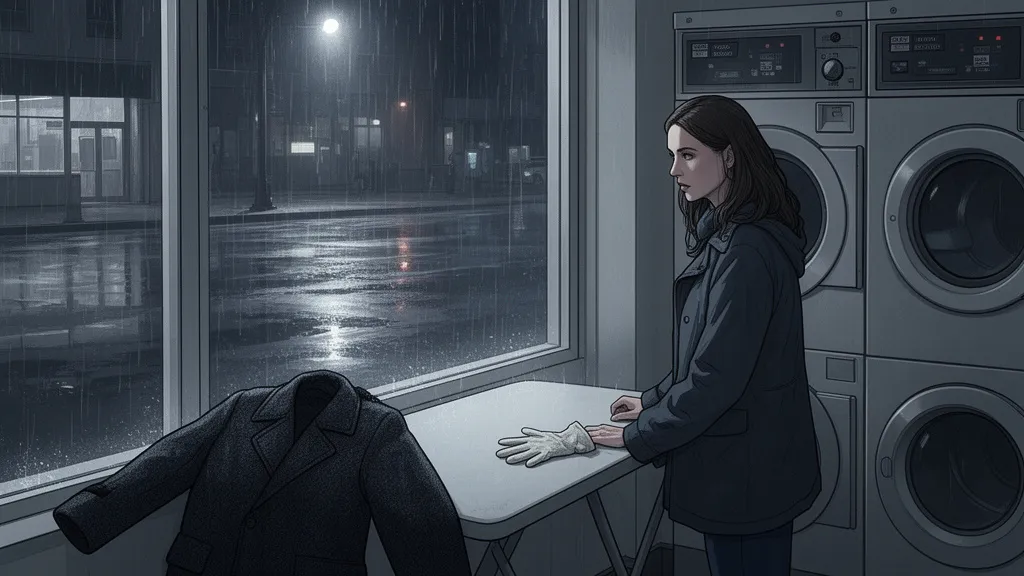
The machine gave a hard metallic knock, then settled back into its wet, circular breathing.
Mizuno Rei looked up from the folding table. Through the laundromat window, rain slid under the streetlamp in white threads. Her brother’s jacket lay open before her, dark wool heavy with water from wherever he had left it before it came to her in a station lost-property bag. He had been missing for three days. The police had called it a likely accident at first. A man who drank too much, walked in the rain, failed to answer his phone. Rivers and retaining walls collected such men.
Then they had found no body, no wallet, no clear route.
Rei put her hand into the jacket sleeve to turn the cuff properly. Something colder than the rest touched her fingers. She drew it out by two damp fingertips.
A glove. Only one.
It was a woman’s glove, thin and plain, the cheap knit kind sold in convenience stores in winter. Wet enough still to cling to itself. The left glove. The cuff was turned inward as if it had been stuffed away in haste. When Rei brought it closer, it carried two smells that did not belong together: rainwater, and the sharp medicinal bite of bleach.
She stood for a moment with the glove hanging from her hand.
Around her, the laundromat continued its practical life. Two dryers revolved with orange-lit serenity. A student in slippers slept with his forehead on a comic magazine. At the far end, beside the change machine, the night manager of the attached self-storage office was balancing a paper cup of instant soup on a stack of brochures and reading horse-racing results with painful concentration.
Rei had noticed him only because the laundromat and the storage facility shared a wall and, after eleven, the same human being.
Her tea from the vending machine had gone cold ten minutes ago. She drank it anyway.
She looked again at the glove.
Her brother, Hiroto, had no reason to be carrying a wet woman’s glove that smelled of bleach.
Unless the reason was the sort a sister preferred not to inspect too closely. Hiroto was thirty-four, attractive in a way that had survived carelessness, and his arrangements with women had always lacked useful edges. They began blurily and ended in omitted details. Still, something in the glove resisted that explanation. A lover’s glove dropped into a pocket was one thing. A glove tucked into the cuff of a jacket and forgotten there was another.
Rei crossed to the counter with the glove in one hand and Hiroto’s jacket over the other arm.
The manager looked up. He was perhaps fifty, with hair trying to retreat and failing untidily. His name tag said Kanda.
“Excuse me,” Rei said. “Do you happen to have storage units here rented under family accounts?”
Kanda blinked. “We have units rented under many regrettable names, if that is what you mean.”
He had the air of a man who disliked excitement because he was certain it would involve paperwork.
“My brother is missing,” Rei said. “His name is Mizuno Hiroto. I found this in his jacket.”
She did not know why she showed him the glove. Perhaps because its absurdity wanted witnesses.
Kanda glanced at it and then at the jacket. “I’m sorry to hear that. But we can’t discuss a customer’s unit unless—”
“It might not be in his name.”
That made him pause. Rei saw, with some interest, the small domestic workings of caution behind his face. Rules, curiosity, sympathy, and the fear of becoming involved all passed over it in sequence.
“Why not his?” he said.
“Because he used my name once to have a parcel delivered when he was avoiding someone. I learned this after the parcel arrived.”
Kanda gave a dry little exhale. He seemed to find this both reprehensible and ordinary.
“What is your name?”
She told him.
He turned to the terminal on the shelf behind him, pecked with one finger, frowned, pecked again. Then he stopped.
“There is a unit,” he said. “Small. Month-to-month. Rented ten days ago.”
Rei felt the laundromat alter around her without changing at all.
“Who signed for it?”
Kanda adjusted his glasses. “Mizuno Rei.”
“That would be difficult,” Rei said. “I was in Nagano attending a symposium on medieval household accounts.”
Kanda looked at her more closely. “You are not joking.”
“No.”
He considered the screen, as if it might improve if left in silence.
“There is a copy of identification on file,” he said.
“Mine?”
“It appears to be.”
“It would. My brother borrowed my wallet in June and returned it with all its contents and one less apology than was needed.”
Kanda looked, despite the hour, almost refreshed by the shape the problem was taking.
“The unit is paid through this month,” he said. “If it is under your name, you may open it.”
“Now?”
He gestured to the clock. “If you wish. I am here until the washing machines stop presenting emergencies.”
Behind them, as if in reproof, one of the larger machines gave a hollow bang.
Rei looked at the jacket on her arm. If Hiroto had planned to disappear, a storage unit under her name was not a good sign. It might mean debt. It might mean theft. It might mean that his being missing had less to do with rain and bad luck than the police preferred.
It might also mean nothing so dramatic. Hiroto was capable of constructing elaborate inconveniences out of laziness.
She looked at the machine still washing his clothes. Twenty-two minutes remained. Her own keys lay beside the cold tea. She was suddenly aware that the drum would one day unlock whether or not she was ready for what else might open tonight.
“Show me,” she said.
The storage corridor smelled of damp concrete and deodoriser. The fluorescent strip overhead was too bright for midnight and yet left the corners dubious. Kanda led the way with a ring of keys large enough to suggest old habits surviving digital systems.
“Unit B-17,” he said. “Your—your brother came in himself, I suppose.”
“You’ve seen him?”
“Perhaps. A man in a cap. Average height. There is no prize in my profession for remembering faces. He came in during rain, that I recall, because he shook water onto the mat and apologised as if it were unusual.”
“When?”
Kanda consulted memory with professional resentment. “Three nights ago. Late. Near closing.”
The same night Hiroto was last seen leaving a bar by the river.
Rei stopped before the unit door. It was a narrow roll-up shutter with a brass padlock. Kanda held out a form on a clipboard.
“You may open it,” he said. “I should witness, given the irregularity. Also because if there is a corpse, I prefer not to meet it secondhand.”
“There will not be a corpse.”
“You say that bravely.”
Rei signed. Her handwriting looked severe even to her.
Kanda fitted the key and stepped back. “Shall I?”
“No.”
She opened the lock herself.
The shutter rose with the disagreeable rattle of light metal performing effort. Inside, the unit was almost empty.
That was the first unsettling thing.
People who planned to hide something usually hid too much. Old boxes. Futons. Broken shelves. Noise around the fact. Hiroto had stored one folding chair, one transparent umbrella with two bent spokes, and a blue plastic crate with a lid.
On the chair lay a train timetable booklet, damp at the edges and dried again into a slight wave.
On top of the crate was her passport.
Rei did not move at once. Kanda, behind her shoulder, made a small sound that might have been apology offered to the world in general.
She picked up the passport. It was unquestionably hers, with the old photograph in which she looked as if she disapproved of photography as a concept. She had not noticed it missing. She kept it in a desk drawer and travelled abroad so rarely that months could pass without checking.
Inside the crate lay three things: Hiroto’s watch, stopped at 11:48; a wallet containing two thousand yen and no cards; and a sheet of paper folded twice.
Rei unfolded it.
It was not a note exactly. It was a list in Hiroto’s handwriting.
umbrella
left glove
watch
wallet cash only
passport
station locker key?
bleach
At the bottom he had written, more hastily:
after rain is better
Kanda read upside down with shameless efficiency. “That,” he said, “is not encouraging.”
“No.”
Rei looked again into the crate. The wallet was one Hiroto had been using last month. The watch had belonged to their father. He never willingly took it off because he said a stopped watch looked like death in miniature. It was exactly the kind of thing he would say and then be pleased by for several days.
She picked up the transparent umbrella. The handle was cheap cloudy plastic. Around the ferrule, where fabric met metal, there was a faint white crust.
Bleach.
“Your brother planned to vanish,” Kanda said carefully.
“Perhaps.”
The word came out flatter than she intended.
On the concrete floor beneath the chair there were specks of dried mud, dark and grainy. Not many. Enough to show that someone had stood there in wet shoes and shifted his weight. Kanda had said Hiroto came in during rain. The umbrella fit that. So did the note. After rain is better. Better for slipping. Better for washed surfaces. Better for a body not found where expected.
But there were things wrong with it.
Rei crouched. The mud had dried into tiny scales. Beside one flake was a short pale fibre clinging to the floor. She pinched it up. Knit wool, cream-coloured.
From the glove.
“One glove,” she said.
Kanda, who had sensibly chosen not to crouch, said, “I beg your pardon?”
“He wrote left glove. Singular. Not gloves.”
He considered this. “If he wished to suggest a woman, one glove is stranger than two.”
“Yes.”
She looked at the list again. It was practical, almost annoyingly so. Hiroto, for all his disorder in ordinary life, became neat when lying. He made arrangements the way some people made bento: each item selected, separated, persuasive. It was one of the few talents he had cultivated seriously.
Wallet cash only. So cards could not be tracked; though Hiroto would not have used the word tracked, because he liked his own melodrama to remain faintly old-fashioned. Passport. To imply flight, or theft of identity, or coercion. Umbrella and rain. Bleach, to remove something. Glove, to suggest another person.
“Did he leave anything in a station locker?” Kanda asked.
Rei was not listening. Her eyes had gone back to the watch.
11:48.
Hiroto’s last confirmed sighting from the bar had been just after eleven. The owner had told police Hiroto stayed only twenty minutes because he had received a message and grown cheerful in a suspiciously performative way. Rei had disliked that detail at once. Hiroto performed cheerfulness most when he wanted it witnessed.
She picked up the watch. The leather strap was damp-stiff. The crown was pulled out.
She smiled, a little despite herself.
“What is it?” said Kanda.
“My brother could not bear a watch that stopped accidentally,” she said. “He would wind it, curse it, take it for repair, accuse humidity, accuse history, accuse our father for buying mechanical nonsense. But if he wished a watch to stop at a useful time, he would pull out the crown because he knew no one would ask whether it had merely run down.”
“That seems a specific brotherly flaw.”
“It is.”
She stood. The unit felt smaller now, not because it held danger but because it held intention. Hiroto had prepared a scene. The missing man by the river. The wallet with no cards. The watch. Her passport. The single glove. Bleach to remove some trace and leave another.
All of it was meant to be found, eventually.
Which raised the awkward question of why it had been hidden under her name unless the finder was meant to be her.
They went back into the office. Kanda made tea from an electric kettle with solemn incompetence and gave Rei a cup too hot to touch. She set it down and let it steam in accusation.
He copied the rental form and the note while she sat beneath a poster advertising climate-controlled safety for musical instruments and wedding dresses.
“What was your brother like?” he asked.
“Alive,” Rei said.
Kanda accepted this.
After a while she said, “He borrowed money from people in instalments, as if shame were more manageable sliced thinly. He made promises with the confidence of a man certain that the future existed mainly to forgive him. Women liked him. Men often did too, though with more damage. He could cook exactly four dishes and therefore was considered charmingly domestic by those who had not eaten them twice. He was not cruel unless cornered. Then he became inventive.”
Kanda, who had perhaps asked less than this, nodded prudently.
“Did he ever disappear before?”
“Only from obligations.”
She touched the edge of the note. “He wanted someone to think he was dead or taken. Not everyone. Someone particular. The glove is too pointed otherwise.”
“A lover?”
“Possibly. Or a creditor who would understand a woman was involved and pursue her instead. Hiroto respected other people’s jealousy because it was cheaper than cash.”
She thought of the glove in the cuff. Hidden, but not very well. Hidden where she would find it if she did something tedious and sisterly, like washing his jacket after he had vanished. Not hidden where police searching pockets would certainly find it at once.
Not the pocket. The cuff.
He had wanted delay, but not too much delay.
“Three days,” Rei said.
Kanda looked up.
“He vanished three days ago. This unit was rented three days ago, during rain. If he meant to disappear entirely, he would not leave his passport here under my name. He meant me to open this after some interval.”
“How much interval?”
She thought about Hiroto’s habits. He was theatrical, but lazy. He liked to arrange revelations just far enough in the future that someone else would do the waiting.
“The wash cycle,” she said.
Kanda stared.
Rei stood abruptly enough that the tea shivered. “The jacket. He put the glove in the cuff of a wet jacket and left the jacket to be found in lost property. Why not in the pocket? Because pockets are checked. Why not at home? Because I might not wash it tonight. But a wet jacket sent to the station laundry would come to me damp and needing immediate attention.”
“That assumes the station would call you.”
“He made sure they would. Yesterday he phoned me from a public line and let it ring twice. That was our old signal from childhood that he wanted me to fetch him from somewhere without asking questions. Stupid, but memorable. When I called back, there was nothing. So this morning I rang the stations on his route. At Shin-Kawara, the clerk said they had a rain-soaked jacket with my number written on the lining tag in Hiroto’s handwriting. He used to do that when he lost umbrellas; I once scolded him for it, at length. He knew I would recognise the trick and collect it before they sent it for cleaning tomorrow.”
Kanda’s eyebrows rose as he followed, step by careful step.
“He expected you,” he said.
“Yes. And he expected I would wash it at once because I dislike damp things in the flat.”
“You do?”
“I catalogue manuscripts for a living. Damp is an enemy religion.”
The machine in the laundromat gave another heavy knock, as if reminding them of time.
Rei felt the pattern settle. Hiroto had not built a disappearance for the police. He had built a trail for her. Clumsy in places, because he always believed affection would sand down his errors. Precise in others, because he knew exactly what details would irritate her into thought.
Passport. Watch. Bleach. One glove. Rain. After rain is better.
And one item on the list with a question mark.
station locker key?
Not crossed out. Not resolved.
“He forgot something,” she said.
“Or failed to obtain it.”
“Yes.”
“If there is a locker key, where is it?” Kanda asked.
Rei looked at her brother’s jacket on the counter. “Not in the pockets, if the station checked them. Not in the cuff, because the glove was there. And if he had no locker key, why write it? Unless the locker mattered more than the key.”
She went through the jacket again. Lining, breast pocket, hem. Her fingers found a stiffness in the collar seam. Not inside a pocket at all, but slipped under the hanging loop at the back where no one touched.
A narrow paper claim ticket, folded twice against the cloth.
Kanda let out a breath of pure bureaucratic satisfaction. “Ah.”
The locker number was from Shin-Kawara Station. Large locker bank, east exit.
The issue date was three days earlier.
Collection valid within seventy-two hours.
Rei checked the clock. Eleven thirty-two.
Kanda glanced at the machines. “Your washing—”
“Can continue without moral support.”
He looked at the storage office, the soup gone cold, the forms, the rain beyond the glass. One could see him deciding against common sense out of sheer narrative curiosity.
“I can lock up in four minutes,” he said. “Shin-Kawara is eight by car if the lights behave.”
Rei picked up the tea and drank it. It was still too hot.
They reached the station with six minutes to spare. The east exit concourse was almost empty, washed bright and stale by late-night cleaning. Locker bank C stood beside a shuttered bakery. The metal doors reflected them in narrow distortions.
Rei found the number from the ticket and inserted the slip.
The locker clicked open.
Inside was a canvas holdall and, on top of it, an envelope with her name.
Her hand paused over it.
“Would you like a witness,” Kanda said, with surprising gentleness, “or privacy?”
“Witness,” Rei said.
She opened the envelope.
The note was brief.
Rei,
if you are reading this, the first part worked, which is a relief because the second part depends on you being less sentimental than the police. I am not dead. I owe too many people and one of them has become energetic. Do not tell the police at once. In the bag is enough cash to settle what matters most, a key to the room at Suzuki Inn where I have been staying under another name, and a letter for S. Give S the letter only if she is alone. You will know why. I am sorry about the passport. Return it before you need it, ideally.
H.
Kanda, reading over her shoulder because he had abandoned delicacy in favour of completeness, said, “There is something almost admirable about this. Like a badly raised cat bringing home a spoon.”
Rei looked into the bag.
Cash, indeed. More than Hiroto ought to have possessed. A room key on a wooden tag burned with the name Suzuki Inn. A sealed letter addressed simply S. And beneath them, wrapped in a plastic shopping bag, a second glove: the right one.
Dry.
So the left glove had been planted wet, with bleach, to be noticed. The right had been kept back. A pair separated into meaning.
“S,” Rei said.
There were two likely names at once. Sae, who had lent Hiroto money and still called him after midnight. And Shun, a former colleague with whom Hiroto had once lived in a relationship the family had never named because Hiroto himself had preferred fog. You will know why. Meaning alone. Meaning not before police, not before creditors, not before whichever version of himself Hiroto had distributed socially.
He had trusted her to identify the right private truth from the noisy public ones. That was either touching or intolerable. Possibly both.
Kanda shut the locker door softly. “What will you do?”
Rei held the note. Hiroto was alive. That should have made the world easier. It did not. Alive meant choice, deceit, debt, and pursuit. Alive meant he had frightened people who cared for him in order to rearrange his life with borrowed time and stolen props.
Alive also meant she would have to decide whether to protect him for an hour, a night, or not at all.
The station announcement sounded above them, apologising for nothing in particular.
“I will tell the police he staged the disappearance,” she said. “Not this minute. But tonight.”
Kanda nodded. He looked neither pleased nor shocked. Merely aligned with the obvious.
“And before that?” he asked.
Rei touched the letter marked S.
“Before that,” she said, “I will find out which of his lies was kind, and which was only lazy.”
They walked back out into rain that had reduced itself to mist. Kanda offered her the transparent umbrella from the locker bag, then noticed the white crust at its edge and thought better of it. Rei almost smiled.
At the laundromat, the machine had long since finished. Through the window she could see the drum standing unlocked and still, Hiroto’s clothes slumped within it like a body after argument.
She