The Blue Tile Name
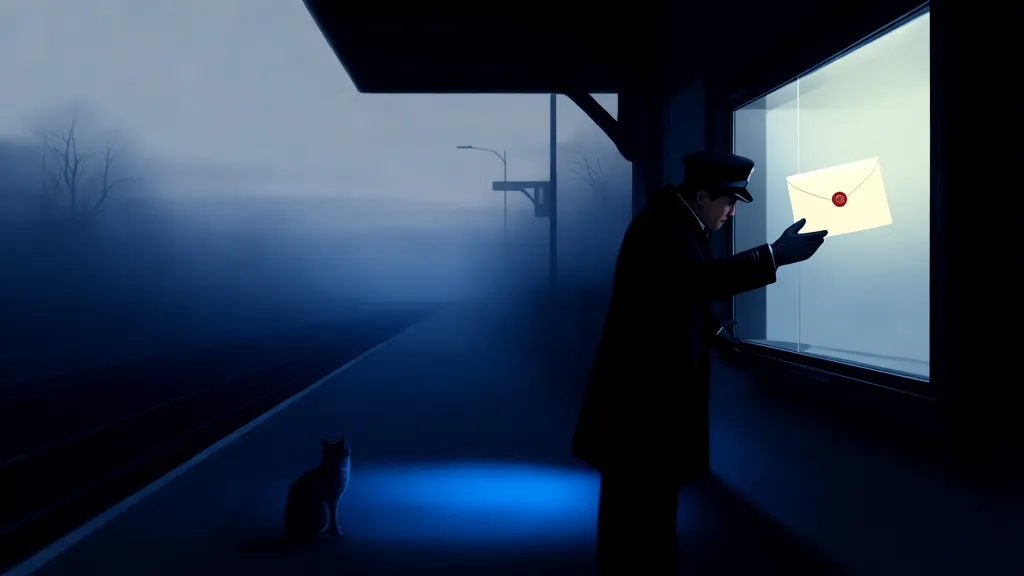
At dawn, while the lamps on Platform Two still burned with the stubbornness of old men, Conductor Shinohara Yui saw the envelope behind the timetable glass.
It sat tucked into the narrow space between the printed sheet and the metal backing, as if the station itself had produced it in the night. The glass case was locked. The envelope was cream, sealed, and addressed in a compact hand.
For Ms. Kurose Aya, on the night express.
Yui stood for a moment with her key in her fingers and the cold biting her through her gloves. The first local would not arrive for thirty-two minutes. The station cat, who belonged to nobody and therefore to everyone, passed along the yellow edge with its tail upright. Nothing else moved.
Katsuragi Station at that hour was a neat arrangement of stillness: one ticket window, one waiting room, two platforms, a footbridge with stairs that complained under every honest weight. Beyond the rails, the mountain held back the sun. It would reach them later, as if reluctantly.
Yui unlocked the timetable case.
The envelope had been pushed deep enough that it could not have been left by accident. Whoever put it there knew the station, knew where she would look first before the morning departures. She turned it over. No sender. The flap had been sealed with plain glue. There was, however, a faint mark in one corner: the soft half-moon of lipstick, no more than someone catching the edge with a mouth that had already been painted.
She did not like messages that arranged to be found. They were theatrical, and theatre at a station usually meant trouble with tickets, lovers, or freight.
She opened it anyway.
Inside were three things.
A list of times, written in the same compact hand:
22:14
22:31
23:08
23:26
0:05
0:41
A ten-yen coin with a red smear near the hole.
And a single folded strip of paper, on which was written:
He knew Blue Moon was cracked before the fourth pillar.
Yui read that twice.
The blue tile on Platform Two, set into a patch of older flooring near the fourth pillar, had a crescent crack through it. Railway staff called it the blue tile because railway staff did not, as a rule, waste poetry. Yet several years before, Assistant Stationmaster Nagasawa's daughter had declared that it looked like a moon floating in pavement, and since then children, one bookseller, and exactly one woman from town had called it Blue Moon. Nobody else did.
Yui looked down the platform. The fourth pillar stood where it always had. The cracked tile beyond it held a little basin of yesterday's rainwater.
Ms. Kurose Aya had not boarded the night express.
Yui knew this because she had worked the last section herself, from Minato Junction up through the mountain line, and had checked every reserved carriage after Hoshiba. The woman had not been in seat 6C, which had been booked in that name and then gone empty. The ticket remained clipped in the manifest as unused. At 0:41, when the express had left Katsuragi on its final northbound run, no one by that name had stepped aboard.
Yet someone had left a letter for her, in a place Yui would find at dawn.
And someone knew the cracked tile by name.
She slipped the papers back into the envelope, put the coin in her coat pocket, and carried everything to the station office.
Stationmaster Toba was asleep at his desk with a timetable over his face and one hand resting protectively on a cold cup of tea. He was a broad man with thin hair and the air of someone who had been betrayed by modernity in several distinct ways. Yui touched the desk once with two fingers.
He snorted awake, dropped the timetable, and reached for his cap, which was not on his head.
"If this is about the boiler," he said, "I already regret it."
"It isn't," Yui said. "It's about the night express, a missing passenger, and a letter hidden behind the platform timetable."
Toba stared at her, then at the envelope. His face changed in stages from sleep to annoyance to something more useful.
"Before first whistle?" he said.
"Before first whistle."
"Good," he said. "At least the day has started with ambition."
He read the contents twice, frowned, and rubbed at the lipstick mark on the coin without quite touching it.
"Aya Kurose," he said. "The florist?"
"The same. She reserved a seat yesterday morning. Didn't board."
"And the note says 'he knew' the blue tile by name. Not 'she.'"
"Yes."
Toba sat back. "This had better not become romantic. I have no training for romantic."
Yui did not answer. In small towns, romance was often only logistics with excuses attached.
She said, "Who had keys to the timetable case?"
"Me. You, when you're on dawn duty. Nagasawa. Night porter Endo, if he asks for them and signs. Cleaning supervisor Mima, in theory, though she prefers to attack dirt directly and distrusts locks." He paused. "And anyone with enough patience and a thin blade."
"Who had access to the station logbook before dawn?"
This time he did not answer at once.
The logbook lay on the shelf behind him, a thick ledger in brown cloth, in which arrivals, departures, delays, maintenance notes, and the smaller embarrassments of station life were entered in disciplined ink. It was not a secret document. It was merely a document everyone believed too dull to be useful. Which made it, as Yui had often noticed, useful in exactly the wrong way.
"Staff on duty," Toba said. "Myself until twenty-two. Nagasawa until midnight. Endo through the night. Ticket clerk Fujino until twenty-three. The cleaner came through around twenty-one-thirty. Why?"
Yui unfolded the list of times and set it beside the previous night's movement chart.
At first they looked ordinary enough. 22:14 was the departure of the local southbound. 22:31, freight passage. 23:08, arrival of the mixed service from the valley. 23:26—
Yui stopped.
The chart said 23:24.
She checked again. Platform movement record: 23:24, down goods siding release, delayed one minute. But the note said 23:26.
The remaining times matched: 0:05 maintenance trolley clearance; 0:41 night express departure.
One departure had been altered after the fact, or the writer wanted her to believe it had.
Toba saw it when she did. His eyebrows climbed. "That wasn't the public timetable, then. That's station record."
"Or someone who copied the station record before it was changed."
"Changed by whom?"
"Someone with the logbook before first whistle," Yui said.
The tea at Toba's hand had gone grey and skin-covered. He drank it with the resignation of a man to whom temperature was only one more inconvenience.
"Go on," he said. "You already have the look."
Yui did. She disliked being interrupted in that condition. It felt like a train forced to stop between stations.
"If Ms. Kurose did not board," she said, "the envelope may not have been meant for her to receive. It was addressed to her so that I would open it without hesitation. If it had been left for me directly, I might have treated it as mischief, or a complaint, and put it aside until daylight and paperwork. But a letter for a passenger who failed to board is railway business at once. Whoever left it needed me to read it before the logbook could settle into fact."
Toba considered this with dislike. "That is annoyingly sensible."
"Someone wanted to identify a man who knew Blue Moon by name, and to direct attention to the station record. The altered time matters. So does the coin."
"Why the coin?"
"Because it is Aya Kurose's, which means the writer had been close enough to her purse to take it, or found it where only someone from the shop would notice it. It ties the message to her without requiring her to have written it. The lipstick mark is not evidence of a telephone call. It is only a signature stolen from her pocket."
Toba nodded once. "Better. I was beginning to fear telephones again."
"There may still be telephones," Yui said. "There are always telephones when people wish to be unwise privately."
"Excellent. Love and telephones."
"And lies," Yui said.
By seven-thirty the station had become itself again: commuters, schoolchildren, a woman carrying three daikon as if they were a grievance. Yui completed two departures, clipped four tickets, and then used her break to walk into town.
Kurose Florist occupied a narrow shop near the post office. Buckets of chrysanthemums and winter branches stood in military rows outside. Inside, the air was damp and green. Aya Kurose was at the worktable wiring white carnations into a wreath.
She looked up, and whatever she had expected that morning, it had not been a railway conductor carrying an envelope.
Aya was thirty, perhaps a year older, with thick hair pinned up badly enough to imply either haste or self-knowledge. Her lipstick was the same muted red as the stain on the coin. Yui noticed because she noticed everything and because the woman noticed her noticing and did not flinch.
"Conductor Shinohara," Aya said. "Have I missed something?"
"Possibly the night express," Yui said.
Aya's mouth moved once, not quite a smile. "I suppose I have."
Yui placed the envelope on the counter. "This was left at the station for you. Hidden behind the timetable."
Aya's hand stopped over the carnations. She did not touch the envelope.
"I didn't leave it," she said.
"I know."
"And I did not board the train. You know that as well."
"Yes."
Aya removed her apron with care, folded it, and set it aside. "Then I should close the shop for ten minutes," she said. "This is either embarrassing or serious, and in this town there is no practical difference."
She turned the sign to Back Soon and led Yui to the rear room, where a kettle sat on a burner and a vase held camellia branches too heavy for themselves. Aya made tea. It arrived too soon, and was, predictably, too hot. Yui accepted it anyway.
Aya read the note, then the times, then stared at the coin until the colour in her face altered.
"That is mine," she said.
"The coin?"
"I had one in my purse yesterday. I used lipstick after lunch, then reached in for change and marked it. I remember because I thought it looked absurdly incriminating. I put it back." She looked up. "It was gone by evening."
"Who was with you?"
"Half the town. More usefully?" Aya considered. "At lunch, Professor Minegishi from the college came in to order flowers for a retirement tea. Mrs. Sugimoto from the bakery. And later—"
She stopped.
Yui waited.
Aya's gaze moved to the window, where passersby drifted beyond the frosted glass as shadows. "Assistant Stationmaster Nagasawa came in at five-thirty," she said. "He wanted a single red rose."
"For whom?"
"He said it was none of my business, which meant it was exactly my business. I wrapped it anyway."
Yui set down the cup before it injured her. "Did he know the blue tile by name?"
Aya looked at her sharply. "Who told you that phrase?"
Yui passed her the strip of paper.
This time Aya sat very still.
"I did," she said.
"To Nagasawa?"
"No." Aya folded the paper once, along an old crease. "To his wife. Last autumn. We were waiting on Platform Two after the festival. Her sandal caught on the crack, and I said to mind Blue Moon. She laughed. She said her husband called it that too, after hearing me say it. He had a habit of borrowing other people's little things and using them as if they had always belonged to him."
"Did she object?"
Aya gave a neat, tired shrug. "His wife objected to many things. Selectively."
"You reserved a seat on the night express," Yui said. "Why?"
Aya did not pretend not to understand the question underneath.
"Because I intended to leave town for two days," she said. "Because I changed my mind. And because if I tell you I changed it for an innocent reason, you will hear the shape of the lie even before the words are done."
"Probably."
That earned a real smile, slight and unwilling. "Then I won't waste us both the effort. I was supposed to meet someone at the station telephones at ten o'clock. He did not come. I went home instead."
"Nagasawa?"
Aya did not answer.
She did not need to. There are silences that are denials, and silences that are merely doors left unlocked.
"Did anyone know you meant to go?"
"He did. And another person may have guessed." Aya looked down at the coin. "His wife saw us once, not doing anything dramatic enough to deserve a scene. Those are often the worst moments. There is no clear role for anyone."
"You didn't board. Yet someone took your coin, wrote this, and left it for you at the station."
Aya tapped the list of times. "Not for me. For you. Or for anyone who could read them. The 23:26 is wrong. I know because the goods release startled me at home. It always rattles the back windows. Last night it came earlier than usual, while the temple bell was still settling after the half-hour."
"At 23:24."
"Yes."
Yui watched her over the rim of the cup. Too hot. Still too hot. "Whom does this help?"
Aya looked almost offended. "No one," she said. "That is why it is honest."
The station logbook had been altered neatly.
By mid-morning Toba had unlocked the office cabinet and let Yui compare the primary ledger with the rough movement slips used overnight. The entry for 23:24 had indeed been overwritten to read 23:26, but only in the logbook. The pressure marks under the ink remained. Whoever had changed it had done so with a careful pen and poor judgement.
The slip itself, crumpled and clipped beneath, still read:
23:24 Down goods siding release complete. Porter Endo present.
There were other notes around it.
22:58 Public telephone reported sticking.
23:03 Assistant Stationmaster Nagasawa left office for Platform Two inspection.
23:11 Returned. Complaint not verified.
Yui read that line three times.
The public telephones stood in a small alcove between the waiting room and the ladies' washroom, with a glass panel that reflected whoever used them and a bench too short for comfort. If Nagasawa had gone to inspect a reported problem at 23:03, he could have seen anyone waiting there.
Or anyone not waiting.
She found Endo in the baggage room, oiling a trolley wheel with theological seriousness. He was seventy if a day, and believed every item in the station had a moral character. The trolley, in his view, had lately become lax.
"Did you make the complaint about the telephone?" Yui asked.
Endo did not look up. "No. Telephone behaved like a telephone. Small, metallic, and resentful."
"Did Nagasawa inspect it?"
"He walked in that direction with his chest full of weather. Came back with less of it."
"Did he speak to anyone on Platform Two?"
Endo considered the ethics of memory. "Not while I watched. But I was under the siding lamp at twenty-four. You cannot see the far pillar from there. Why?"
Yui did not answer. Instead she asked, "Who else was about after eleven?"
"Fujino left at twenty-three with his scarf in the ticket drawer again. Mima cleaner came through the waiting room around ten past, muttering against sunflower seed shells left by civilisation. Then Professor Minegishi appeared."
"At the station?"
Endo looked mildly surprised that a professor should not. "Where else would a professor appear? He asked if the northbound had gone. I said yes, the branch local, not the express. He stood by the telephones for a minute, then went out to the platform and back again. Very elegant coat. Shoes unsuitable for remorse."
"What time?"
"Just before twenty past eleven."
That was interesting. Less because Minegishi was from the college and therefore prone to being exactly where he ought not, and more because Yui had seen him before at the florist's, leaning too far over the carnations while Aya tied stems with twine.
The college sat uphill from the station in a brick cluster that mistook itself for distinction. Professor Minegishi taught French literature and wore scarves with personal opinions. When Yui found him in the faculty lounge after lunch, he was arguing with a machine over coffee and losing narrowly.
"Conductor Shinohara," he said. "Has the railway come to recruit? My talents are regrettably wasted on Racine."
"You were at Katsuragi Station last night at around eleven-twenty," Yui said.
He put down his cup. "So this is not recruitment."
"Did you go to meet Ms. Kurose?"
His expression altered by one degree. In some men that would have been invisible. In Minegishi, who lived in larger gestures, it was practically a confession.
"No," he said. "I went because Mrs. Nagasawa sent me a message asking if I might escort her onto the express. She said she wished to go to her sister in Ueda and would rather avoid explanation on the platform. I believed I was being useful. This is a defect of mine."
"Did she appear?"
"No. I waited by the telephone alcove. Assistant Stationmaster Nagasawa came through, saw me, and looked as though he had swallowed a fishbone. He asked whom I was meeting. I told him it was private. That was a childish indulgence. He went out to the platform. I left two or three minutes later."
"Why didn't you report this sooner?"
Minegishi glanced at the faculty room door, behind which several scholars were performing a loud dispute about parking permits. "Because married people are entitled to their foolishness," he said. "And because I had no wish to become a footnote in it."
"Are you involved with Ms. Kurose?"
He sighed. "No. I would not have minded being. She made that plain with exemplary kindness."
Again, honest because it helped no one.
"Are you involved with Mrs. Nagasawa?"
The professor's brows lifted. Then, unexpectedly, he laughed.
"No," he said. "Though she flirted with me once in a way that suggested she was using me to sharpen a knife elsewhere. She was too intelligent to waste the effort seriously."
Yui left him there with his coffee and his unnecessary sadness.
Mrs. Nagasawa, however, was gone.
She had left the couple's house after breakfast with a handbag and no indication of destination. A neighbour had seen her walking toward the shrine road. Nagasawa himself was at the station, pale with anger wrapped around worry like paper around a parcel.
"My wife is not your concern," he said when Yui asked for a word.
"Then perhaps the station logbook is."
That struck. Only slightly, but enough.
They stood in the disused parcel room because Toba considered quarrels healthier when they occurred away from customers. Dusty shelves lined the walls. An old destination board leaned face-first in a corner like an ashamed official.
"The 23:24 entry was altered to 23:26," Yui said. "You had access."
Nagasawa was a narrow man with polished shoes and a face that believed itself dignified. This would have been more convincing if his tie had not been knotted too tightly whenever he lied.
"Then look at Toba," he said. "Look at Endo. Look at anyone. I am not the only person who can hold a pen."
"You inspected the telephones at 23:03 after a complaint no one seems to have made."
"Routine."
"You bought a rose from Ms. Kurose yesterday."
His ears coloured. That was almost useful.
"For my wife," he said.
"Did she receive it?"
"No. I threw it away. We had argued."
"About Ms. Kurose?"
He met that with indignation so prompt it had rehearsed itself. "Certainly not."
"About Professor Minegishi?"
The pause was tiny and complete.
There it was. Not the affair itself, perhaps, but the shape into which jealousy had arranged the furniture.
Nagasawa said, "My wife enjoys causing scenes in installments. If she sent foolish messages, that is her business."
"Did she send one to Minegishi?"
"How should I know?"
"Did you see him waiting by the telephones?"
Another pause.