The Box in the Locker Room
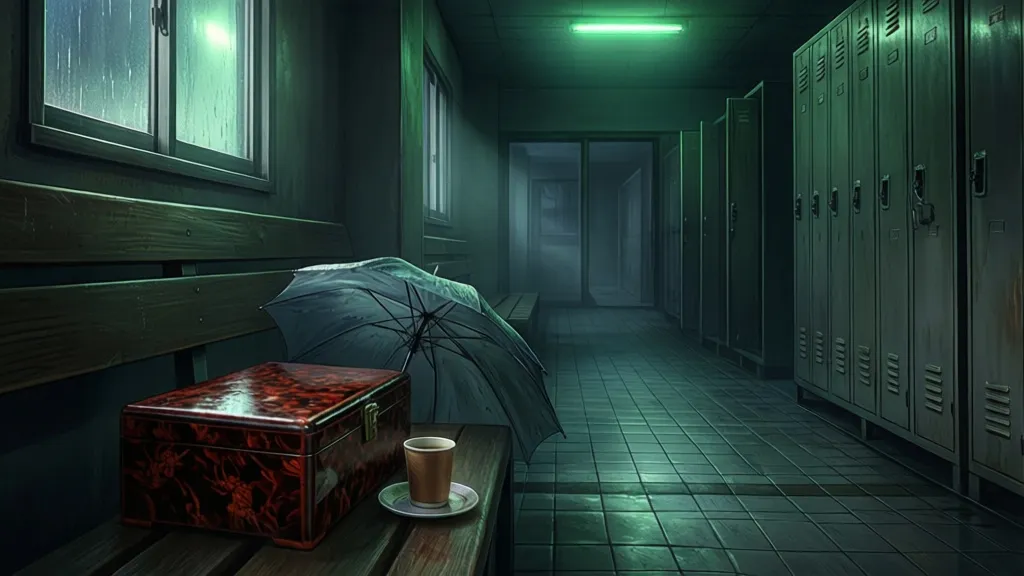
At two seventeen in the morning, Kiyomi found the lacquered box beside a damp umbrella and a paper cup of cold tea.
She had come into the staff locker room because the west corridor still smelled faintly of turpentine from the conservation lab upstairs, and because Mr. Endo, who did the first floor rounds before going home, had once left his bicycle key in locker twelve and blamed a ghost. Kiyomi did not believe in ghosts. She believed in pockets, distraction, and the way people put objects down in order not to think about what they were doing.
The umbrella stood open in the tiled drain area, black fabric dripping patiently. The tea had the skimmed, dull surface of something poured an hour earlier and then forgotten. The box sat between them as neatly as if it belonged there.
It was small enough to fit across both her palms, black lacquer with gold reeds at one corner, old but not precious-looking in the theatrical way visitors expected. The exhibition card had called it Portable Incense Box, late Edo period. The curator had told a donor, in a voice arranged for donor ears, that its monetary value was modest.
Then, seeing the donor’s disappointment, she had added that provenance mattered more than price.
Kiyomi looked at the locker room door behind her. Locked when she had opened it, locked now if she pulled it shut. She looked at the box again.
At seven-thirty, before the museum had closed, she had stood in Gallery Three while a school group passed too near the low lacquer case and their teacher said, with desperate optimism, "Hands behind your backs, everyone." The little box had been there then, under glass. Kiyomi remembered because one child had asked what incense was, and another had said, with contempt, "Old-person smell."
Since ten o’clock the building had been closed, alarmed in sections, and reduced to four people. Kiyomi on night rounds. Curator Takase in the conservation lab on the second floor, preparing condition reports for a lender. Cleaner Fujino until midnight. Security supervisor Shiraishi in the basement office, where he watched panels, signed forms, and heated things in a microwave that made all food smell faintly of sweet soy.
The key to the Gallery Three case was on the curator’s ring. There was no duplicate. Kiyomi knew this because Takase had explained it twice, once to her and once to anyone else in earshot. The lock itself was old, original to the case, and annoyingly delicate. Takase had also explained that. If one failed to turn the key back fully before withdrawing it, the bolt sometimes sat proud while the brass tongue dropped into place. The lid looked locked, and would even catch, though a practiced hand could lift it again.
Kiyomi took a breath, then another. She did not touch the box. She went to the wall phone and called the basement.
Shiraishi answered on the fifth ring. "If this is about the vending machine, hit the side lower down."
"It isn't. Please come to the locker room."
A pause. He knew her well enough to hear the shape of trouble in her voice. "Now?"
"Now. And bring the incident folder."
He arrived in four minutes carrying the folder under one arm and looking, as always after midnight, as if sleep had put in a complaint with management. He was broad, careful, and too fond of procedural dignity for a man whose tie was usually askew by ten in the morning.
He saw the umbrella first, then the cup, then the box. The complaint from sleep became a resignation from the soul.
"Please tell me that didn't come from Gallery Three," he said.
"It did."
"Did you move it?"
"No."
He looked at her as if hoping she might improve with rehearsal. She did not.
Shiraishi stepped to the threshold and did what people always did when faced with a puzzle they disliked: he checked the obvious objects with exaggerated seriousness. The room was narrow and fluorescent, a line of dented metal lockers on each side, a bench in the middle, the sink and drain area at the end. No windows. One door in, one door out, and they were the same door.
"Who uses that umbrella stand area?"
"Anyone in weather."
"Whose umbrella?"
She bent to look at the handle tag. "No tag. Cheap vinyl grip. It could belong to half the city."
He peered at the cup. The museum café had printed paper cups with blue cranes. This one came from there. Half an inch of tea. No lid.
"Cold," he said.
"Yes."
"Wonderful. We have a historical object and refreshments."
He opened the incident folder, then stopped. "No. First things first." He glanced toward the ceiling. "Takase."
The conservation lab was on the second floor beyond a coded fire door. Takase opened at Kiyomi’s knock with nitrile gloves still on and her reading glasses halfway down her nose. She was in her early forties, handsome in a severe way that suggested she had once made several people nervous without trying. Tonight her dark hair was pinned carelessly, which on her looked as deliberate as a speech.
"What is it?" she asked. "If the humidity logger has failed again, I refuse to be emotionally surprised."
Shiraishi said, "The incense box from Gallery Three is in the locker room."
The pause after that was exact and clean.
"No," Takase said.
"Yes," Kiyomi said.
Takase took off her gloves finger by finger. "Who moved it?"
"We are asking you," said Shiraishi. "You have the key."
Takase's face altered, not toward guilt but toward offence. It suited her. "The key is here." She held up the ring from a carabiner clipped to her belt. There were six keys and a little brass label stamped T. Takase. "I have not left this lab since eleven twelve except to use the washroom at one twenty-three."
"The washroom beside the staff room?"
"Yes. For less than three minutes. And before you ask, I did not carry an Edo-period object in with me."
Kiyomi, who had intended to ask, found this only mildly disappointing.
The lab was a white, ordered room with bright benches, lamps, trays of brushes and swabs, a stainless sink, and in one corner a kettle beside a stack of tea packets that nobody had arranged by flavour because Takase did not believe flavour improved tea. On the central table lay a hanging scroll under tissue and weights. Beside it sat an open notebook and a camera tripod with no camera mounted.
At the edge of the bench nearest the door hung a blue-grey scarf, carelessly looped over a stool back as if someone had taken it off and forgotten to reclaim it.
Takase saw Kiyomi looking. "Professor Segawa's," she said. "No, Harada's. He left it here last week after lecturing me about donor relations and body temperature. Segawa borrowed it tonight because the office air-conditioning has morals."
From the side office, visible through a glass partition, someone moved.
"Professor Segawa can confirm I stayed here," Takase said.
The professor emerged with the awkward dignity of a man who had forgotten his body years ago and saw no reason to resume the acquaintance now. He taught art history at the university and was presently advising on the lender's catalog essay. He had a long neck, astonishingly white hair, and a cardigan whose elbows had surrendered.
"Confirm what?" he asked.
"That Ms. Takase stayed here," said Shiraishi.
Segawa blinked. "Until one o'clock, certainly. After that I slept."
"Slept?" said Kiyomi.
He pointed, not ashamed, to a folding camp bed behind the office desk. "My last train had gone, young lady. Scholarship and transport are old enemies. I was awake again at two five, I think. Takase was here then, muttering at a hinge under magnification."
"I was not muttering," said Takase.
"No," said Segawa. "You were conducting a private trial of someone named Harada's competence."
Takase ignored him. "The key has not left my ring."
Kiyomi looked at the ring. The case key was brass, slim, and longer than the others. Nothing about it suggested mystery. Most of the time, she thought, mystery came from ordinary things refusing to stay in their places.
Shiraishi said, "We need to see the case."
Gallery Three lay in darkness except where emergency strips made the edges of plinths and walls uncertain. Shiraishi switched on only half the track lights, as if full illumination might frighten facts away. The low lacquer display case stood where it had stood all evening, reflecting pale bars of light.
Its lid was closed. Its small brass lock was engaged.
Inside, the velvet mount where the box should have rested was empty.
Takase made a small sound through her nose. Irritation, not alarm. Perhaps alarm had to queue behind irritation with her.
Shiraishi held out a hand. She hesitated just enough to be noticed, then unclipped the ring and passed it over.
He opened the case. The lid lifted with slight resistance, then too easily for the last inch. Kiyomi heard Takase inhale.
"There," Takase said sharply. "The bolt never seated. Someone turned the key back poorly and let the tongue catch. I told Harada not to handle this case in front of visitors. He always twists as if disciplining machinery."
The mount was undisturbed except for a faint rectangular absence in the dust where the box had been lifted. Kiyomi leaned closer.
At the back left corner of the velvet she saw a tiny crescent of water darkening the pile.
"There," she said.
Takase bent. "Moisture."
"From the umbrella?" said Shiraishi.
"Or from anything wet," said Takase. "Please do not become imaginative before three in the morning."
Kiyomi straightened. The exhibition room smelled of wood polish and conditioned air. Nothing in it looked disordered. The labels were aligned. The ropes had not shifted. On the nearby wall hung the other item in the case’s little thematic grouping: a framed document under UV-filter glass, brittle paper mounted over backing board, the label reading Inventory Fragment, Nakamura Household Storehouse, 1864.
Takase saw her looking. "Do not start on the document."
"Why not?"
"Because the condition report on it is what I was writing. Because it is intact. And because one absurdity in a night is enough."
Kiyomi moved closer to the frame. It looked intact. She was not an expert, but she was good at looking where people preferred not to. There was the inventory fragment, all cramped brushstrokes and brown paper fibres; the old mounting; the simple dark frame.
At the lower right edge of the paper, half hidden by glare, a thread was caught beneath the frame's inner rebate, not inside the sealed glazing but pinched where the backing board met wood. Blue-grey, very fine.
Her own jacket was black fleece. Shiraishi wore navy polyester. Takase wore a white lab coat over charcoal trousers. Segawa’s cardigan was brown.
She said nothing yet.
By two fifty, all four of them sat or stood in the staff room adjoining the lockers. Shiraishi had opened the incident folder, then a second notebook when the first page filled too quickly. Kiyomi had finally put on gloves and transferred the box to a padded tray from conservation. Takase had objected to the quality of the padding and accepted it when no better one appeared by magic.
The paper cup of tea and the umbrella remained where they had been found. It seemed best.
Rain tapped steadily at the narrow clerestory window above the sink. Somewhere deep in the building, a pipe knocked once and then, apparently satisfied with its contribution, went silent.
Shiraishi said, with the painful courtesy of a man beginning formal statements, "We will proceed in order. Ms. Takase, your movements from ten p.m."
Takase gave them with the efficiency of someone who had already judged the questions inferior. She had locked Gallery Three at nine forty-eight after the last docents cleared. She had gone to the conservation lab with the key ring, carried out checks, met Professor Segawa there at ten fifteen, worked on reports and a minor hinge issue on a travel frame, left only for the washroom at one twenty-three, returned immediately, and had remained until Kiyomi knocked.
"Why the washroom on this floor?" Kiyomi asked.
"Because the lab sink is not a washroom, and because there are standards even in decline."
"Did you bring tea?"
Takase looked at the cup. "I brought tea at eleven. I drank it in the lab. Cold tea revolts me."
Professor Segawa admitted cheerfully that he had taken a paper cup downstairs around midnight because Takase’s tea tasted, in his words, like a reprimand dissolved in water. He had used the café kettle in the staff room, then returned to the lab office, where he had fallen asleep over exhibition proofs.
"Did you leave the cup there?" asked Shiraishi.
"No. I am absent-minded, not feral."
Cleaner Fujino, called on his mobile and persuaded back from bed with grim promises about insurance, arrived at three twenty in rubber sandals and a floral raincoat. He was a thin man in his sixties who treated every institution as if it existed chiefly to scatter hairpins in impossible corners. He had cleaned the staff room at eleven forty-five, he said. No umbrella. No tea. No lacquer box. At twelve ten he had mopped the second-floor corridor. At twelve twenty he had seen Professor Segawa at the vending machine speaking to no one and bowing to it as if to a dean.
"I was trying to make it release canned coffee," Segawa said.
"It refused," Fujino said. "Correctly. Then at around one twenty-five I saw Ms. Takase go to the washroom and back. Very fast, like an arrow with opinions. At one thirty-five I left by the loading door. It was still only a mean drizzle then. At one fifty, when I reached the bus stop, the sky finally committed itself. After that it was proper rain. You can ask my knees."
Kiyomi made notes. The umbrella drew her eye as though it had manners. Cheap, black, recently used. Someone had opened it to dry, which meant either carelessness or comfort. A thief who intended to flee with a stolen object did not usually pause to arrange their umbrella.
Shiraishi said, "Kiyomi, your rounds."
She gave them. Basement and first floor from ten to eleven. Second floor at eleven ten. Gallery Three at eleven fifty: all in order. Main hall and café at twelve thirty. Loading area at one ten. Exterior perimeter at one forty-five, by which time the rain had become serious enough that the courtyard stones shone white under the lamps. Locker room at two seventeen.
"Any visitors after close?" Takase asked.
"None." Kiyomi paused. "Except the deputy director."
All three looked up.
"When?" said Shiraishi.
"At nine fifty-five. He came back for his scarf, he said. Signed in and out at reception. Left at ten oh six."
"That preening martyr," Takase said softly.
"Do not editorialise," Shiraishi said automatically, though not with conviction.
Deputy Director Harada, summoned by telephone from a respectable apartment and an undoubtedly expensive duvet, arrived at four ten in a camel overcoat and an expression of outrage that had taken some polishing. He was younger than Takase by several years, elegantly groomed, and so well tailored that his annoyance seemed part of a collection.
"A box moved," he said. "At this hour?"
"A locked case opened," said Takase. "Try to keep up."
Harada spared her the look of one professional enemy acknowledging another's existence. It was not a generous look. "I returned only for my scarf. Reception can attest to that."
"Why were you upstairs at ten o'clock?" Kiyomi asked.
He looked briefly surprised that she had spoken. Night guards were often expected to function as doors with pulse rates.
"I was not upstairs."
"Mr. Fujino did not see you?"
"Mr. Fujino sees lint and destiny. I went to my office on one, found the scarf, and left."
Takase said, "Your office is beside the registrar's corridor. Two doors from Gallery Three."
"How thrilling for architecture."
Shiraishi rubbed his forehead. "Enough. Deputy Director, did you have any reason to approach the case or the framed inventory fragment displayed with the box?"
For the first time, Harada was not immediately fluent. It lasted only a second. Kiyomi noticed seconds.
"No," he said.
Takase noticed too. Her mouth altered very slightly.
"Interesting," she said.
Kiyomi looked from one to the other. There it was: not surprise, but a piece of a conversation already in progress somewhere else.
She said, "What concerns the inventory fragment?"
Takase folded her arms. "It concerns a catalog note."
"It concerns a tendency," said Harada.
"Toward accuracy?" Takase asked.
"Toward melodrama." He turned to Shiraishi, then perhaps realised that security supervisors were poor audiences for museum politics and shifted toward Kiyomi instead, which was another error. "The document's attribution is under review. Ms. Takase believes it may prove that a storehouse inventory long cited as the Nakamura family archive was assembled later from unrelated papers. If true, one very beloved local legend becomes less tidy."
Segawa, who had so far watched this as if it were a lecture with better lighting, said mildly, "Also one donor's grandfather, who authenticated the archive in 1978, becomes less infallible. The donor in question funds half our educational programs and all of Harada's smiles."
Harada closed his eyes briefly, perhaps against murder, perhaps against tenure.
Takase said, "The inventory fragment and the incense box matter because the box's underside bears an old collection number. The same number sequence appears, partially trimmed, on the backboard behind the inventory fragment. They were likely mounted together during a later reclassification. If the box and document were paired after the date our records claim, then the sealed account of their discovery in the upstairs storehouse—"
"The sealed room," said Kiyomi.
The museum's founding story was printed in brochures and repeated with civic affection. In 1924, after an earthquake, workers had opened a long-walled storage room on the museum's top floor—formerly the private archive room of the merchant family who had owned the building. The room had been said to be untouched for sixty years. Inside, among ledgers and household effects, were found the inventory fragment and several small domestic objects including the incense box. It was modestly romantic, which was enough.
"You think the room was not untouched," Kiyomi said.
"I think," Takase said, "that someone entered it later, altered contents, and then allowed the legend to harden. The fragment may prove that. The box certainly helps. The underside label was not listed in 1924, which is suspicious. It was also not visible in the display because nobody thought to care until I did."
"And because you enjoy causing inconvenience," said Harada.
"Only where deserved."
Kiyomi looked at the box on the tray. Stolen for value? No. Stolen to suppress evidence? More likely. Moved, not removed from the building. Why? Because someone had been interrupted? Or because moving it somewhere absurd made another point?
Her tea, poured by Shiraishi fifteen minutes earlier from the staff room kettle, had gone from perilous to merely hostile. She drank it anyway.
Then she looked at the paper cup beside the umbrella and thought: someone else had done the same.
Cold tea in a museum at night belonged to patience, paperwork, waiting. Not to panic.
She stood.
"I want to see the upstairs storehouse," she said.
Harada said, too quickly, "At this hour?"
"It is already this hour," Kiyomi said.
The sealed room upstairs was no longer sealed, of course. It had become Storage Annex C after restoration works in the 1980s, though everyone still called it the sealed room because legends outlive usefulness. The old inner door remained, however: thick wood banded with iron, preserved behind a newer fire door along the top-floor corridor.
Kiyomi had been inside only once before. The room held archival cartons, rolled mats, obsolete display furniture, and the exhausted smell of paper that had lived too long among paper. Tonight, under the strip lights, its dust looked almost orderly.
Takase unlocked the modern door. Harada hovered three steps back as if disclaiming all floors in advance.
Inside, Kiyomi moved slowly. She did not know collections, but she knew rooms. The old iron-banded door stood on the far wall; its original lock had long since been fixed permanently open for safety, but the heavy bar brackets still showed where it had once been secured from outside. Against the left wall were shelves of labelled boxes. Along the right, stacked frames and folded plinth cloths.
At first she saw nothing.
Then she saw what did not match the room’s fatigue: on the floor near the old door lay a scatter of damp specks no larger than sesame seeds. Rainwater, dropped recently from fabric or hair. One speck had caught a thread. Blue-grey, very fine.
She crouched. The thread matched the one trapped under the frame rebate below.
"Who wears blue-grey?" she asked.
Nobody answered at once.
Then Fujino, from the doorway, said, "Deputy Director's scarf was blue-grey. Soft one. Like expensive dust.